

Imagine two websites that publish articles on the same topic. Both use the right keywords, both load quickly, and both have a similar number of pages. One has named authors with real credentials, clear contact details, honest reviews, and examples drawn from real work. The other has anonymous posts, stock images, and no way to tell who is behind it. Which one would you trust with your money, your health, or your business decisions?
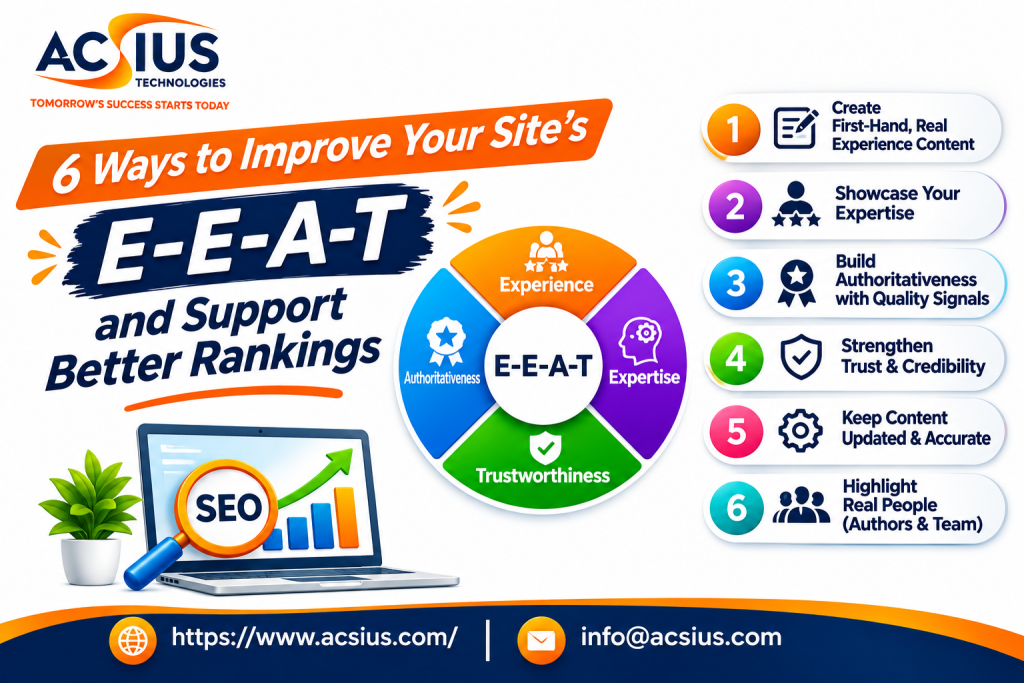
Search engines face the same question millions of times a day, and E-E-A-T is Google’s way of describing what a trustworthy source looks like. It stands for Experience, Expertise, Authoritativeness, and Trustworthiness, and it comes from the Search Quality Rater Guidelines used by human evaluators to assess search results. This guide shows six practical ways to strengthen each of those qualities on your own website, with clear actions you can start today.
First, a Reality Check on What E-E-A-T Is and Is Not
Before you start, it helps to clear up some common myths. E-E-A-T is not a single ranking factor, a number you can look up, or a plugin you can install. Google’s ranking systems use many signals, and E-E-A-T is a framework for describing the kind of quality those signals are meant to identify. Google’s guidelines describe trust as the most important element, because a page can seem expert and still be unsafe or misleading if it cannot be relied upon.
This matters because it changes how you approach improvement. You cannot trick a framework. You can only become the kind of website it describes. That means showing real people, real knowledge, and real proof, and being honest about what you do and do not know. The benefit goes beyond rankings: visitors who trust you are more likely to subscribe, buy, call, and recommend you to others.
Way 1: Audit Your Site Through a Visitor’s Eyes
The fastest way to improve trust is to find out where it is currently missing. Take ten minutes and pretend you are a first-time visitor who has never heard of your brand. Open your homepage, one blog post, and one service or product page, and ask yourself:
- Can I tell who runs this website within a few seconds?
- Is there a real person or team behind the content?
- Can I find contact details easily?
- Does the site feel safe, current, and professionally maintained?
- Do the claims on the page have evidence to support them?
- Would I feel comfortable giving this site my email address or payment details?
Write down every moment of doubt. Those moments are your improvement list. Common gaps include missing About pages, outdated copyright dates, broken links, no author names, no privacy policy, vague claims like “best in the industry” with no proof, and pages that have not been updated in years.
For larger websites, a structured review often reveals problems that are hard to see from the front end, such as thin pages, duplicate content, indexing issues, or weak internal links. Working with professional SEO Services India can help you combine content, technical, and trust checks into one prioritized plan, so you fix the issues that matter most first rather than guessing.
Way 2: Give Your Content Real Authors and Visible Credentials
Anonymous content is difficult to trust. If your articles are published under “Admin,” “Team,” or no name at all, search engines and readers have no way to judge who is speaking and whether that person knows the subject.
What to do:
- Add a named author to every article. Use a real person’s name and photo.
- Write a short, honest bio. Mention role, years of experience, relevant training or certifications, and what the person has actually done. Avoid exaggerated titles.
- Create an author page. List the author’s articles, background, and links to professional profiles such as LinkedIn.
- Add an editor or reviewer where it matters. For health, legal, financial, or safety-related content, have a qualified professional review the page and mention it clearly.
- Use consistent identity. Keep the same name, photo, and profile links across your site and other platforms.
- Mark up authorship where possible. Structured data for articles and people can help search engines understand who wrote what.
A word on credentials: formal qualifications are important for some topics, but not all expertise is academic. A mechanic with twenty years of experience can write expertly about car repair, and a baker can explain bread better than most food scientists. What matters is that the expertise fits the topic and that you present it truthfully.
Way 3: Create Content That Shows First-Hand Experience
Experience is the newest letter in the framework, and it is also one of the hardest for copycat sites and mass-produced text to fake. It answers a simple question: has this person actually done what they are writing about?
Ways to show it:
- Original photos and videos. Show the product in use, the project in progress, or the place you visited, rather than only stock images.
- Real examples and case studies. Describe the situation, what you did, and what happened, with permission from clients.
- Test results and data. Share measurements, comparisons, and outcomes you collected yourself.
- Honest details. Mention what went wrong, what surprised you, and what you would do differently.
- Personal commentary. Add practical tips that only someone with hands-on involvement would know.
As an example, compare two articles about a project management tool. One lists features from the vendor’s website. The other explains how a team used it for three months, where it saved time, where it frustrated them, and which plan was worth paying for. The second article gives a reader something that cannot be found elsewhere, and that uniqueness is exactly what makes content worth citing.
Also go beyond the basics. Answer the follow-up questions that readers will naturally have, cite credible sources, and keep facts accurate. Depth and honesty are the hallmarks of expertise.
Way 4: Earn Authority Beyond Your Own Website
You can say you are an expert on your own pages, but authority grows when others say it about you. This includes links from respected websites, mentions in the press, citations in other people’s articles, speaking invitations, and recommendations from real customers and peers.
Practical ways to build it:
- Publish original research. Surveys, data analysis, benchmarks, and industry reports give other sites a reason to reference you.
- Contribute expert commentary. Respond to journalist requests, join podcasts, and share insights with trade publications.
- Write genuinely useful guest content. Choose relevant, reputable sites and offer value, not thinly disguised promotion.
- Create resources people want to cite. Calculators, checklists, templates, glossaries, and visual guides naturally attract links.
- Build partnerships. Co-host webinars, co-author studies, or collaborate with complementary businesses.
- Strengthen your brand. When people search for your name directly, it shows recognition that no tactic can fake.
- Track unlinked mentions. If a website mentions your brand without a link, a polite request may turn it into one.
Be careful about shortcuts. Buying bulk links, joining link exchange schemes, or publishing mass guest posts on low-quality sites can damage your reputation and violate search guidelines. Authority earned slowly and honestly lasts longer.
If you do not have the time or experience to run outreach, hiring a respected SEO Agency India can help you plan content that earns attention, identify relevant publications, and avoid risky tactics. Look for an agency that explains its methods clearly, shares realistic expectations, and focuses on relevance and quality rather than volume.
Way 5: Make Trust Visible Through Transparency, Reviews, and Local Proof
Trust is built from many small details, and most of them are simple to fix. A trustworthy site makes it easy to see who you are, how to reach you, what you promise, and what other people think of you.
Essential trust elements:
- A detailed About page with your story, team, mission, and company details.
- Clear contact information, including email, phone number, and a physical address where relevant.
- Privacy policy, terms, and refund or shipping policies written in plain language.
- HTTPS security across the whole site, especially on forms and checkout pages.
- Real reviews and testimonials with names, photos, or links where customers agree to share them. Never invent or buy reviews.
- Case studies and results that show what you actually delivered.
- Disclosures for sponsored content, affiliate links, and partnerships.
- Visible corrections when you update a page to fix a mistake.
If your business serves a particular city or region, local trust signals matter even more. Keep your business name, address, and phone number consistent across your website, Google Business Profile, and directories. Encourage satisfied customers to leave honest reviews and respond to every review politely. Add photos of your actual office, team, and projects. For companies in the capital region, partnering with a specialist offering the Best SEO Services Delhi can help you manage local listings, reviews, and location-based content so your business appears reliable and consistent to both local customers and search engines.
Remember that reputation is also shaped off your site. Search for your brand name and see what appears: reviews, news, forum threads, and social profiles. If something inaccurate or outdated shows up, work to correct it or publish better information.
Way 6: Keep Content Accurate, Fresh, and Technically Sound
A website that was trustworthy two years ago can lose credibility if its information goes stale. Accuracy and maintenance are quiet but powerful trust signals, and they protect all the work you have done in the other five areas.
Content upkeep:
- Review key pages every three to six months. Check statistics, prices, laws, screenshots, links, and tool names.
- Add visible update dates when you have truly revised a page, not as a cosmetic trick.
- Fact-check before publishing. Verify claims with primary sources and link to them.
- Merge or remove thin and duplicate pages. Fewer, stronger pages are better than many weak ones.
- Match search intent. Make sure your page gives the type of answer people expect, whether a guide, a comparison, or a product page.
- Use AI tools carefully. They can help with outlines and editing, but every published page needs human review, original insight, and fact-checking.
Technical foundations:
- Speed and Core Web Vitals. Compress images, use caching, and reduce heavy scripts.
- Mobile usability. Test your pages on real phones.
- Clean navigation and internal links. Help visitors and crawlers find related content.
- No broken links or error pages. Fix 404s that affect valuable pages.
- Limited intrusive ads and popups. Content should be easy to read.
- Accessibility. Use readable fonts, strong contrast, descriptive headings, and alt text.
- Structured data. Add schema where it helps explain your articles, products, reviews, and organization.
A fast, clear, well-kept website does not just support rankings. It tells visitors that someone is paying attention, which is a basic form of respect.
A Simple 60-Day E-E-A-T Plan
If you are unsure where to start, follow this schedule:
| Period | Focus | Actions |
| Days 1 to 10 | Audit | Review top pages as a first-time visitor and list trust gaps. |
| Days 11 to 20 | Identity | Add authors, bios, About page improvements, contact details, and policies. |
| Days 21 to 35 | Content | Upgrade priority pages with first-hand examples, original visuals, and updated facts. |
| Days 36 to 50 | Proof | Collect reviews and case studies, add them to key pages, and tidy local listings. |
| Days 51 to 60 | Authority and measurement | Start outreach, plan a research piece, and set up tracking for progress. |
After 60 days, keep improving one page group at a time. Small, steady improvements usually beat sudden overhauls.
How to Measure Progress
Because E-E-A-T is not a score, you track it through outcomes and signals:
- Rankings and impressions for priority keywords, using Google Search Console.
- Organic traffic and engagement such as time on page and return visits.
- Branded search volume, which shows growing recognition.
- Backlinks and mentions from relevant, trusted websites.
- Review quantity and rating, especially for local businesses.
- Conversions, including leads, sign-ups, and sales.
Look at trends over months, not days. Trust builds gradually, and so do the results.
Common Mistakes to Avoid
- Publishing without authors. Hidden writers reduce credibility.
- Exaggerating credentials. Claims you cannot support harm trust.
- Buying reviews or links. These shortcuts can backfire.
- Copying competitors. Rewording the same information adds no value.
- Ignoring outdated pages. Old content can lower confidence in the whole site.
- Writing about everything. Focus on topics where you have real knowledge.
- Neglecting basic trust pages. Missing contact details and policies make a business seem unreliable.
Final Thoughts: Build the Site You Would Trust
Improving E-E-A-T comes down to one idea: build the kind of website you would trust yourself. Audit your site honestly, put real authors and credentials in view, show first-hand experience, earn recognition beyond your own pages, make trust visible with transparency and reviews, and keep everything accurate and well maintained. These steps help search engines understand your value, and they help people feel confident choosing you.
If you would like expert support strengthening your website’s credibility and search visibility, ACSIUS can help with audits, content strategy, authority building, and technical improvements focused on E-E-A-T principles. Get in touch with ACSIUS today to build a website that earns trust, supports better rankings, and keeps growing with your business.
FAQs
Which part of E-E-A-T matters most?
Trust. Google's guidelines describe it as the most important element, because the others only matter when information can be relied on.
Do small or new websites need E-E-A-T?
Yes, and they can compete by showing real experience, focused expertise, and transparent business details that large generic sites often lack.
How long does it take to see results?
Technical and content improvements may show effects within weeks, while reputation and authority usually take several months or longer.
Can AI-written content satisfy E-E-A-T?
It can if people add real experience, verify facts, and provide original value. Unreviewed generic text rarely meets these standards.
