
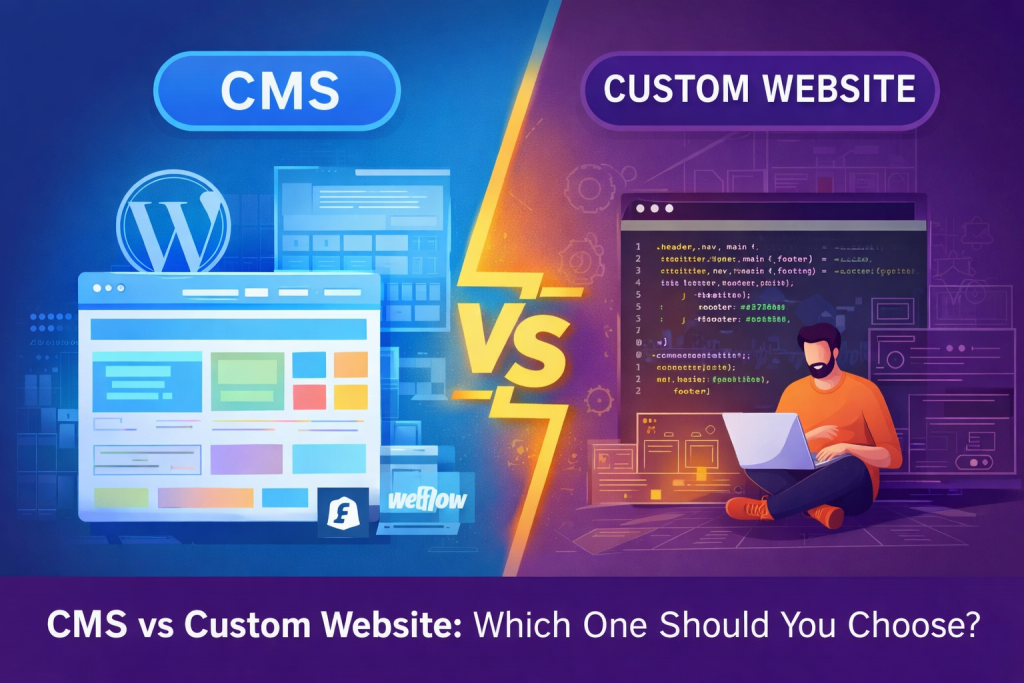
In the modern digital landscape, your website is no longer just a static online presence. It is your brand’s authority signal, your sales engine, your lead generation platform, and often your most important marketing asset.
Yet when businesses begin planning their website, they frequently underestimate one critical decision: choosing between a CMS-based website and a fully custom-built solution.
At first glance, this may seem like a purely technical discussion. In reality, it is a strategic business decision. The structure you choose will affect performance, scalability, marketing flexibility, operational control, long-term costs, and even your competitive positioning.
This guide explores the CMS vs custom website debate in complete detail — not just from a development perspective, but from a business growth standpoint.
Understanding the Foundation: What Is a CMS?
A Content Management System (CMS) is a software framework that enables users to create, manage, and modify website content without building everything from scratch.
Instead of writing every line of code manually, developers use a pre-built core system and customize it through themes, plugins, and configuration settings.
Common CMS platforms include WordPress, Shopify, Webflow, Magento, and others.
A typical CMS includes:
- A structured backend dashboard
- Theme-based front-end design
- Plugin or extension ecosystem
- User role management
- Content editing tools
- SEO configuration options
- Hosting compatibility
The purpose of a CMS is efficiency. It removes the need to reinvent fundamental website components.
Why CMS Platforms Dominate the Market
CMS systems power a significant percentage of websites globally. This dominance is not accidental.
1. Speed of Deployment
One of the strongest advantages of CMS platforms is reduced time-to-market. Businesses can launch functional websites quickly because core infrastructure already exists.
For startups and small businesses, speed often matters more than architectural perfection.
2. Lower Upfront Cost
Since the base system is pre-built, development costs are typically lower. You are paying for customization rather than full architectural development.
This makes CMS solutions accessible to growing businesses with limited initial budgets.
3. Ease of Content Management
Marketing agility is a major advantage. Internal teams can:
- Publish blog content
- Update landing pages
- Manage product listings
- Optimize on-page SEO
- Adjust images and copy
Without relying heavily on developers.
4. Plugin Ecosystem
Need advanced SEO tools? E-commerce functionality? CRM integration? Analytics? Payment gateways?
CMS platforms offer plugin ecosystems that allow rapid feature expansion.
This flexibility is extremely valuable for marketing-driven websites.
The Hidden Limitations of CMS Systems
While CMS platforms are powerful, they are built for broad compatibility — not extreme customization.
Structural Constraints
Themes and plugins operate within a shared framework. Deep architectural changes may require complex modifications.
Performance Trade-Offs
Over time, plugin accumulation can create:
- Code bloat
- Slower page load times
- Compatibility conflicts
Performance optimization requires active management.
Security Exposure
Popular CMS platforms are common targets for cyber threats. Proper updates and maintenance are essential to avoid vulnerabilities.
Scalability Ceiling
As traffic increases or technical requirements become more advanced, CMS systems may require heavy restructuring.
What Is a Custom Website?
A custom website is built entirely from scratch using programming languages and frameworks specifically chosen for your business needs.
Instead of adapting a shared system, developers architect a platform tailored precisely to:
- Business workflows
- User experience design
- Data management requirements
- Integration complexity
- Future growth plans
Every element is intentionally designed.
The Core Advantages of Custom Development
1. Complete Architectural Freedom
Custom websites allow businesses to implement complex workflows without structural limitations.
This is especially valuable for:
- SaaS platforms
- Online marketplaces
- Membership systems
- High-interaction dashboards
- Enterprise-level solutions
2. Superior Performance Optimization
Since only required code is written, custom websites often achieve:
- Faster load speeds
- Cleaner backend structure
- Optimized database queries
- Improved Core Web Vitals
Performance directly impacts user experience and SEO.
3. Enhanced Security Control
Without heavy reliance on third-party plugins, custom systems can reduce exposure to common vulnerabilities.
Security protocols are tailored rather than generalized.
4. Long-Term Scalability
Custom platforms are designed with growth in mind. Infrastructure can be planned to handle:
- High traffic volumes
- Data-heavy operations
- Advanced automation
- Complex integrations
Cost Analysis: Short-Term vs Long-Term
One of the biggest misconceptions in the CMS vs custom debate revolves around cost.
Short-Term Cost
CMS is typically cheaper upfront. Custom development requires greater initial investment.
Long-Term Cost
However, businesses should consider:
- Migration expenses
- Redesign costs
- Performance restructuring
- Plugin dependency risks
- Technical debt accumulation
Sometimes, starting cheap leads to higher restructuring costs later.
SEO Perspective: Does Platform Choice Matter?
Both CMS and custom websites can rank highly in search engines.
However, execution matters more than platform.
CMS advantages:
- Easy metadata management
- SEO plugins
- Structured URL settings
Custom advantages:
- Precise technical SEO optimization
- Advanced schema implementation
- Server-level performance control
In competitive industries, technical precision may provide a marginal advantage.
Decision Framework: How to Choose Strategically
Instead of asking, “Which is better?” ask:
- Is your website primarily marketing-focused or product-driven?
- How complex are your required features?
- What is your 3-year growth projection?
- How important is internal content control?
- What is your budget flexibility?
- Will traffic scale aggressively?
Answering these questions provides clarity.
Real Business Scenarios
Scenario 1: Local Service Business
Goal: Lead generation
Best Fit: CMS
Scenario 2: Growing E-commerce Brand
Goal: Scalable product management
Best Fit: CMS initially, custom if complexity increases
Scenario 3: SaaS Startup
Goal: Subscription-based user dashboards
Best Fit: Custom development
Scenario 4: Enterprise Platform
Goal: Integration-heavy infrastructure
Best Fit: Custom architecture
Hybrid Approach: The Strategic Middle Ground
Many businesses combine CMS foundations with custom modules.
This allows:
- Controlled investment
- Gradual scaling
- Flexibility for expansion
Hybrid models often provide balance between speed and scalability.
The Migration Question
Businesses often ask: “Can we start with CMS and move to custom later?”
Yes — but migration involves:
- Data transfer complexity
- URL restructuring risks
- SEO impact
- Development downtime
Planning ahead reduces disruption.
The Bigger Picture: Technology Should Support Strategy
Your website technology should align with:
- Revenue goals
- Marketing plans
- Operational complexity
- Customer experience expectations
Choosing based solely on immediate savings may create long-term limitations.
FAQs
Final Verdict: Align with Growth Vision
CMS solutions are efficient, cost-effective, and powerful for many businesses.
Custom development offers architectural precision, scalability, and advanced flexibility for complex digital systems.
The correct choice depends on your business model and long-term objectives — not trends or assumptions.
A website should not restrict your expansion. It should enable it.
When selected strategically, both CMS and custom websites can serve as strong digital foundations.
The key is alignment.
