

Google continues to make changes to the systems that determine which websites appear in search results. For website owners and SEO professionals, these updates are important because even small changes in Google’s search systems can sometimes lead to noticeable changes in rankings and organic traffic.
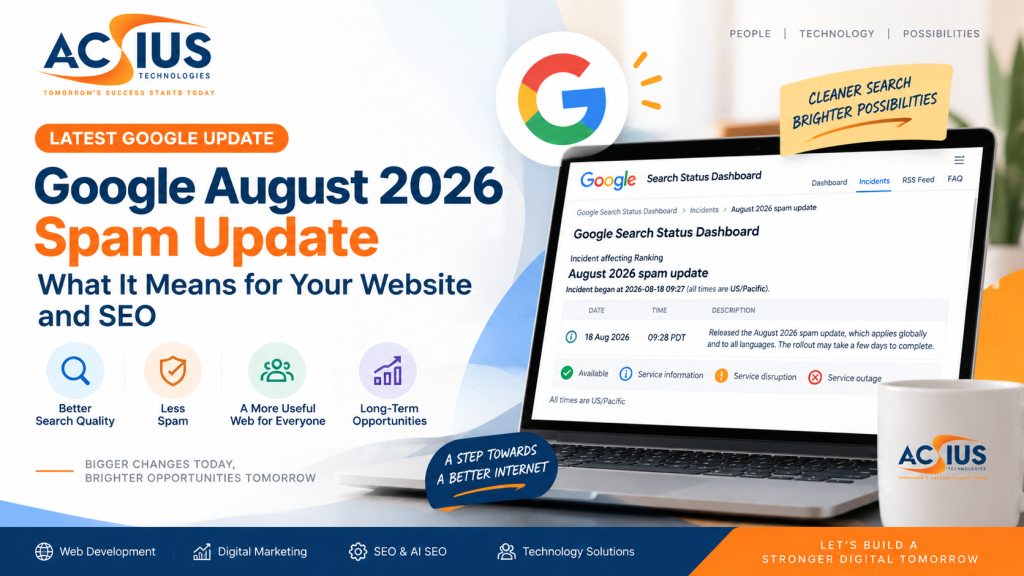
On 18 August 2026, Google released its August 2026 Spam Update, a global update that applies to all languages. According to Google’s Search Status Dashboard, the rollout may take a few days to complete.
This is not a reason for every website owner to panic. A ranking movement during an update does not automatically mean that a website has been penalised. Instead, it is a good opportunity to review the quality of your website, content, technical SEO and overall search strategy.
In this article, we look at what is currently known about the August 2026 Spam Update and what businesses should consider while the rollout continues.

What Is the Google August 2026 Spam Update?
Google regularly improves the systems it uses to identify spam and low-quality practices in Search. Spam updates are focused on improving those systems so that search results are less affected by practices designed to manipulate rankings.
Google confirmed that the August 2026 Spam Update was released on 18 August 2026 and that it applies globally and across all languages. Google also stated that the rollout may take several days to complete.
It is important to distinguish a spam update from a core update. Google describes core updates as broad changes to its ranking systems, while spam updates are associated with improvements to its spam-detection systems.
For this reason, website owners should avoid assuming that every ranking change during this period is the result of a penalty.
Why Does This Update Matter?
Search has become increasingly competitive. Businesses are publishing more content, creating more landing pages and using more automation than ever before.
At the same time, Google is becoming better at identifying content and practices that do not provide genuine value to users.
Google’s current Search Essentials explain that websites should focus on helpful, reliable, people-first content and avoid practices that attempt to manipulate search rankings. Websites that violate Google’s spam policies may rank lower or may not appear in Search at all.
For businesses, this means SEO should not simply be about producing more pages or adding more keywords. The focus needs to be on building a website that is genuinely useful to the people searching for its products or services.
Should You Be Worried About a Ranking Drop?
Not necessarily.
Search rankings naturally move over time, and a confirmed Google update can create additional fluctuations while its systems are being updated.
If you notice a decline in rankings or organic traffic after 18 August, the first step should be to collect the data rather than immediately changing large sections of the website.
Look at:
- Google Search Console performance
- Organic clicks and impressions
- Average search position
- Important keyword rankings
- Pages that have gained or lost visibility
- Organic traffic in Google Analytics
- Indexing and crawling issues
- Manual actions or security issues, if any
It is also useful to compare the performance of individual pages rather than looking only at the overall website.
A website might show a small overall traffic decline while some important pages remain stable. Equally, a website could maintain traffic while several commercially important keywords experience ranking changes.
Quality Matters More Than Content Volume
One of the biggest mistakes businesses can make is responding to a search update by publishing large quantities of new content without considering whether that content actually helps users.
Google’s spam policies specifically discuss scaled content abuse. The policy focuses on creating many pages primarily to manipulate search rankings rather than helping users. Google states that this can apply regardless of whether the content is produced manually, through automation or with generative AI.
This is an important distinction.
The problem is not simply the number of pages on a website. The question is whether those pages provide meaningful value.
For example, creating ten genuinely useful service pages covering different customer needs can be very different from creating hundreds of almost identical pages simply to target slightly different keyword variations.
A sustainable SEO strategy should therefore prioritise quality, relevance, usefulness and originality.
What About AI-Generated Content?
AI has become a major part of the content and marketing industry, but businesses should be careful about how they use it.
Google’s guidance does not say that using AI automatically makes content unacceptable. Instead, Google’s concern is with using automation or AI to generate large amounts of content without adding value, particularly when the purpose is to manipulate Search rankings.
That means businesses should not approach content creation with the mindset of:
“How many articles can we publish?”
A better question is:
“What useful information can we provide that our customers actually need?”
AI tools can potentially assist with research, organisation and initial ideas, but published content should still be reviewed carefully for accuracy, originality, relevance and real-world usefulness.
For businesses operating in competitive industries, first-hand knowledge and genuine expertise can make a significant difference.
Common SEO Practices Worth Reviewing
The August 2026 Spam Update does not mean that Google has publicly announced that every item below is specifically being targeted by this update. However, Google’s existing spam policies make it clear that certain practices can create problems in Search.
Keyword Stuffing
Keywords are still an important part of SEO because they help search engines understand the topic of a page.
However, repeating the same keyword unnaturally throughout a page does not create a better experience.
Content should be written for people first, with keywords included naturally where they genuinely make sense.
Low-Value or Thin Content
Pages that contain very little useful information may struggle to provide a strong reason for users to visit them.
This can be particularly problematic when a website has many pages covering almost the same topic with only minor wording changes.
Instead of creating multiple weak pages, businesses should consider whether a smaller number of comprehensive resources would better serve their audience.
Manipulative Link Practices
Backlinks remain part of the wider SEO ecosystem, but not every link-building method is safe.
Google’s spam policies include practices such as buying or selling links for ranking purposes, excessive link exchanges and automated link-building schemes.
A strong SEO strategy should focus on earning relevant and trustworthy mentions rather than simply trying to increase the number of links pointing to a website.
Doorway Pages
Creating multiple pages that target very similar searches and ultimately funnel users toward the same destination can create a poor search experience.
Google identifies this type of practice as doorway abuse within its spam policies.
Location-based SEO is a good example where businesses need to be careful. If a company creates dozens of location pages, each page should have a genuine purpose and useful information for people in that location rather than simply changing the city name.
Automatically Generated Pages Without Added Value
Automation can make it easier to produce content at scale, but scale alone does not equal quality.
Google specifically identifies generating many pages with little or no added value as an example of scaled content abuse.
Businesses should therefore review large collections of automatically generated pages and ask whether each page deserves to exist independently.
What Should You Do If Your Rankings Have Dropped?
If your website has experienced a noticeable decline, avoid making multiple major changes at the same time.
Start with an audit.
1. Check Google Search Console
Review the Performance report and compare recent data with the previous period.
Look for:
- Pages losing clicks
- Queries losing impressions
- Keywords with significant position changes
- Changes in click-through rate
- Changes in indexed pages
Search Console can help identify whether the change is site-wide or limited to particular sections.
2. Check Your Important Landing Pages
Review your main service, product and commercial pages.
Ask:
- Does the page clearly answer the searcher’s question?
- Is the content genuinely useful?
- Is the information current?
- Does the page provide something different from competing pages?
- Is the page easy to navigate?
- Are important internal links present?
- Are there unnecessary sections or repetitive content?
3. Review Your Content Strategy
If your website has a large number of blog posts or landing pages, look for pages that are:
- Very similar to each other
- Extremely thin
- Outdated
- Written primarily around keywords
- Providing little information beyond what is already available elsewhere
These pages may need improvement, consolidation or, where appropriate, removal.
4. Review Your Backlink Profile
A backlink audit can help identify potentially problematic patterns.
Look at the quality and relevance of links rather than focusing only on the total number of backlinks.
A smaller number of relevant, legitimate links can be more valuable than a large collection of low-quality links.
5. Check for Technical Problems
Not every ranking decline is caused by a Google update.
Technical issues can also affect organic visibility.
Check:
- Indexing status
- Robots.txt
- XML sitemap
- Canonical tags
- Redirects
- Broken pages
- Server errors
- Mobile usability
- Page speed
- Security issues
A website migration, accidental noindex tag or server problem can sometimes have a much bigger impact than an algorithm update.
Don’t Make Panic Changes During the Rollout
Google has confirmed that the August 2026 Spam Update may take a few days to complete.
That means ranking fluctuations during the rollout should be interpreted carefully.
If a keyword moves from position 5 to position 9 for a short period, there may be no need to rewrite the entire page immediately.
Instead, monitor the trend.
If a significant decline continues after the update has settled, then a deeper analysis can provide a more reliable basis for action.
SEO works best when decisions are based on data rather than short-term reactions.
Build an SEO Strategy That Can Handle Algorithm Changes
Google will continue to update Search. There will always be new ranking changes, spam updates, core updates and changes to the way search results are presented.
Businesses cannot realistically build a strategy around trying to predict every update.
A better approach is to build a website around fundamentals that remain useful regardless of individual algorithm changes.
That means:
- Creating genuinely useful content
- Demonstrating real expertise
- Maintaining a technically healthy website
- Building relevant authority
- Improving the user experience
- Keeping important information up to date
- Avoiding manipulative SEO practices
- Monitoring Search Console and analytics regularly
Google’s Search Essentials continue to emphasise helpful, reliable, people-first content as one of the key foundations of search visibility.
How ACSIUS Approaches SEO in a Changing Search Landscape
At ACSIUS, we believe SEO should be treated as an ongoing process rather than a one-time optimisation exercise.
Search behaviour continues to change, and businesses need strategies that combine technical SEO, content optimisation, user experience, authority building and performance monitoring.
Our approach focuses on understanding how a website is currently performing, identifying areas that need improvement and developing a strategy around the business’s actual goals.
Rather than creating content simply to increase the number of pages on a website, the focus should be on creating useful resources that support customers throughout their search journey.
This becomes even more important as search continues to evolve and AI-powered search experiences become part of the wider search ecosystem.
Final Thoughts
The Google August 2026 Spam Update is another reminder that sustainable SEO is not about finding shortcuts.
Google has confirmed that the update began on 18 August 2026 and applies globally across all languages, with the rollout expected to take a few days.
If your website has experienced changes in rankings, don’t immediately assume that your website has been penalised. Start by analysing the data, identifying which pages and queries have changed and checking whether there are any technical or content-related issues.
Most importantly, continue to focus on providing genuine value to your audience.
The websites that invest in useful content, strong technical foundations, trustworthy information and a good user experience are better positioned to adapt as Google Search continues to evolve.
Frequently Asked Questions
When did the August 2026 Spam Update start?
Google released the update on 18 August 2026 at 09:28 PDT. Google stated that the rollout may take a few days to complete.
Does the update affect websites worldwide?
Yes. Google stated that the August 2026 Spam Update applies globally and to all languages.
Will every website experience a ranking change?
No. An algorithm update does not mean that every website will experience a noticeable increase or decrease in rankings.
What should I do if my website loses rankings?
Start by checking Google Search Console, organic traffic, important landing pages, indexing and technical SEO. Avoid making large changes until you understand what has actually changed.
Does Google penalise all AI-generated content?
Google's guidance does not say that AI use by itself makes content spam. The concern is using automation or AI to produce large amounts of content without adding value, particularly when it is created primarily to manipulate Search rankings.
How long should I wait before making SEO changes?
Because Google has stated that the August 2026 Spam Update may take a few days to roll out, it is sensible to monitor performance during the rollout and then investigate persistent changes more carefully once the update has settled.
What is the most important SEO lesson from this update?
Focus on creating a website that is useful to people rather than one designed primarily to manipulate search rankings. Strong content, technical quality, relevant authority and a good user experience remain important foundations for long-term SEO.
About ACSIUS
ACSIUS helps businesses improve their digital presence through web development, SEO, digital marketing and technology solutions. Our approach combines technical expertise with practical strategies designed around long-term business growth.
