

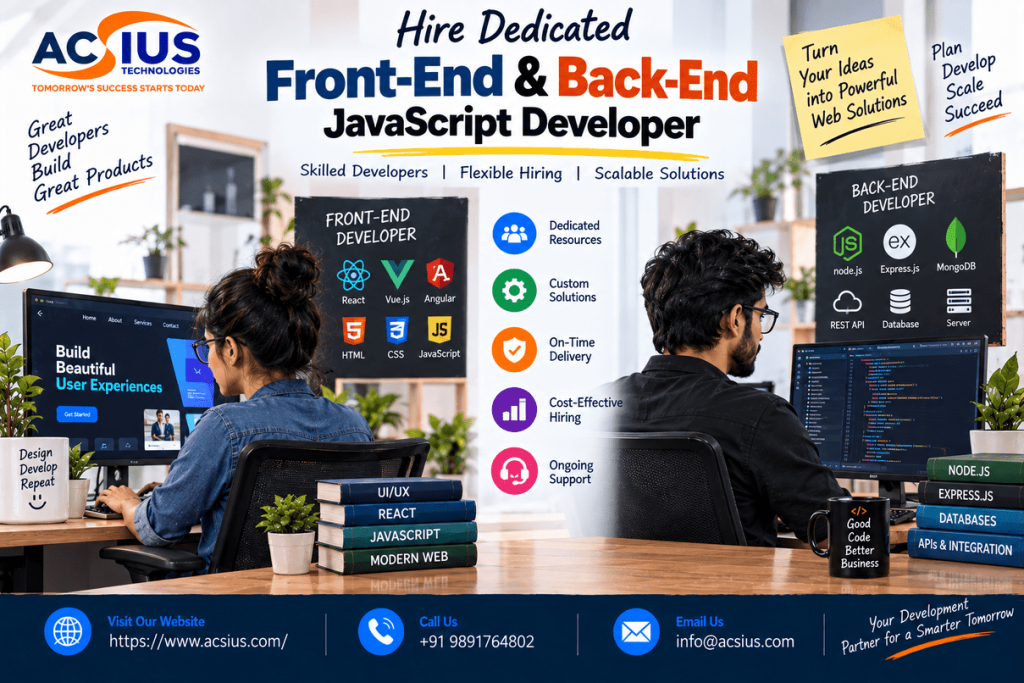
JavaScript has quietly become the one language almost every modern web project touches in some way. It powers the interactive front end users click through, and thanks to Node.js, it now runs entire back-end systems too — meaning a single language can, in theory, span your whole application stack. That versatility is exactly why “hire a JavaScript developer” has become one of the most searched phrases among businesses building or scaling a web product, and also one of the most misunderstood, because JavaScript development today covers an enormous range of specializations that don’t always overlap.
If you’re planning to hire dedicated JavaScript talent, the first thing worth understanding is that “JavaScript developer” isn’t really one job description — it’s a category that spans front-end specialists building interactive user interfaces, back-end engineers building APIs and server logic, and full-stack developers who move fluidly between both. Knowing which of these you actually need, and how to evaluate candidates or agencies against that need, makes the difference between a hire that accelerates your roadmap and one that quietly stalls it. Let’s break down exactly what to look for.
Understanding the Front-End Side of JavaScript Development
Front-end JavaScript development is what most people picture when they think of building a website or web app — the buttons, forms, animations, and interactive elements a user actually sees and clicks on. Modern front-end work almost always involves a framework like React, Vue, or Angular, each with its own ecosystem, conventions, and performance characteristics. A skilled front-end JavaScript developer needs to understand not just how to make an interface look good, but how to make it fast, accessible, responsive across devices, and maintainable as your product grows in complexity.
When you’re looking to hire dedicated front-end talent, it’s worth asking specifically about their experience with the framework your project already uses or plans to use, since expertise doesn’t always transfer cleanly between them. Ask to see live examples of interactive features they’ve built — not just static screenshots — and pay attention to how smoothly those interfaces perform under real interaction. A team that lets you hire dedicated javascript developer talent should be able to walk you through their approach to component architecture, state management, and performance optimization, since these are the areas where front-end quality really shows up over time, especially as an application scales beyond its initial version.
Understanding the Back-End Side of JavaScript Development
On the back-end side, JavaScript — primarily through Node.js — has become a serious contender alongside more traditional server-side languages, particularly for applications that need to handle real-time data, high concurrency, or a unified codebase across the entire stack. Back-end JavaScript developers build the APIs, database logic, authentication systems, and server infrastructure that power everything happening behind the scenes of your application.
The advantage of using JavaScript on both ends of your stack is real: your team can share code, logic, and even entire libraries between front end and back end, reducing duplication and making it easier for developers to move between different parts of the codebase without a steep learning curve. But back-end JavaScript work also has its own specialized concerns — database design, API architecture, security, and scalability — that require genuinely different expertise than front-end interface work, even though both use the same underlying language. When evaluating a back-end JavaScript hire, ask about their experience with database technologies, API design patterns, and how they’ve handled scaling challenges in past projects, since these are the areas where inexperienced developers most often run into trouble as an application grows.
Why Full-Stack Doesn’t Always Mean What You Think
“Full-stack JavaScript developer” has become such a common phrase in job postings and freelancer profiles that it’s worth pausing on what it actually means — and what it doesn’t. A genuine full-stack developer should be comfortable working across both front-end and back-end code, understanding how data flows from a database, through an API, into a user interface, and back again. But depth varies enormously. Some “full-stack” developers are strong on one side and merely functional on the other, which can be perfectly fine for smaller projects but risky for anything requiring genuine expertise on both ends simultaneously.
Before hiring, it’s worth asking directly about a candidate’s or agencies relative strengths, rather than assuming “full-stack” means equally expert in everything. For projects with significant complexity on both sides — a data-heavy backend paired with a highly interactive front end, for example — it’s often smarter to work with a team that has dedicated specialists for each layer, coordinated together, rather than relying on generalists stretched thin across the entire stack.
Considering Python Alongside JavaScript for Backend-Heavy Projects
While Node.js has made JavaScript a legitimate backend choice, it’s not always the right fit for every project. Applications with heavy data processing needs, machine learning components, or complex scientific computing often benefit from Python’s mature ecosystem of specialized libraries, which can outperform JavaScript for these specific use cases. If your project involves this kind of backend complexity alongside a JavaScript front end, it’s worth considering a hybrid approach, working with a team that can also provide a skilled python programmer for hire to handle the specialized backend logic while your JavaScript developers focus on building a fast, interactive user interface. This kind of polyglot approach isn’t unusual in modern development — plenty of successful applications combine a JavaScript front end with a Python-powered backend for data-intensive features, and having both capabilities available under one roof simplifies coordination considerably compared to managing separate vendors for each language.
When Your Project Includes E-Commerce Requirements
Many businesses hiring JavaScript developers are building or expanding an online store, and this introduces another layer of specialization worth considering. While a custom JavaScript front end can absolutely be built for an e-commerce experience, plenty of businesses find more value in a mature, feature-rich platform purpose-built for online retail rather than building every commerce feature from scratch. If your project has e-commerce components — product catalogs, checkout flows, inventory management, payment processing — it’s worth asking whether your development partner can also hire dedicated magento developer talent to handle that side of the build, integrating custom JavaScript functionality on top of a proven commerce foundation rather than reinventing complex retail logic that’s already been solved and battle-tested at scale. This combined approach often gets you to market faster and with fewer bugs than building an entire custom commerce system purely in JavaScript from the ground up.
Evaluating Technical Depth Beyond the Resume
A resume or portfolio only tells you so much about a developer’s actual capability. Strong evaluation goes deeper: ask candidates or agencies to walk you through a technically challenging problem they solved on a past project, and pay attention to how clearly they explain their reasoning. Genuine expertise usually comes with the ability to explain trade-offs — why they chose one approach over another, what alternatives they considered, and what they’d do differently next time. Vague or overly simplistic answers to technical questions often indicate surface-level familiarity rather than deep, hands-on expertise.
For agencies specifically, ask about their code review practices, testing standards, and documentation habits. These aren’t glamorous topics, but they directly affect how maintainable your codebase will be over time, especially if you plan to scale your team or bring development in-house eventually. A team that treats these practices as core to their process, rather than optional extras, tends to produce more reliable, longer-lasting code.
Understanding Different Engagement Models
When hiring dedicated JavaScript developers, you’ll typically encounter a few different engagement structures: dedicated hourly resources, fixed-price project contracts, or staff augmentation models where developers effectively join your existing team on a long-term basis. Each has trade-offs. Fixed-price contracts work well for clearly scoped, well-defined projects but can create friction if requirements shift midway through. Dedicated hourly or staff augmentation models offer more flexibility for evolving projects or ongoing development needs, but require more active management on your end to keep the engagement productive and focused.
Think honestly about your project’s certainty level before choosing a model. If you have a clear, well-documented specification and a fixed deadline, a fixed-price contract might minimize your risk. If you’re building something more exploratory, iterating based on user feedback, or planning ongoing feature development well beyond an initial launch, a dedicated resource model that lets you scale the team up or down as needed is often the smarter long-term choice.
The Importance of Communication and Collaboration Style
Especially when working with a development partner across time zones, communication quality often matters just as much as raw technical skill. Ask how the team structures updates — do you get regular demos, sprint reviews, or written progress reports? Will you have direct access to the actual developers working on your project, or will communication be filtered entirely through an account manager who may not fully understand the technical details? Ask about their availability for live calls relative to your working hours, and how they handle urgent issues that arise outside of typical overlap windows.
The strongest development partnerships tend to feel collaborative rather than purely transactional — developers who ask clarifying questions, flag potential issues proactively, and push back thoughtfully when a requested approach might cause problems down the line, rather than simply implementing whatever is asked without question.
Testing Before You Commit Long-Term
Before committing to a long-term engagement, consider starting with a smaller paid trial project or a short technical assessment. This gives you real, firsthand insight into a developers or agency’s actual working style, code quality, and communication habits, without the risk of a large upfront commitment. Pay attention not just to whether the trial work gets completed, but how it gets completed — was communication clear throughout, were questions asked when requirements were ambiguous, and was the final code clean, well-documented, and genuinely production-ready rather than just functional enough to pass a quick review?
Planning for Long-Term Maintenance and Growth
Hiring a JavaScript developer or team isn’t just about the initial build — your application will need ongoing maintenance, bug fixes, security updates, and new features as your business grows and your user base provides feedback. Ask potential hires or agencies about their approach to long-term support: how quickly do they respond to critical issues, do they offer flexible ongoing engagement options, and how do they handle knowledge transfer if you eventually want to bring development fully in-house? A partner who thinks beyond the initial launch and plans for sustainable, long-term collaboration is far more valuable than one focused solely on shipping an initial version and moving on to the next client.
Making Your Final Hiring Decision
Ultimately, finding the right dedicated JavaScript developer or team comes down to clearly understanding your specific project needs — whether that’s front-end interface work, back-end API and server logic, or genuine full-stack capability spanning both — and evaluating candidates against those specific needs rather than generic JavaScript familiarity alone. Take the time to ask detailed technical questions, request real examples of relevant past work, and consider a trial project before committing to a longer engagement. Whether your project also touches specialized areas like data-heavy Python backends or e-commerce platforms, working with a partner who has genuine cross-stack depth can save you the complexity of managing multiple vendors while ensuring every piece of your application works together seamlessly.
If you’re looking for a partner with genuine expertise across front-end and back-end JavaScript, alongside complementary capabilities in Python and e-commerce development, ACSIUS is worth a conversation. With a track record of building reliable, scalable applications across multiple technologies under one roof, ACSIUS focuses on matching the right talent to your specific project needs — so you get developers who can grow alongside your business rather than a vendor you’ll eventually outgrow.
FAQs
Is a "full-stack" JavaScript developer as skilled as two specialists?
Not always. Many full-stack developers are strong on one side and only functional on the other. For complex projects, it's often better to have dedicated specialists on each layer working together rather than relying on a generalist stretched across both.
Why would I need both JavaScript and Python developers on one project?
JavaScript (via Node.js) handles general backend and front-end logic well, but Python's libraries are often better suited for data-heavy tasks, machine learning, or complex scientific computing. Combining both lets each language handle what it does best.
Do I need Magento developers if I already have JavaScript developers?
If your project includes e-commerce features — catalogs, checkout, inventory — a mature platform like Magento often gets you to market faster and more reliably than building all that commerce logic from scratch in custom JavaScript.
What should I ask a JavaScript developer before hiring them?
Ask about their specific framework experience, request live examples (not just screenshots) of past interactive work, and have them walk you through a technically challenging problem they've solved, paying attention to how clearly they explain trade-offs.
What's the benefit of using JavaScript on both the front end and back end?
It allows code, logic, and even libraries to be shared across the stack, reducing duplication and making it easier for developers to move between different parts of the codebase without a steep learning curve.
Fixed-price or dedicated hourly hiring — which is better?
Fixed-price works well for clearly scoped, well-defined projects. Dedicated hourly or staff augmentation models offer more flexibility for evolving or ongoing development, but need more active management on your end.
Should I request a trial project before a long-term hire?
Yes. A small paid trial or technical assessment gives you real insight into a developer's code quality, communication style, and problem-solving approach without a large upfront commitment.
How important is time zone overlap when hiring JavaScript developers in India?
Very important for collaboration speed. Ask about their available overlap hours for live calls and how they handle urgent issues outside that window — proactive written updates matter just as much as live availability.
What happens after my application launches — do I still need the developer?
Yes. Ongoing maintenance, bug fixes, security updates, and new features are all part of a healthy application lifecycle. Ask upfront about post-launch support options and response times for critical issues.
