
For two decades, the deal between Google and website owners was simple: you publish useful content, Google ranks it, and searchers click through. Rankings translated into traffic, and traffic translated into leads and sales. Then Google began placing AI-generated summaries, called AI Overviews, at the very top of the results page. Suddenly, a searcher could read a complete answer without visiting a single website.
Between October 2024 and May 2025, that shift moved from an experiment to a visible, measurable force. AI Overviews appeared on far more queries, pushed organic listings further down the page, and changed how people interact with search results. For marketers, the question is no longer whether AI Overviews affect click-through rate (CTR). The question is by how much, on which queries, and what can be done about it. This article compares the two periods, looks at the data from several independent studies, and explains how brands can adapt.
What Are AI Overviews, and Why Do They Matter for CTR?
AI Overviews are short, AI-written answers that Google shows above the traditional blue links. They pull information from multiple web pages, summarize it, and display a handful of source links alongside the text. Google introduced them in the United States in May 2024 and then expanded them to many more countries and languages through the second half of that year, including India.
They matter for CTR because of how search behavior works. Most searchers want an answer, not a website. When a summary delivers that answer directly on the results page, the incentive to click drops. Even when your page is cited as a source, the searcher may feel satisfied by the summary and never visit. This is what the industry now calls “zero-click search,” and AI Overviews accelerated it significantly.
If your business depends on organic traffic, understanding this change is essential. Many brands that once enjoyed stable rankings noticed that impressions held steady while clicks fell. A professional AI SEO Company India can help you measure that gap and respond with strategies built for AI-driven search, such as answer-focused content, entity optimization, and structured data that makes your pages easier for AI systems to cite.
Where Things Stood in October 2024
In October 2024, AI Overviews were present but still limited. They appeared mostly on informational queries such as “what is,” “how to,” and “why does” searches. Commercial and transactional searches, where users want to buy something or compare providers, rarely triggered an Overview. For most websites, the impact on traffic was noticeable only on blog and glossary content.
An analysis by ACSIUS, which examined 40,000 keywords in the banking, financial services, and insurance (BFSI) sector in India, gives a useful snapshot. It found that only about 6.86% of the tracked queries triggered an AI Overview in October 2024. Informational queries accounted for nearly all of that, at around 6.78%, while transactional queries sat at a negligible 0.08%.
CTR levels in that period still looked familiar. The same analysis recorded a position-one CTR of about 10.67%, a position-two CTR of about 7.09%, and a position-three CTR of about 4.1%. These figures are specific to one dataset and one industry, so they should be treated as a directional benchmark rather than a universal rule. Still, they match the general pattern SEO professionals had relied on for years: the top spot captures a large share of clicks, and the share falls quickly as you move down the page.
Where Things Stood in May 2025
By May 2025, the picture had changed sharply. In the same ACSIUS dataset, the share of queries showing an AI Overview rose from 6.86% to 29.07%, an increase of more than 320%. Informational queries climbed from 6.78% to 27.50%, which means more than one in four informational searches now began with an AI-written answer. Transactional queries also grew, from 0.08% to 1.08%. That is still small, but it signals that Google was beginning to test summaries on buying-intent searches too.
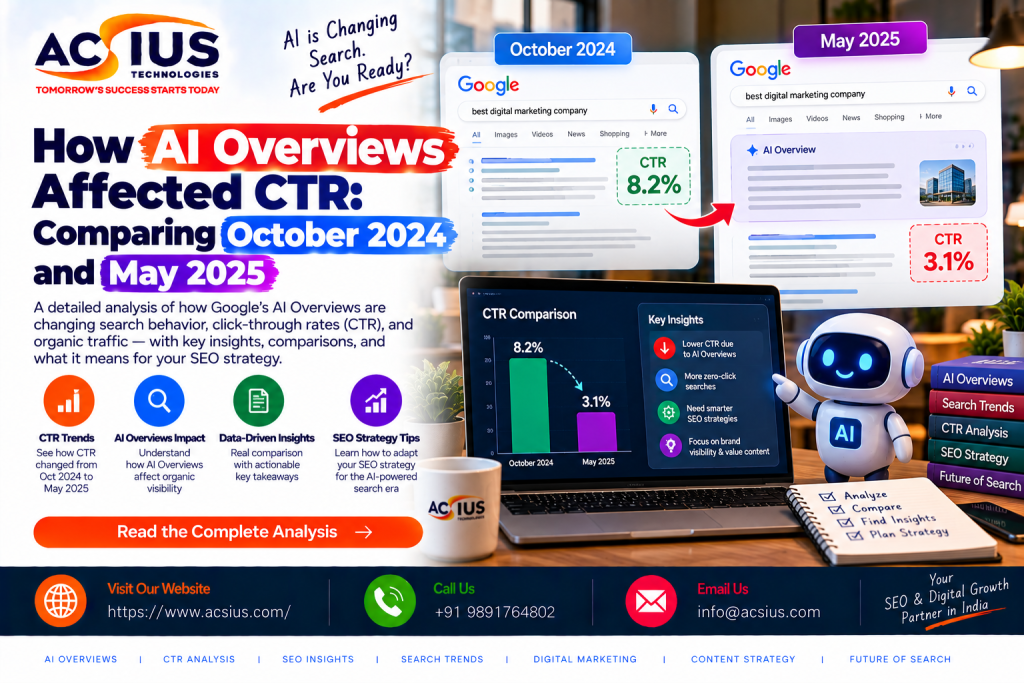
Click-through rates moved in the opposite direction. Position one fell from 10.67% to about 7.0%, a drop of roughly 34%. Position two fell from 7.09% to 4.9%, down about 31%. Position three slipped from 4.1% to 3.3%, down about 20%. Informational CTR dropped by around a third, from roughly 6% to 4%, while transactional CTR declined by a much smaller 9.5%, from 4.42% to 4%.
Two lessons stand out. First, the top positions lost the most, because they had the most to lose. A page ranking first was already competing with a summary placed directly above it. Second, informational content suffered far more than transactional content, which fits the pattern of where AI Overviews appeared most often.
October 2024 vs May 2025: A Side-by-Side View
The comparison below summarizes the figures from the ACSIUS BFSI analysis discussed above.
| Metric | October 2024 | May 2025 | Change |
| Queries with an AI Overview | 6.86% | 29.07% | Up about 324% |
| Informational queries with an AI Overview | 6.78% | 27.50% | Up sharply |
| Transactional queries with an AI Overview | 0.08% | 1.08% | Small but growing |
| Position 1 CTR | 10.67% | 7.0% | Down about 34% |
| Position 2 CTR | 7.09% | 4.9% | Down about 31% |
| Position 3 CTR | 4.1% | 3.3% | Down about 20% |
| Informational CTR | 6% | 4% | Down about 33% |
| Transactional CTR | 4.42% | 4% | Down about 9.5% |
The table shows that the bigger story is not just that CTR fell, but that exposure expanded. More queries were affected, so the overall damage to organic traffic grew faster than any single CTR number suggests.
What Other Studies Say About AI Overviews and CTR
One dataset should never be treated as the whole truth, so it helps to compare it with other research from the same period. The findings broadly point in the same direction, although the exact percentages differ because each study uses a different method, region, and keyword set.
Ahrefs analyzed a large set of keywords and reported in April 2025 that AI Overviews were associated with a 34.5% lower CTR for the top-ranking page compared with similar queries that had no Overview. That figure is remarkably close to the roughly 34% drop in position-one CTR seen in the Indian BFSI data. Ahrefs later repeated the exercise on a larger dataset and found the effect had grown, with position-one CTR falling by well over half when an Overview appeared.
The Pew Research Center took a different approach. It tracked the real browsing behavior of more than 900 US adults and analyzed tens of thousands of searches in March 2025. When an AI summary appeared, users clicked a traditional result in about 8% of visits. When no summary appeared, that figure was about 15%. Users also clicked a link inside the AI summary itself in only about 1% of visits, and they were more likely to end their browsing session entirely after seeing a summary.
Seer Interactive, which tracks brand-level performance, has also reported steep organic CTR declines on queries that trigger Overviews. It also found that brands cited inside an Overview earned significantly more clicks than brands that were not cited. This is an important detail: being mentioned in the AI answer is becoming a ranking outcome in its own right.
Taken together, the research suggests that the CTR decline is real, that it is concentrated on informational queries, and that visibility inside the Overview partially offsets the loss.
Why Informational Queries Took the Biggest Hit
Informational content has always been the top of the marketing funnel. Searches like “what is a mutual fund,” “how to improve credit score,” or “what is the difference between term and whole life insurance” bring in readers who are early in their journey. These are exactly the queries that AI systems answer best, because the answer is factual, general, and available across many sources.
When Google can summarize a definition or a how-to list in four sentences, a click to a blog post feels unnecessary. Publishers who built traffic on short, generic explainers saw the sharpest declines. Content that offers original data, expert opinion, calculators, templates, or personal experience held up better, because the summary cannot fully replace it.
This does not mean informational content has lost its value. It means the standard has risen. Content that only repeats what every other page says is now easy for AI to absorb and hard to justify clicking. Content that adds something new still earns attention, clicks, and citations.
Why Transactional and Local Queries Held Up Better
Searches with buying intent behave differently. Someone searching for “buy health insurance online” or “best CA firm near me” wants to compare options, check prices, read reviews, and take action. A summary cannot complete a purchase or book an appointment, so people still need to visit a website, call a business, or open a map listing.
That is why transactional CTR fell by under 10% in the dataset above, compared with a third for informational queries. It is also why local search remains one of the strongest areas of organic visibility. The Local Pack, Google Business Profile listings, maps, reviews, and “near me” results are built around real-world businesses, and they continue to drive calls, directions, and store visits.
For a business serving specific cities or regions, investing in local seo India is one of the most practical responses to the AI Overview era. Optimizing your Google Business Profile, collecting authentic reviews, keeping your name, address, and phone details consistent across directories, and building location-specific landing pages all strengthen visibility in the parts of search results that AI summaries have affected least. Local intent is high, competition is often lower, and the conversion path from search to customer is short.
How AI Overviews Changed Search Behavior, Not Just Rankings
The impact goes beyond a lower click rate on a single listing. Searchers have changed how they scan the page. Many now read the AI summary first, skim the first one or two organic results, and stop. Others use the summary to refine their question and run a second, more specific search. Longer, conversational queries have become more common, and the follow-up questions people ask are more detailed.
This has three consequences for SEO. First, impressions can rise while clicks fall, so impression-based reporting can hide a real loss. Second, brand awareness matters more, because searchers who see your name inside an AI answer may remember it and search for you directly later. Third, the quality of the visit improves, because people who do click after reading a summary tend to be further along in their decision and more likely to convert.
Measurement needs to adapt. Instead of focusing only on sessions, track branded search growth, assisted conversions, lead quality, and visibility inside AI answers. A drop in clicks does not automatically mean a drop in business value, but it does mean you should look at a wider set of signals.
Practical Ways to Protect and Grow Traffic
The brands that handled this period well did not panic and abandon SEO. They adjusted their approach. The following actions have proven useful.
Write for answers, then give readers a reason to click. Start sections with a clear, concise answer, which makes your content easier for AI to cite. Then go deeper than a summary can, with examples, comparisons, data, and decision frameworks.
Strengthen expertise and trust. Show author credentials, cite reliable sources, publish original research, and keep content current. Google’s quality systems and AI citation behavior both favor pages that demonstrate real experience.
Use structured data. Schema markup for organizations, FAQs, products, reviews, and local businesses helps search systems understand your content and can improve how it appears.
Target high-intent keywords. Because transactional and commercial queries are less exposed to AI Overviews, give service pages, comparison pages, and case studies the attention they deserve.
Build topical authority. Cover a subject in depth with connected pages, clear internal linking, and consistent terminology. Sites that are seen as authorities on a topic are more likely to be cited.
Earn mentions beyond your own site. Digital PR, expert quotes, partnerships, and industry directories all increase the chance that AI systems recognize and reference your brand.
Improve the technical foundation. Fast load times, mobile usability, clean site architecture, and crawlable pages remain the base on which everything else depends.
Building a Complete Strategy Around Core SEO
Adapting to AI Overviews does not replace traditional optimization. It sits on top of it. Pages that rank well in conventional results are still the main source from which AI systems draw their citations, so strong fundamentals remain the foundation. Keyword research, on-page optimization, technical audits, content planning, and link building all continue to matter.
A business that wants steady growth needs a program that covers all of these areas. Working with a provider of SEO Services India gives you a structured process: an audit to find technical and content gaps, keyword mapping based on search intent, on-page improvements, authoritative link acquisition, and monthly reporting that ties rankings to leads and revenue. In the AI Overview era, that process should also include tracking which of your target queries trigger an Overview, which competitors are being cited, and where your content can be improved to earn a place in the answer.
The strongest programs combine three layers. The first is technical and on-page excellence, so your site is easy to crawl and understand. The second is content that is genuinely useful and different from what already exists. The third is authority, built through links, mentions, and consistent brand signals across the web.
What to Expect Going Forward
The period from October 2024 to May 2025 should be read as an early chapter, not the final result. Google has continued to expand AI features, and newer research suggests that the CTR effect on queries with Overviews has remained substantial or grown. At the same time, the share of searches showing an Overview moves up and down as Google tests, adjusts, and refines where summaries appear.
Several trends seem likely to continue. AI answers will cover more query types, including some commercial ones. Conversational and multi-step searches will keep growing. Citations and brand mentions inside AI answers will become a standard visibility metric. And the gap between generic content, which loses clicks, and distinctive content, which earns citations, will widen.
None of this makes organic search obsolete. Search remains one of the most reliable ways to reach people with active intent, and it still delivers some of the best returns of any marketing channel. What has changed is that the work now includes earning a place in the answer as well as earning a place in the list of links.
Key Takeaways
- AI Overviews expanded rapidly between October 2024 and May 2025. In one Indian BFSI dataset, they grew from under 7% of queries to over 29%.
- CTR fell across the top positions. Position one dropped by roughly a third, which is consistent with the 34.5% figure reported by Ahrefs.
- Informational queries lost the most. Transactional and local queries were affected far less.
- Pew Research found that users clicked a result in about 8% of visits with an AI summary, compared with about 15% without one.
- Being cited inside an AI Overview is linked to higher click performance than being left out.
- The best response combines strong SEO fundamentals, original and trustworthy content, structured data, local optimization, and broader measurement.
Final Thoughts
AI Overviews have permanently changed how search results are read, and the comparison between October 2024 and May 2025 shows how quickly that change can happen. Clicks are harder to win, but they are not gone, and the visitors who do arrive are often better informed and closer to a decision. Brands that update their content, strengthen their authority, and measure success more broadly will continue to grow, while those that rely on old tactics will keep seeing traffic slip.
If you want expert help turning this shift into an advantage, ACSIUS offers search marketing support built for the AI era, from technical audits and content strategy to local visibility and performance reporting. Connect with ACSIUS today to review how AI Overviews are affecting your site and to build a plan that protects your traffic, earns citations, and drives real business results.
FAQs
How much did AI Overviews reduce CTR between October 2024 and May 2025?
In a ACSIUS analysis of 40,000 Indian BFSI keywords, position 1 CTR fell from 10.67% to about 7.0%, a drop of roughly 34%. Position 2 fell by about 31%, and position 3 by about 20%.
How many searches show an AI Overview?
In the same dataset, the share of queries with an AI Overview rose from 6.86% in October 2024 to 29.07% in May 2025. The share varies by industry, region and query type, and Google keeps adjusting it.
Which types of queries are affected the most?
Informational queries, such as "what is" and "how to" searches, are affected the most. Their CTR dropped by about a third. Transactional queries fell by only about 9.5%, because buyers still need to visit a website to compare options or complete a purchase.
Do AI Overviews affect all rankings equally?
No. The top positions lost the most clicks in absolute terms. Ahrefs reported a 34.5% lower CTR for the top-ranking page on queries with an Overview, which is close to the Indian dataset's figure.
Is organic SEO still worth it?
Yes. Pages that rank well in normal results are still the main source of AI citations. Search also still brings in high-intent visitors, who are often further along in their decision after reading a summary.
Does being cited in an AI Overview help?
Yes. Seer Interactive found that brands cited inside an Overview earned more clicks than brands that were not cited. Citations also build brand awareness, which can lead to later branded searches.
How can I get my content cited in AI Overviews?
- Lead each section with a clear, direct answer.
- Add original data, expert input and real examples.
- Use structured data such as FAQ, organization and local business schema.
- Build topical authority with connected, in-depth pages.
- Keep the content current and the site technically sound.
Are local businesses affected by AI Overviews?
Local searches are affected less. Maps, the Local Pack and Google Business Profile listings drive calls, directions and visits that a text summary cannot replace. Consistent business details, genuine reviews and location pages remain effective.
How should I measure SEO success now that clicks are falling?
Look beyond sessions. Track impressions against clicks, branded search growth, lead quality, assisted conversions and whether your brand appears in AI answers. A drop in clicks does not always mean a drop in business value.
