
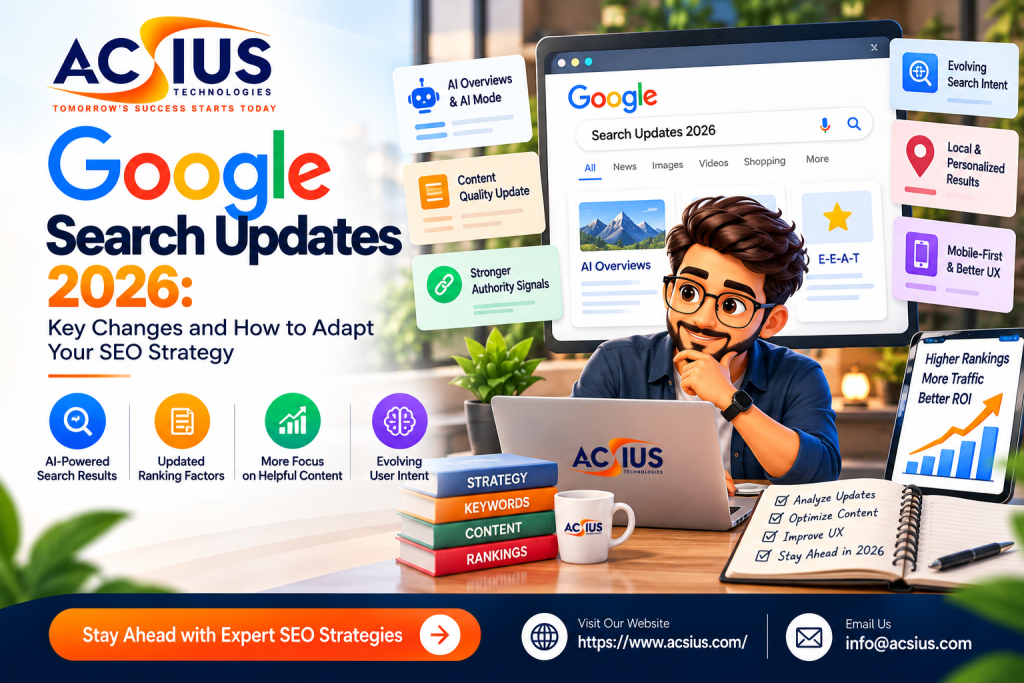
Google Search has changed more in 2026 than in any year since the early days of mobile-first indexing. Two heavy core updates, a Discover-only update, several spam updates, a redesigned search experience, and the rapid growth of AI Mode and AI Overviews have left many site owners watching their analytics and wondering what actually happened to their traffic.
This guide explains the key changes in plain language, step by step. It also covers what each change means for your rankings and how to adapt your SEO strategy for the rest of 2026 and beyond.
Step 1: Understand the 2026 Update Timeline
Before you change anything on your site, you need to know which update, if any, affected you. Google has confirmed several named updates this year. The February 2026 Discover core update ran from February 5 to February 26, the March 2026 core update ran from March 27 to April 8, and the May 2026 core update ran from May 21 to June 2. Google also ran spam updates during the year, which use a separate system from core ranking updates.
The key distinction is that a core update is a broad re-evaluation of how Google scores content quality across its whole index. A spam update targets specific policy violations such as scaled content abuse, link spam, or site reputation abuse. The Discover update only affected the Discover feed, not regular web search results. If your traffic changed outside a confirmed rollout window, the cause was probably something else, such as seasonality, a technical issue, or a change in how AI features display results.
Step 2: Get Your Fundamentals Right with Professional Support
Every major update this year pointed to the same message: sites with strong foundations survived, and sites that relied on shortcuts did not. Technical health, content quality, internal linking, and trustworthy backlinks matter more than any single trick. Many businesses now work with providers of SEO Services India to run a structured audit, fix crawl and indexing problems, and build a long-term roadmap instead of reacting to every ranking swing.
Start by checking the basics. Confirm your pages are indexable, your site loads fast on mobile, your sitemap is clean, and your most important pages are linked prominently from within your site. Updates rarely reward a site that has unresolved technical debt, however good the individual articles are.
Step 3: Learn What the March 2026 Core Update Changed
The March update was one of the most disruptive on record. More than 55% of monitored sites saw measurable ranking changes, and about 24% of pages that had been in the top 10 fell out of the top 100 entirely, compared with 14.7% after the December 2025 update. Industry analysis also found that nearly 80% of top-three results shifted, and that the update hit aggregators and thin comparison pages while favouring brands, official sources, and data-rich content.
The lesson is clear. Pages that restate what everyone else says, without original data, firsthand experience, or a clear point of view, are increasingly easy for Google to replace. Pages that offer something unique, such as proprietary research, real product testing, or expert commentary, held their ground much better.
Step 4: Understand Why the May 2026 Core Update Hit Harder
The May update arrived in a more complicated environment. Google announced it on May 21, 2026, and it finished rolling out on June 2, with about 88% of top-10 rankings and nearly 98% of the top 100 experiencing some change. It also landed during a wider shift in how Google presents results. The rollout coincided with Google I/O announcements, the global deployment of Gemini 3.5 Flash in AI Mode, a redesigned search box, and Google’s confirmation that AI Mode had passed one billion monthly users.
That overlap made it hard to separate ranking losses from click losses. A page could hold its position yet receive fewer visits because an AI answer sat above it. Analysts reported that pages with no clear author attribution and affiliate-heavy sites with thin value were among the groups that struggled most. The practical takeaway is to measure carefully before you decide what went wrong, since a drop in clicks does not always mean a drop in rankings.
Step 5: Treat AI Overviews and AI Mode as a Distinct Channel
AI Overviews and AI Mode are no longer experiments. They are a central part of how people use Google, and they change what “visibility” means. Your page can be cited inside an AI answer without earning a traditional click, and a top organic position may now deliver fewer visits than it did two years ago.
Brands that are adapting treat AI visibility as its own metric, separate from classic rankings. They track whether they are cited for their priority questions, which competitors appear alongside them, and whether the AI’s description of their brand is accurate. This is where specialised AI SEO Services India have become valuable, because optimising for citations requires clear answer structure, strong entity signals, schema markup, and content that language models can extract without confusion.
Step 6: Use the New Search Console AI Reporting
Measurement improved this year. Google has been rolling out reporting in Search Console that shows how pages perform in AI features separately from traditional organic data. This helps you answer questions that were previously guesswork: which pages are being shown in AI Overviews and AI Mode, how often users click through from them, and where impressions are rising while clicks fall.
Build a baseline now. Export at least eight weeks of Search Console data, group your pages by topic, and compare clicks, impressions, and click-through rate before and after each rollout window. Look at patterns across groups of pages rather than single URLs, because core updates re-score entire sites and individual page fluctuations can mislead you.
Step 7: Strengthen EEAT, Authorship, and Trust
Experience, Expertise, Authoritativeness, and Trustworthiness remain the quality lens behind every core update. Google’s guidance continues to stress people-first content, and the helpful content system now operates as part of core ranking instead of as a separate update.
To strengthen EEAT on your site:
- Add real author names, photos, and short bios explaining each writer’s qualifications.
- Publish firsthand evidence such as original photos, screenshots, test results, and case studies.
- Cite reputable primary sources and show clear publication and update dates.
- Make About, Contact, privacy, and editorial policy pages easy to find.
- Collect genuine reviews and respond to criticism professionally.
For topics involving health, money, legal matters, or safety, these signals matter even more, because Google holds that content to a higher standard.
Step 8: Build Topical Authority Instead of Isolated Pages
Google increasingly evaluates how well your whole site covers a subject, not just whether one page is well written. A site with a deep, organised library on a single topic is easier to trust than a site with a few articles on dozens of unrelated subjects.
Plan your content in clusters:
- Choose a core topic that matches your business.
- Create a comprehensive pillar page that covers the topic broadly.
- Write supporting articles on subtopics, questions, comparisons, and use cases.
- Link the supporting articles to the pillar and to each other.
- Review the cluster every quarter and add pages where gaps appear.
This structure helps classic ranking systems and also makes it easier for AI tools to recognise you as a complete source on the subject.
Step 9: Optimise Local Search for the New Results Layout
Local results are changing too. Map packs, AI-generated local summaries, and “near me” answers all draw on a business’s real-world signals: a complete Google Business Profile, consistent name, address, and phone details, authentic reviews, and content that shows genuine knowledge of the area. Businesses that serve a particular city or region increasingly rely on local seo services India to manage citations, reviews, and location pages so they appear when customers search close to home.
To improve local visibility, keep your business hours and categories accurate, add fresh photos regularly, and answer customer questions on your profile. Publish local content based on real customer questions, such as pricing, availability, and service areas. Avoid creating dozens of near-identical city pages, since thin, repetitive pages can hurt the quality of your whole site.
Step 10: Respond Correctly to Spam Updates
Spam updates are a different kind of event, and recovering from them is also different. Google’s spam policies cover scaled content abuse, expired domain abuse, site reputation abuse, link schemes, cloaking, and misleading practices. Google does not always name the specific target of a given spam update, so you should not automatically blame AI content or links when your rankings move.
If you suspect a spam issue, audit honestly:
- Remove or substantially improve mass-produced pages with little value.
- Disavow or remove manipulative links you have built or purchased.
- Stop hosting low-quality third-party content on your domain just to borrow its authority.
- Review any past agency work for tactics that violate Google’s policies.
Recovery from spam problems usually requires fixing the underlying issue and waiting for Google’s systems to reassess your site.
Step 11: Make Content Easy for Both Users and Machines to Understand
Clear structure helps people and helps AI systems extract your answers accurately. Place a direct answer near the top of each page, then expand with detail. Use descriptive headings that mirror real questions, short paragraphs, lists, and tables where they help comprehension.
Add structured data that fits your content: Article, Organization, Person, FAQ, Product, LocalBusiness, and Review markup where appropriate. Schema does not guarantee better rankings, but it helps search systems understand who wrote the page, who published it, and how the entities on it relate to each other. Keep the markup accurate and consistent with what appears on the page.
Step 12: Protect Page Experience and Core Web Vitals
Page experience remains a tiebreaker that supports good content. Aim for fast loading, stable layouts, and responsive interactions, especially on mobile, where most searches take place. Compress images, reduce heavy scripts, use caching and a content delivery network, and avoid intrusive pop-ups that block the content. A page that is helpful but slow or frustrating to use gives competitors an opening.
Step 13: Diversify Beyond Google Rankings
One of the biggest lessons of 2026 is that relying on a single traffic source is risky. Build an audience that does not depend entirely on any algorithm. Grow your email list, publish video content, participate in communities relevant to your industry, and earn mentions across trusted sites and publications.
Brand mentions also feed AI systems. When your company is repeatedly named alongside a topic across the web, models learn to associate you with it. Digital PR, expert commentary, original research, and genuine community participation all strengthen that association.
Step 14: Diagnose a Traffic Drop the Right Way
When traffic falls, resist the urge to rewrite everything immediately. Follow a calm process:
- Check the timing. Did the drop begin inside a confirmed rollout window on Google’s Search Status Dashboard?
- Check the scope. Was it broad across many pages and queries, or limited to one section?
- Separate impressions from clicks. If impressions are steady but clicks fell, AI features may be absorbing the clicks.
- Compare against competitors. See who gained and what they did differently.
- Wait for the rollout to finish before making major changes.
- Prioritise fixes on your highest-value pages first.
Remember that full recovery often has to wait for the next core update, which re-evaluates the improvements you have made. There is rarely a quick fix, and sites that improve steadily tend to recover better than sites that panic.
Step 15: Build an Adaptation Plan for the Rest of 2026
Put everything together into a practical plan:
- Month 1: Run a technical and content audit, set up Search Console baselines, and fix indexing and speed problems.
- Month 2: Strengthen authorship, update outdated pages, remove or merge thin content, and add structured data.
- Month 3: Expand topic clusters, publish original research or case studies, and improve local profiles.
- Ongoing: Track AI citations, monitor each update, earn external mentions, and refresh your best content regularly.
Common Mistakes to Avoid
- Making sweeping changes in the middle of a rollout
- Blaming every traffic drop on an algorithm update
- Publishing unedited AI-generated content at scale
- Ignoring author information and trust pages
- Treating AI visibility and organic rankings as the same thing
- Chasing quick tricks instead of long-term quality
Final Thoughts
Google’s 2026 updates share a common thread. Search is rewarding original, trustworthy, well-structured content from sources with real expertise, and it is becoming less forgiving of thin, repetitive, or manipulative pages. At the same time, AI-driven results are changing how people reach websites, which means success now involves rankings, citations, and brand reputation together. Businesses that respond with patience, measurement, and genuine quality will adapt far better than those that chase every rumour.
If you want a clear, data-driven strategy for navigating Google’s changes, ACSIUS can help you strengthen your technical foundations, build authority, and earn visibility across traditional search, AI Overviews, and local results, so your growth stays steady no matter how the algorithm evolves.
FAQs
Does a core update mean my website has been penalized?
No. Core updates are broad changes to how Google’s systems assess helpful and reliable content. They do not target specific sites. A drop in rankings usually means other pages now answer the searcher’s question better, not that you broke a rule. Penalties are separate and appear as manual actions in Search Console.
How long should I wait before analyzing my traffic after an update?
Wait until Google confirms the rollout is complete on its Search Status Dashboard, then give it at least one full week before reviewing Search Console data. Rankings often swing up and down during a rollout, so early changes can lead you to fix the wrong things.
Why did my rankings drop after the latest update?
Common reasons include thin or generic content, outdated pages, weak trust signals, a poor mobile experience, slow loading, or competitors publishing stronger material. Compare affected pages with those now ranking above you, then improve depth, originality, evidence, and usability rather than making random changes.
How do AI Overviews and AI Mode affect organic traffic?
They can reduce clicks on simple informational queries because the answer appears directly in the results. However, they also create visibility through citations and mentions. Businesses with strong service pages, expert content, local presence, and recognizable brands can still attract qualified visitors, especially for commercial and high-intent searches.
Is AI-generated content safe to publish in 2026?
It can be safe when the content is accurate, original, genuinely helpful, and reviewed by a knowledgeable human. Google’s spam systems target mass-produced, low-value content created mainly to capture search traffic. Using AI for research, outlines, or editing support is fine, as long as you add real expertise and fact-check everything.
What is AI SEO, and do I need it?
AI SEO is the practice of optimizing your content and brand so that both traditional search and AI answer systems can understand, trust, and cite you. It includes clear direct answers, structured data, entity clarity, strong author credentials, and quality backlinks. If your customers use Google, AI Mode, or other assistants to research providers, it is worth investing in.
Is local SEO still important with AI-driven search?
Yes. Local searches often carry strong buying intent, such as people looking for clinics, restaurants, or repair services nearby. An optimized Google Business Profile, steady genuine reviews, consistent business details, and useful location pages remain some of the most effective ways to generate calls, visits, and bookings.
How can I make my website more resilient to future Google updates?
Focus on the fundamentals: original, expert-led content, strong technical health, fast mobile performance, clear site structure, genuine reviews, and quality backlinks. Avoid shortcuts like paid link schemes or mass-produced pages. Review your site regularly and track business results such as leads and revenue, not only rankings.
How do I choose the right SEO partner during so many changes?
Look for transparency, ethical white-hat methods, customized strategies, proven case studies, and awareness of AI search trends. Be cautious of anyone promising guaranteed rankings or overnight results. A good partner explains what work is being done, reports on business outcomes, and sets realistic timelines.
