

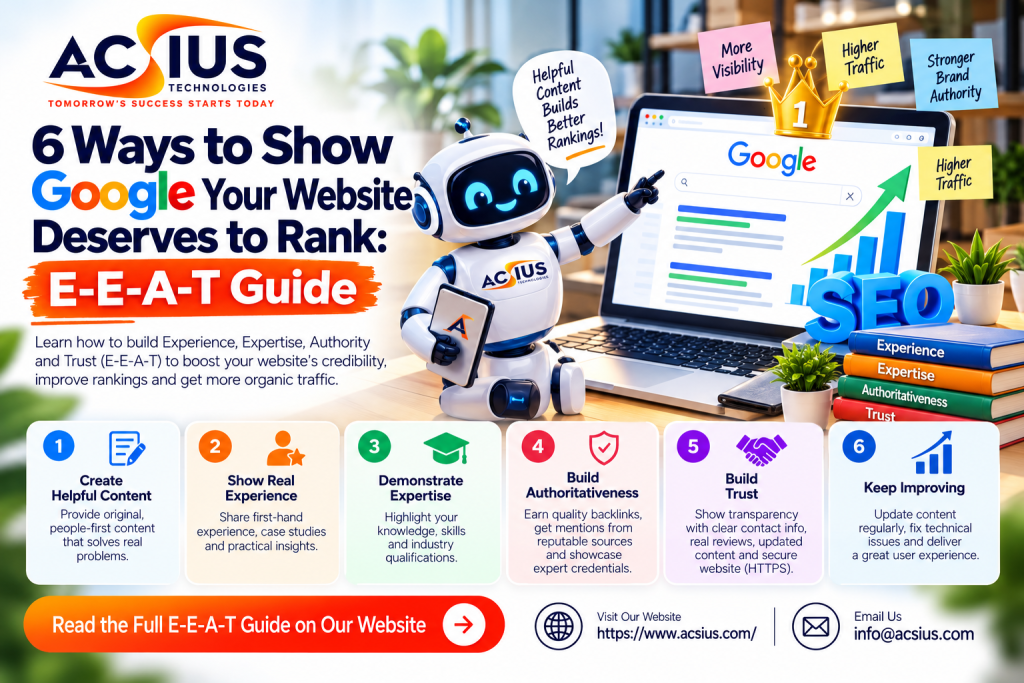
Every website owner wants the same thing: to be seen by Google as the best answer to a searcher’s question. But “best” is not only about keywords and backlinks. Google wants to send people to sources they can trust, especially when the topic affects health, money, safety, or major life decisions. That is where E-E-A-T comes in.
E-E-A-T stands for Experience, Expertise, Authoritativeness, and Trustworthiness. It comes from Google’s Search Quality Rater Guidelines, which human evaluators use to judge how well search results meet user needs. In this guide, you will learn what E-E-A-T really means, what it does and does not do for rankings, and six practical ways to show Google, and your visitors, that your website deserves to rank.
What Is E-E-A-T, Exactly?
Let us break down each part in plain language:
- Experience: Does the content show first-hand, real-world experience? A review written by someone who actually used the product is more useful than a summary written from other websites.
- Expertise: Does the creator have the knowledge or skill needed for the topic? A tax guide should come from someone who understands taxes.
- Authoritativeness: Is the website or author recognized as a go-to source in the field? Authority is often shown by mentions, citations, and recommendations from others.
- Trustworthiness: Is the page accurate, honest, transparent, and safe? Google’s guidelines describe trust as the most important part of the framework, because the other three only matter when people can rely on the information.
A common misunderstanding needs clearing up. E-E-A-T is not a single ranking factor or a score that Google assigns to your page. It is a framework that helps raters evaluate quality, and Google’s ranking systems aim to reward content that demonstrates these qualities using many signals. The practical takeaway is simple: if your website truly shows experience, expertise, authority, and trust, you are building the kind of site Google wants to rank.
Why E-E-A-T Matters More Than Ever
Two trends have made E-E-A-T more important. First, the web is flooded with generic content, much of it produced quickly by automated tools. When thousands of pages say nearly the same thing, search engines need ways to identify which sources are genuinely reliable. Second, AI-generated answers now appear in many search results, and these systems prefer to draw from sources that look credible and well-supported.
The stakes are highest for what Google calls “Your Money or Your Life” topics, such as medical advice, financial guidance, legal information, and safety. A weak page about movie trivia is a small risk. A weak page about medication dosage is a serious one. But even for ordinary business sites, blogs, and online stores, strong E-E-A-T can improve conversions, because visitors are more likely to buy, call, or subscribe when they trust you.
Way 1: Show First-Hand Experience
The extra “E” added in 2022 stands for Experience, and it is one of the easiest areas to win because AI tools and copycat writers cannot fake it convincingly. Experience tells readers, and Google, that you have actually done the thing you are writing about.
How to show it:
- Use original photos and videos. Show the product in use, the project in progress, or the process step by step, not just stock images.
- Share real results. Include before and after outcomes, test data, measurements, or client case studies, with permission.
- Write from the field. Describe what surprised you, what went wrong, and what you would do differently. These details signal real involvement.
- Publish detailed reviews and comparisons. Explain how you tested, how long you used the item, and what trade-offs you noticed.
- Add personal commentary. Even on informational posts, include practical tips from your own work.
For example, a travel blogger who writes “best time to visit” with a generic weather chart looks like thousands of other sites. A blogger who shares what crowds looked like, which hours were quiet, and what to avoid, with original photos, shows real experience. That difference is what readers remember and what search systems increasingly look for.
Way 2: Demonstrate Expertise Through Credible Authors and Depth
Expertise is about knowledge, and it should be visible. Many websites hide their writers behind vague bylines like “Admin” or “Staff,” which makes it hard for readers to judge credibility.
How to show it:
- Add clear author bios. Include the author’s name, role, qualifications, years of experience, and a photo. Link to professional profiles where relevant.
- Create author pages. A dedicated page listing a writer’s articles, credentials, and social links helps establish a consistent identity.
- Use expert review for sensitive topics. If you write about health, law, or finance, have a qualified professional review the content and say so on the page.
- Go beyond the basics. Explain concepts thoroughly, address common misconceptions, and answer follow-up questions that beginners and advanced readers might have.
- Cite credible sources. Link to research, official guidance, and reputable publications. Citing sources shows you did the homework and lets readers verify claims.
- Keep terminology accurate. Define technical terms clearly and avoid exaggerated promises.
Expertise does not always mean a formal degree. For many topics, such as cooking, gardening, or software tutorials, everyday expertise from years of practice can be just as valuable, provided you demonstrate it clearly. The key is matching the type of expertise to the topic.
Way 3: Build Authority Beyond Your Own Website
Authority is the part you cannot create alone. It grows when other trusted people and organizations recognize you. Think of it as your reputation in your industry.
How to build it:
- Earn quality backlinks. Links from relevant, reputable sites remain a strong signal. Focus on relevance and credibility, not quantity.
- Publish original research. Surveys, data studies, benchmarks, and industry reports give others something worth citing.
- Get mentioned in trusted publications. Contribute expert commentary, guest articles, or interviews on respected sites.
- Speak and participate. Webinars, podcasts, conferences, and community discussions raise your profile.
- Collaborate with other experts. Joint studies, co-authored guides, and partnerships help transfer trust.
- Build a recognizable brand. When people search for your name directly, it signals real-world recognition.
As AI-driven search expands, these off-site signals are becoming even more valuable, because systems that summarize information tend to rely on sources that appear credible across the wider web. Many brands now work with AI SEO Services India providers to monitor where their brand is mentioned, understand how AI answers describe them, and structure content so it is easier to cite. Used well, this support complements traditional authority-building rather than replacing it, since the best results still come from genuine reputation and high-quality content.
Way 4: Make Trust Visible and Easy to Verify
Trust is the foundation of the whole framework, and it is shown through many small details. Visitors should never have to wonder who runs your site, how to contact you, or whether their information is safe.
How to show it:
- Be transparent about who you are. Create a detailed about page with your story, team, mission, and business details. Add a clear Contact page with a working email, phone number, and physical address where appropriate.
- Publish policies. Privacy policy, terms of service, refund and shipping policies, and editorial standards show that you operate professionally.
- Use HTTPS and secure practices. A secure connection is a basic expectation. Protect forms, checkout pages, and user data.
- Display genuine reviews and testimonials. Show real customer feedback, ratings, and case studies. Never fake reviews, since doing so damages trust and may violate platform rules.
- Show credentials and affiliations. Awards, certifications, memberships, and partnerships help confirm legitimacy.
- Be honest about limitations. Disclose sponsored content, affiliate relationships, and conflicts of interest. Clear disclosure builds credibility.
- Correct errors. If you update or fix a mistake, note the change. Readers respect transparency.
For businesses that serve customers in specific areas, trust is also tied to local proof: consistent business details, real reviews, and visible community presence. Working with dedicated local seo services India can help you manage your Google Business Profile, citations, and review strategy, so your name, address, and phone details match everywhere and local customers can see clear signs that your business is real and reliable.
Way 5: Publish Accurate, Original, and Up-to-Date Content
Trust and expertise fall apart if the information is wrong or outdated. Google’s systems and human raters both look for content that is accurate, complete, and created to help people, not just to capture traffic.
How to do it:
- Start with real user needs. Study the questions people ask and write answers that satisfy them fully.
- Match search intent. If searchers want a step-by-step guide, do not give them a sales page. If they want to compare products, provide a fair comparison.
- Add unique value. Include insights, examples, tools, templates, or data that competitors lack.
- Fact-check everything. Verify statistics, quotes, prices, laws, and technical details before publishing.
- Update regularly. Review key pages every few months and refresh outdated information. Add a visible last-updated date when you make real changes.
- Avoid thin and duplicate pages. Merge overlapping articles and remove content that does not help anyone.
- Be careful with AI-generated drafts. AI tools can speed up writing, but always add human review, original insight, and fact-checking. Publishing unedited generic text is a fast way to lose trust.
Create content for people first and optimize for search second. A page that clearly helps a reader will usually perform better in the long run than a page stuffed with keywords.
Way 6: Strengthen the Technical and User Experience Foundations
People judge trust within seconds of landing on a page. A slow, cluttered, or confusing website sends the wrong message, even if the content is excellent. Technical quality also helps search engines crawl, understand, and evaluate your pages.
How to do it:
- Improve page speed and Core Web Vitals. Compress images, use caching, reduce heavy scripts, and choose reliable hosting.
- Design for mobile first. Most visitors use phones, so text, buttons, and menus must work smoothly on small screens.
- Keep navigation simple. Use clear menus, logical categories, and strong internal links, so people and crawlers can find related pages easily.
- Limit intrusive ads and popups. Content that is hard to read or buried under ads feels untrustworthy.
- Add structured data. Schema markup for articles, products, reviews, FAQs, organizations, and authors helps search engines interpret your content accurately.
- Fix broken links and errors. Dead pages and redirect problems signal neglect.
- Make content accessible. Use readable fonts, good contrast, descriptive alt text, and clear headings.
A well-organized site also helps you apply every other E-E-A-T tactic, since author pages, policies, reviews, and cornerstone content need to be easy to find. If you are unsure where your site stands, a professional audit from reliable SEO Services India specialists can uncover technical, content, and trust gaps in one review and give you a prioritized plan to fix them.
A Quick E-E-A-T Self-Audit Checklist
Use this checklist on your most important pages:
| Area | Questions to ask |
| Experience | Does the page show first-hand use, original media, or real examples? |
| Expertise | Is the author named, qualified, and clearly described? Are sources cited? |
| Authority | Do other trusted sites link to or mention you? Are you known in your niche? |
| Trust | Can visitors easily find contact details, policies, and real reviews? |
| Accuracy | Are facts verified and the content updated recently? |
| Experience of the site | Is the page fast, mobile-friendly, and easy to navigate? |
Score each page honestly. Pages that fail several checks are your first priority for improvement.
Common E-E-A-T Mistakes to Avoid
- Hiding authors. Anonymous content is harder to trust, especially on important topics.
- Fake credentials or reviews. Dishonesty can destroy credibility and invite penalties from platforms.
- Copying competitors. Rewriting what others already say adds no new value.
- Ignoring updates. Outdated advice can harm both users and your reputation.
- Overlooking policies and contact details. Missing basics make a business look unreliable.
- Chasing low-quality links. Spammy backlinks can hurt rather than help.
- Publishing outside your expertise. If you write about everything, you look like an expert in nothing. Stay focused on topics you can truly cover well.
How Long Does It Take to See Results?
E-E-A-T improvements are not a quick switch. Content updates and technical fixes can be recognized within weeks, but reputation building takes longer, usually several months or more. You will often see gradual improvements in rankings, impressions, branded searches, and conversions as your site earns more trust. Keep measuring progress, track the pages you improve, and repeat what works.
Final Thoughts: Earn Trust, Then Rankings Follow
Showing Google that your website deserves to rank is not about tricks. It is about proving, page by page, that real people with real knowledge stand behind your content that others recognize your work, and that visitors can rely on what you say. Share first-hand experience, present credible authors, build authority beyond your site, make trust visible, keep content accurate and fresh, and give users a fast, smooth experience. Do these six things consistently, and you will build a site that both people and search engines respect.
If you would like expert help strengthening your website’s credibility and search visibility, ACSIUS can support you with audits, content strategy, authority building, and technical improvements designed around E-E-A-T principles. Contact ACSIUS today to build a website that earns trust, ranks higher, and keeps growing.
FAQs
Which part of E-E-A-T is most important?
Trust. Google's guidelines describe it as the most important member of the family, because the other qualities only matter when information can be relied upon.
Do small websites need E-E-A-T?
Yes. Smaller sites can compete by showing real experience, focused expertise, and transparent trust signals that large generic sites often lack.
Can AI-written content meet E-E-A-T standards?
It can if humans add real experience, verify facts, and provide original value. Unreviewed, generic AI text usually falls short.
How do I show expertise without formal qualifications?
Share practical experience, case studies, original examples, and results. Be honest about your background and let the quality of your work speak.
What does the extra "E" for Experience mean?
It refers to first-hand, real-world involvement with the topic, such as having used a product, visited a place, or completed a project. Original photos, test results, and personal observations are common ways to show it.
Do author bios really matter for SEO?
They help readers and raters judge credibility, especially on health, finance, and legal topics. A clear name, role, qualifications, and links to professional profiles make content easier to trust.
Do backlinks still matter for authority?
Yes. Links and mentions from relevant, reputable sites remain a strong sign that others recognize your work. Focus on quality and relevance rather than the number of links.
How can local businesses improve E-E-A-T?
Keep your business name, address, and phone number consistent everywhere, collect genuine reviews, show real photos and team details, and publish helpful location-specific content.
How often should I update content to maintain E-E-A-T?
Review important pages every three to six months, and sooner for topics that change quickly. Update facts, examples, and sources, and add a visible last-updated date when you make real changes.
