
Search engine optimization has always been a moving target, but the last couple of years have shaken up the playing field more than usual. With AI-powered search experiences, generative answer engines, and increasingly sophisticated algorithms reshaping how people find information online, businesses are asking a new question: should we lean into AI-driven SEO tools and strategies, or double down on traditional organic SEO practices that have worked for decades?
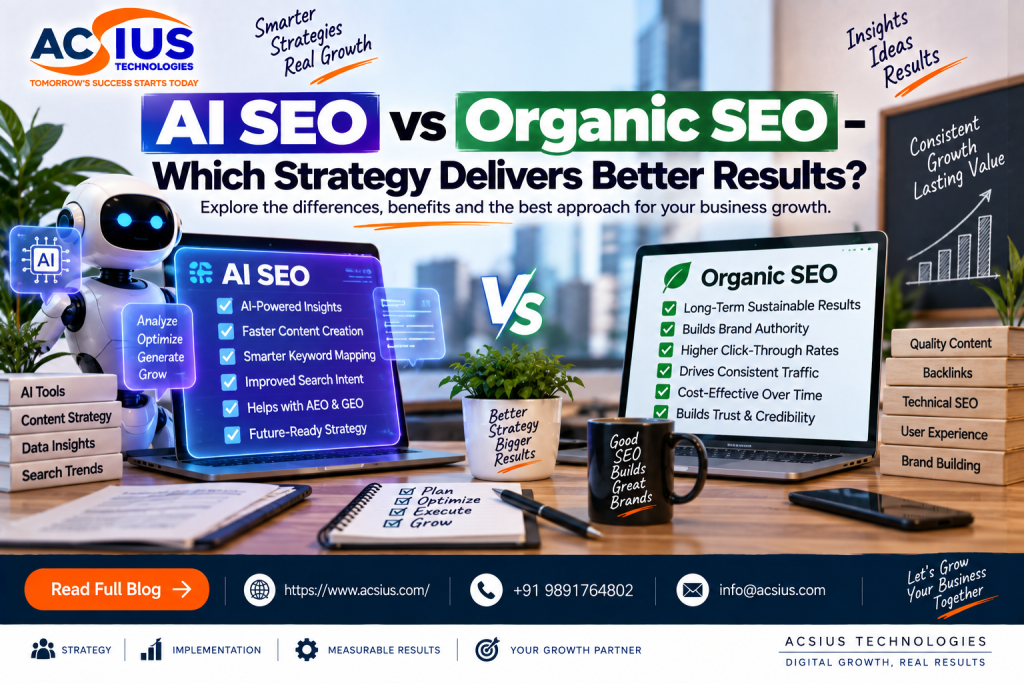
The honest answer is that this isn’t really an either-or decision — but understanding the strengths, limitations, and ideal use cases of both approaches is essential before you allocate budget and resources. Some businesses are seeing incredible early results by integrating AI into their SEO workflows, while others are finding that the fundamentals of organic SEO remain irreplaceable. This blog breaks down both strategies in depth, compares their real-world effectiveness, and helps you figure out which combination makes sense for your business.
Understanding Organic SEO: The Time-Tested Foundation
Organic SEO refers to the practice of improving a website’s visibility in search engine results through non-paid methods — quality content, technical optimization, backlink building, keyword research, and consistent adherence to search engine guidelines. It’s been the backbone of digital marketing since the early 2000s, and despite constant algorithm updates, its core principles have remained remarkably stable: create valuable content, build authority, and structure your site in a way that both search engines and users can understand easily.
The strength of organic SEO lies in its durability. Rankings built through genuine authority, quality backlinks, and consistently valuable content tend to hold up over time, even as algorithms shift. It’s also inherently trust-building — users tend to place more confidence in organically ranked results compared to paid placements, and that trust translates into higher engagement and conversion rates. Businesses that invest in comprehensive Organic SEO Services typically see compounding returns: content published years ago can continue driving traffic today, provided it’s kept updated and relevant.
However, organic SEO isn’t instant. It typically takes months to see meaningful ranking improvements, and it requires sustained effort — content creation, link building, technical audits, and ongoing optimization. For businesses that need quick wins or are entering highly competitive niches, this timeline can feel frustratingly slow.
Enter AI SEO: Speed, Scale, and Predictive Intelligence
AI SEO represents a newer, rapidly evolving approach that leverages artificial intelligence and machine learning to accelerate and enhance traditional SEO processes. Rather than manually researching keywords, analyzing competitor strategies, or auditing technical issues, AI-powered tools can process massive datasets in seconds, identify patterns invisible to human analysts, and generate actionable recommendations at a scale no human team could match.
AI SEO tools excel at several things: rapid keyword clustering and intent analysis, predictive content performance modeling, automated technical SEO audits that flag issues across thousands of pages instantly, and content optimization suggestions based on real-time SERP analysis. Increasingly, AI SEO also encompasses optimizing for AI-driven search experiences themselves — like Google’s AI Overviews, ChatGPT search, and other generative answer engines — which requires a different content structure and semantic approach than traditional ranking factors alone. Businesses turning to specialized AI SEO Services India are essentially future-proofing their visibility strategy for a search landscape that’s shifting from “ten blue links” to conversational, AI-generated answers.
The speed advantage is significant. What used to take an SEO analyst days — competitor gap analysis, content audits, technical crawls — can now be done by AI tools in a fraction of the time, freeing up human strategists to focus on creative and strategic decisions rather than repetitive data processing.
Where Each Strategy Truly Shines
To make a fair comparison, it helps to look at specific use cases rather than treating this as a blanket “which is better” question.
Content Creation and Optimization
Organic SEO has traditionally relied on human writers crafting content based on keyword research and audience understanding. This produces content with genuine expertise, unique perspectives, and the kind of nuanced storytelling that builds brand voice and trust. AI SEO tools, on the other hand, can rapidly analyze what’s already ranking, suggest content gaps, optimize for semantic relevance, and even draft initial content structures — dramatically speeding up production without necessarily replacing the human judgment needed for quality and authenticity.
Technical SEO
This is an area where AI has made enormous strides. Crawling a website with thousands of pages to identify broken links, duplicate content, slow-loading pages, or indexing issues used to require extensive manual auditing. AI-driven tools now handle this almost instantaneously, flagging priority issues and even suggesting fixes. For large e-commerce sites or content-heavy platforms, this efficiency gain alone can justify integrating AI into the SEO workflow.
Link Building and Authority
This remains firmly in organic SEO’s domain. Building genuine backlinks requires relationship building, outreach, PR strategy, and creating content worth linking to — none of which AI can meaningfully automate without risking spammy, low-quality links that could trigger penalties. Authority is still earned through human relationships and genuinely valuable content, not algorithmic shortcuts.
Local Search Visibility
Local search deserves its own mention because it operates differently from broader organic or AI SEO strategies. When people search for services “near me” or within a specific city or region, search engines prioritize signals like Google Business Profile optimization, local citations, review management, and geographically relevant content. Businesses targeting a specific city or region — whether a restaurant chain, a healthcare provider, or a service-based business — need a dedicated approach here. This is where working with a specialist in local seo services India becomes particularly valuable, since local SEO combines elements of both technical optimization and community-specific authority building that neither pure AI automation nor generic organic strategies fully address on their own.
The Data: What Results Are Businesses Actually Seeing?
When comparing outcomes, it’s worth separating short-term metrics from long-term trends.
In the short term, businesses integrating AI SEO tools often report faster identification and resolution of technical issues, quicker content production cycles, and faster adaptation to algorithm changes since AI tools can process and flag pattern shifts almost as soon as they occur. Some businesses have also seen improved visibility specifically within AI-generated search results and answer boxes after optimizing content structure based on AI SEO recommendations — a growing and increasingly important slice of search traffic.
In the long term, organic SEO continues to demonstrate stronger, more durable authority signals. Websites with a long history of quality backlinks, consistent content publishing, and genuine user engagement tend to maintain rankings through algorithm updates that can destabilize sites relying purely on rapid, AI-generated content without human oversight. Google and other search engines have also been increasingly vocal about penalizing low-quality, mass-produced AI content that lacks genuine expertise or added value — meaning businesses using AI tools irresponsibly, purely for content volume rather than quality, have actually seen ranking declines in some cases.
The pattern that emerges from real-world results is fairly clear: AI SEO accelerates processes and improves efficiency, but organic SEO principles — quality, relevance, authority, and trust — remain the foundation that determines whether those accelerated efforts actually translate into sustained rankings.
Common Misconceptions Worth Addressing
“AI SEO will replace organic SEO entirely.” This isn’t accurate. AI tools are best understood as powerful assistants that enhance human SEO strategy, not replacements for it. The judgment, creativity, and relationship-building that underpin strong organic SEO still require human expertise.
“Organic SEO is too slow to matter anymore.” While it’s true organic SEO takes time, its results tend to be more resilient and cost-effective over the long run compared to strategies that chase short-term algorithmic tricks. Patience with organic SEO typically pays off in traffic that doesn’t evaporate with the next algorithm update.
“AI-generated content ranks just as well as human-written content.” Search engines have become increasingly sophisticated at identifying low-effort, purely AI-generated content that lacks genuine expertise or unique value. AI can assist with research, structure, and optimization, but content still needs a human layer of expertise, editing, and authenticity to perform well and maintain credibility.
“You have to choose one or the other.” In practice, most successful SEO strategies today blend both approaches — using AI tools to handle data-heavy, repetitive tasks like technical audits and keyword research, while relying on human expertise for content quality, strategic decisions, link building, and brand voice.
Building a Hybrid Strategy: Getting the Best of Both Worlds
Given everything above, the most effective approach for most businesses isn’t picking a side — it’s building a hybrid strategy that uses each approach where it performs best.
Start by using AI tools for the heavy lifting of research and analysis: keyword clustering, competitor gap analysis, technical audits, and content performance predictions. This gives your team a data-driven foundation without burning weeks of manual labor. From there, apply human expertise to shape that data into genuinely valuable content, strategic link-building campaigns, and brand-consistent messaging that resonates with your actual audience — not just search algorithms.
For businesses with a strong local component — service providers, multi-location businesses, or regional brands — layering in dedicated local optimization ensures you’re capturing geographically relevant search intent that broader strategies often miss. Meanwhile, as AI-driven search experiences continue to grow (AI Overviews, conversational search, and answer engines), structuring your content to perform well in these new formats — clear, well-organized, authoritative, and directly answering user questions — has become just as important as traditional ranking optimization.
The businesses seeing the strongest results right now are the ones treating AI SEO and organic SEO as complementary layers of one comprehensive strategy, rather than competing philosophies. AI brings speed, scale, and adaptability to fast-changing search landscapes; organic SEO brings the trust, authority, and durability that keep results stable over years, not just months.
Which Strategy Should Your Business Prioritize?
The right balance depends largely on your business goals, timeline, and resources. If you’re a newer business or entering a highly competitive market and need to move fast on technical issues and content gaps, leaning more heavily into AI-powered tools initially can help you catch up quickly. If you’re an established business with existing authority and a longer time horizon, doubling down on organic SEO fundamentals — quality content, genuine backlinks, user experience — will likely deliver more sustainable returns.
For most businesses, though, the smartest path forward is combining both: using AI to work smarter and faster on data-heavy tasks, while never losing sight of the human-centered principles — expertise, trustworthiness, and genuine value — that have always been at the heart of what search engines ultimately reward.
Final Thoughts
The debate between AI SEO and organic SEO isn’t really about which one wins — it’s about understanding what each does best and building a strategy that leverages both intelligently. AI SEO offers unprecedented speed, scale, and adaptability to an evolving search landscape that increasingly includes generative AI answer engines. Organic SEO offers the enduring trust, authority, and resilience that keep your visibility stable through algorithm changes and shifting search behaviors.
Businesses that treat this as a false choice and instead build integrated strategies — using AI for efficiency and organic principles for sustainability — are the ones best positioned to win in search results today and in the years ahead.
If you’re trying to figure out the right mix of AI-driven and organic SEO strategies for your business — including local optimization for region-specific visibility — ACSIUS works with businesses to design and execute SEO strategies tailored to their goals, blending data-driven AI tools with proven organic SEO practices to deliver results that actually last.
FAQs
Is AI SEO going to replace organic SEO completely?
No. AI SEO tools are best used as powerful assistants that make SEO processes faster and more data-driven, not as replacements for human expertise. The strategic thinking, content quality, and relationship-building (like link building) that drive organic SEO still require human judgment that AI can't fully replicate.
Which strategy delivers faster results — AI SEO or organic SEO?
AI SEO generally delivers faster operational results, such as quicker technical audits, faster keyword clustering, and rapid content optimization suggestions. Organic SEO tends to take longer to show ranking improvements but typically produces more durable, long-lasting results once established.
Does AI-generated content rank well on search engines?
Not automatically. Search engines have become better at identifying low-effort, purely AI-generated content that lacks genuine expertise or unique value, and can penalize it. AI can assist with research, structure, and optimization, but content still needs human editing, expertise, and authenticity to perform well and build trust.
Can small businesses benefit from AI SEO, or is it only for large companies?
Small businesses can benefit significantly from AI SEO, especially for tasks like technical audits and keyword research that would otherwise take a lot of manual time. It allows smaller teams to compete more efficiently without needing a large in-house SEO department.
What is local SEO, and how does it fit into this comparison?
Local SEO focuses on improving visibility for geographically specific searches, such as "near me" queries, through Google Business Profile optimization, local citations, and review management. It's a distinct strategy that combines elements of both technical and organic optimization, and is especially important for businesses serving specific cities or regions.
How is AI changing SEO for platforms like Google's AI Overviews or ChatGPT search?
As search shifts toward AI-generated answers and conversational search experiences, content needs to be structured clearly and directly answer user questions to perform well in these formats. This is a growing focus within AI SEO strategies, since ranking well in traditional search results doesn't automatically translate to visibility in AI-generated answers.
Is it better to use AI SEO tools alone, or combine them with organic SEO practices?
Combining both generally produces the best results. AI tools handle data-heavy tasks like audits and research efficiently, while organic SEO principles — quality content, genuine backlinks, and user trust — provide the sustainable foundation that keeps rankings stable long-term.
Does organic SEO still matter if algorithms increasingly favor AI-driven search experiences?
Yes. Even as AI reshapes how search results are presented, the underlying signals search engines value — authority, relevance, and trustworthiness — are still built through organic SEO practices. A strong organic foundation actually makes it easier to perform well in AI-driven search formats too.
How long does it take to see results from an SEO strategy that blends AI and organic approaches?
Some improvements, like fixed technical issues or optimized content, can show impact within weeks. However, meaningful ranking gains and sustained authority typically take a few months to materialize, and continued investment over 6–12 months usually delivers the most significant, lasting results.
