
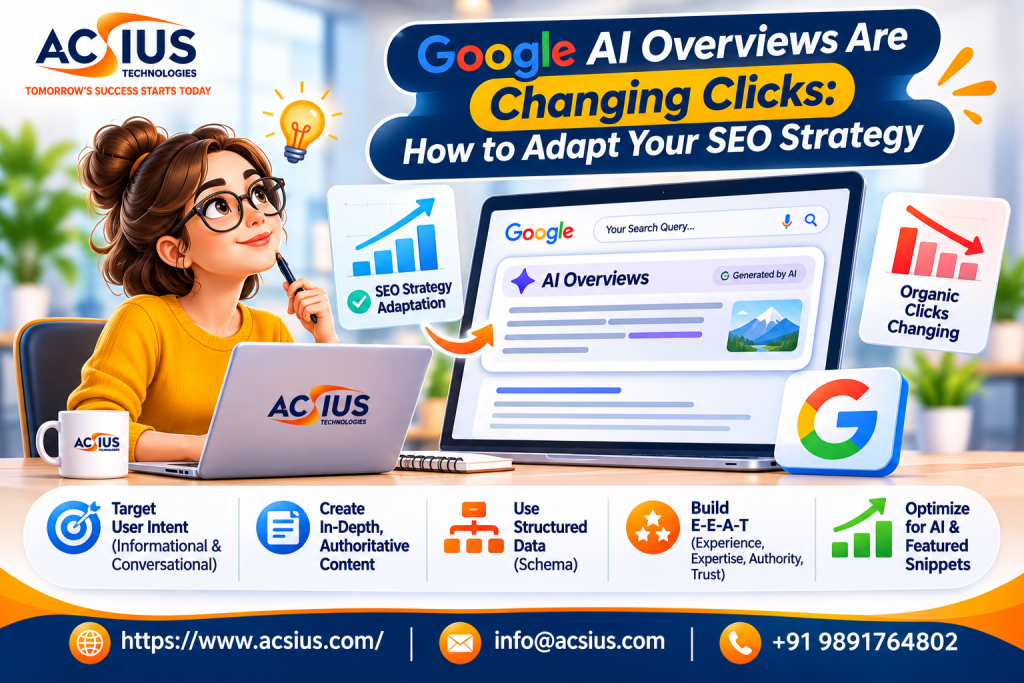
If you have opened Search Console recently and noticed that impressions are steady while clicks are slipping, you are not alone. Many site owners are seeing the same pattern, and a growing body of research points to the same culprit: AI Overviews, the AI-generated summaries that now appear at the top of many Google results. Searchers get a quick answer without scrolling, and fewer of them visit the websites behind that answer.
But the full story is more nuanced than “SEO is dying.” Studies disagree on how large the impact is, some data suggests click-through rates are beginning to stabilize, and brands that adapt are finding new ways to earn visibility. This guide explains what the research actually shows, which kinds of pages are most affected, and how to adjust your SEO strategy with practical steps that put people first.
What Are AI Overviews, and Why Do They Change Clicks?
AI Overviews are summaries generated by Google’s AI that appear above the traditional blue links for many queries. They pull information from several web pages, present a short answer, and usually include links to sources. Google has also been connecting them more closely to AI Mode, where people can ask follow-up questions in a conversational flow.
The effect on clicks is simple to understand. If the summary answers the question, the searcher has less reason to open a website. This is similar to what featured snippets did for years, but on a larger scale and for more types of queries. Searches that end without any click are often called zero-click searches, and AI Overviews can increase them for certain topics.
That does not mean your pages are invisible. Your content may still be used and cited inside the overview, and your traditional listing remains available below it. What changes is where attention goes, and therefore how you should measure and plan your work.
What the Research Says (and Why the Numbers Differ)
If you search for data on this topic, you will find numbers that seem to contradict each other. That is because studies measure different things in different ways. Here is a fair summary of the main findings published in 2025 and 2026.
- Ahrefs analyzed Search Console data for 300,000 keywords and reported in early 2026 that the top-ranking page had a click-through rate about 58 percent lower when an AI Overview appeared, compared with similar keywords without one. An earlier version of the same study, published in 2025, had measured a 34.5 percent reduction, which suggests the effect grew over time.
- Pew Research Center found in 2025 that users clicked on a traditional result about 8 percent of the time when an AI summary appeared, compared with about 15 percent when it did not.
- A randomized field experiment by researchers at the Indian School of Business and Carnegie Mellon University, reported in 2026, found that AI Overviews reduced organic clicks by about 38 percent on queries where they appeared, and that zero-click searches rose from about 54 percent to about 72 percent. Because users were randomly assigned, this type of study is better at isolating cause and effect than correlation-based analyses.
- Seer Interactive reported more encouraging data, with organic click-through rates on queries that show an AI Overview rising from about 1.3 percent in December 2025 to about 2.4 percent in February 2026, based on millions of tracked queries. That suggests some recovery from earlier lows, though from a small base.
- Google has said that links in AI features can attract high-quality clicks and that users who click after reading an overview tend to spend more time on the destination site. Independent studies do not all agree, and Google does not publish detailed click data for AI Overviews inside Search Console.
The honest conclusion is that clicks are generally lower on queries that show AI Overviews, the size of the loss varies widely by topic and method, and the situation is still evolving. Plan for lower click-through on some pages, but do not assume the worst case for every page on your site.
Which Pages and Queries Are Most Affected?
Not every search triggers an AI Overview, and the effect is uneven. Based on the research and Google’s own behavior, these patterns are common:
- Simple informational queries. Definitions, quick facts, and “what is” or “how does” questions are the most likely to be answered directly.
- Long, conversational questions. These fit the way AI features respond.
- Top-of-funnel content. Pages written only to answer basic questions often lose the most traffic.
- Pages that repeat common information. If your page says what ten others already say, an AI summary can replace it easily.
By contrast, these types of searches tend to hold up better:
- Branded searches, where people want your specific website.
- Transactional and high-intent queries, where users want to buy, book, or compare in detail.
- Local searches, which often trigger map results and business listings.
- Complex research, where readers need depth, original data, or expert judgment.
Check your own data before changing course. In Search Console, compare clicks and impressions by page and query over several months, and look for pages where impressions held steady while clicks fell. Those are your most likely AI Overview casualties.
Strategy 1: Keep the Foundations Strong
It may sound unexciting, but the first step in adapting is to protect the basics. Google has stated that its AI features rely on indexed, high-quality pages and follow standard SEO fundamentals. To be included, a page must be indexed and eligible to appear with a snippet. That means technical health, relevant content, and trustworthy signals still matter.
Make sure of the following:
- Important pages are crawlable, indexed, and not blocked by noindex tags or robots rules.
- Pages load quickly and work smoothly on phones.
- Your site structure is logical, with strong internal links between related pages.
- Titles, headings, and content match what searchers actually want.
- Structured data is valid where it applies.
A steady, well-built website gives every other tactic something to stand on. If you need help auditing technical health, content quality, and authority in one coordinated plan, dependable Organic SEO Services can identify the problems that most affect your visibility and prioritize fixes, so you are not guessing where to start.
Strategy 2: Create Content That an AI Summary Cannot Replace
If a page only repeats basic facts, an AI answer can replace it. If a page offers something extra, a reason to visit remains. Focus on adding value that goes beyond a summary:
- Original research and data. Surveys, benchmarks, and studies are hard to duplicate and worth citing.
- First-hand experience. Real examples, test results, case studies, and lessons from practice.
- Expert insight. Clear judgments, trade-offs, and recommendations from qualified people.
- Tools and templates. Calculators, checklists, and downloads that people use rather than just read.
- Depth and nuance. Detailed comparisons, step-by-step guidance, and answers to follow-up questions.
- Visuals and demonstrations. Original diagrams, screenshots, and videos that explain what text cannot.
At the same time, make the key answer easy to find. Place a clear, direct answer near the top of each section, then support it with detail. This helps readers scan quickly and makes your content easier for AI systems to understand and cite.
Strategy 3: Optimize for Citations, Not Just Rankings
Being mentioned inside an AI answer can introduce your brand to people who may never scroll to your listing. That makes citation visibility a goal alongside rankings. Practices that help include:
- Use question-based headings that mirror how people ask.
- Write in clear, complete sentences, avoiding vague or padded text.
- Cite credible sources and keep facts accurate and current.
- Show authorship and expertise. Add author names, bios, and credentials.
- Use structured data such as article, FAQ, product, and organization markup where relevant.
- Keep content fresh. Update statistics and examples, and show real update dates.
- Build recognition beyond your site. Mentions, reviews, and links from reputable sources help systems recognize you as a trustworthy source.
This discipline is often called answer engine optimization or generative engine optimization. It is not a replacement for SEO; it is an extension of it. Many brands now work with providers of AI SEO Services India to track where they appear in AI-driven results, find gaps in topic coverage, and structure content so it is easy to understand and cite. Used alongside strong fundamentals, this support can help you stay visible as search habits evolve. Remember that no one can guarantee inclusion in an AI answer, so treat promises of that kind with caution.
Strategy 4: Protect and Grow Your Brand Demand
As generic informational clicks become less reliable, brand strength becomes more valuable. People who search for your name, or add your name to a query, are far more likely to click your site and far less likely to be diverted by a summary.
Build brand demand by:
- Publishing distinctive content that people remember and share.
- Earning coverage through original research, expert commentary, and partnerships.
- Engaging in communities where your audience asks questions, such as forums, social platforms, and industry groups.
- Collecting genuine reviews and showcasing real customer results.
- Staying consistent in messaging and visual identity across platforms.
- Building an email list or community so you do not depend entirely on search.
Track branded search growth in Search Console. It is a useful signal that your visibility is turning into real recognition.
Strategy 5: Focus on High-Intent and Transactional Pages
Because informational traffic is the most exposed, it makes sense to strengthen the pages closest to revenue. Review your service pages, product pages, pricing pages, comparison pages, and case studies. Are they clear, trustworthy, and useful for someone ready to decide?
Improve them by adding specific details, real testimonials, transparent pricing or ranges where possible, answers to common objections, and clear next steps. Link to them naturally from your helpful articles, so readers who learn from your content can move toward a decision.
For online stores, this matters even more. Product and category pages face their own AI-related changes, with shopping features, product summaries, and comparisons shaping how people evaluate options. Store owners often benefit from specialized E-commerce SEO Services that optimize product data, category structure, reviews, structured data, and page performance, so their listings are accurate, complete, and easy for both search engines and shoppers to understand.
Strategy 6: Strengthen Local Visibility
Local searches often behave differently from general informational queries because people want a specific business nearby, and results frequently include maps and listings. That gives local businesses a more stable path to visibility, but only if their information is accurate and trusted.
Keep your Google Business Profile complete with correct categories, services, hours, photos, and updates. Make sure your business name, address, and phone number are consistent across your website and directories. Collect honest reviews and reply to them, and create unique location pages with real local details. Conversational local searches are also growing, so clear information about services, pricing, and policies helps both users and AI systems.
Businesses with several branches or service areas often use dedicated local seo services India to manage profiles, citations, reviews, and location pages at scale, so their local presence stays consistent and credible as search features change.
Strategy 7: Update How You Measure Success
If you judge SEO only by clicks, AI Overviews will make results look worse than they may be. A broader scorecard gives a more accurate picture:
| Metric | What it tells you |
| Impressions and visibility | Whether your pages still appear for important queries |
| Clicks and click-through rate | How many people visit, by query group and page type |
| Branded search growth | Whether recognition is increasing |
| Conversions and revenue | Whether visitors take valuable actions |
| Assisted conversions | Whether search supports sales that finish elsewhere |
| AI citations and mentions | Whether your brand appears in AI-driven answers |
| Engagement | Whether visitors find your content useful and return |
Segment your data. Compare informational and transactional queries, branded and non-branded searches, and different page types. A drop in simple informational clicks may be acceptable if conversions and brand searches are growing. Use trends over months rather than days, since search results and AI features change often.
A Practical 90-Day Plan
- Days 1 to 30: Diagnose. Export Search Console data and identify pages where clicks fell while impressions held steady. Group them by intent and topic. Check technical health and indexing for key pages.
- Days 31 to 60: Upgrade. Add original insights, examples, and tools to your most affected pages. Place direct answers near the top, update facts, and strengthen author and trust signals. Improve high-intent pages.
- Days 61 to 90: Expand and measure. Fill topic gaps, build internal links, pursue relevant mentions, and set up a reporting dashboard that includes branded search, conversions, and AI visibility.
- Ongoing: Review monthly, refresh key content quarterly, and avoid reacting to short-term swings.
Mistakes to Avoid
- Panicking and rewriting everything. Focus on pages that matter and make changes in stages.
- Blocking AI features out of fear. Restricting snippets can reduce eligibility, so consider the trade-offs carefully before changing settings.
- Mass-producing generic content. Unedited, repetitive pages add little value and increase quality risks.
- Chasing tricks to get cited. There is no shortcut, and manipulation can backfire.
- Ignoring conversions. Fewer clicks can still produce good results if visitors are more qualified.
- Relying only on search. Diversify with email, community, social, and partnerships.
- Trusting a single study. Compare sources and check your own data.
Final Thoughts: Adapt, Do Not Abandon
AI Overviews have changed how people interact with search, and for many informational queries, fewer clicks are a reality. But search is not disappearing. It is shifting toward a world where being useful, trustworthy, and recognizable matters more than ever. Protect your technical foundations, create content that offers more than a summary, aim for citations as well as rankings, build brand demand, strengthen high-intent and local pages, and measure results with a wider lens. Do these things consistently, and you will be better prepared for whatever Google changes next.
If you would like expert help adapting your SEO strategy to AI-driven search, ACSIUS can support you with audits, content planning, technical optimization, and authority building through clear, ethical, and results-focused methods. Contact ACSIUS today to build a search presence that stays strong as search continues to evolve.
FAQs
Is SEO still worth it?
Yes. Google says AI features rely on indexed, high-quality pages and follow standard SEO fundamentals. The goal is broader now: rank, be cited, and build a brand people search for.
Can I opt out of AI Overviews?
Controls such as snippet restrictions exist, but they can also reduce your visibility in regular results. Consider the trade-offs carefully before using them.
What is the difference between SEO, GEO, and AEO?
SEO aims to rank in traditional results. GEO and AEO focus on being understood and cited by AI answer systems. They overlap heavily, and strong SEO supports both.
Which content is safest from AI Overviews?
Original research, expert analysis, tools, detailed comparisons, and strong brand content are harder to replace with a short summary than basic definitions.
Do AI Overviews affect local businesses?
? Less often, since many local searches show maps and business listings. Accurate profiles, reviews, and consistent details remain important.
How can I track AI Overview impact in Search Console?
Search Console does not report AI Overview clicks separately. Compare impressions, clicks, and click-through rate by query and page over time, and use third-party tools for visibility tracking.
How long will it take to adapt?
Technical and content improvements can show results in weeks, while authority and brand growth usually take several months or longer.
