

Search is changing faster than ever before.
For years, Google Search Console has been the go-to platform for monitoring how websites perform in Google Search. SEO professionals, business owners, and digital marketers have relied on it to understand search visibility, indexing, clicks, impressions, and technical issues.
But today’s search landscape is no longer limited to websites.
Millions of people now discover brands through Instagram posts, YouTube videos, TikTok content, and conversations on X. Social platforms have become powerful discovery engines, influencing purchasing decisions long before users visit a website.
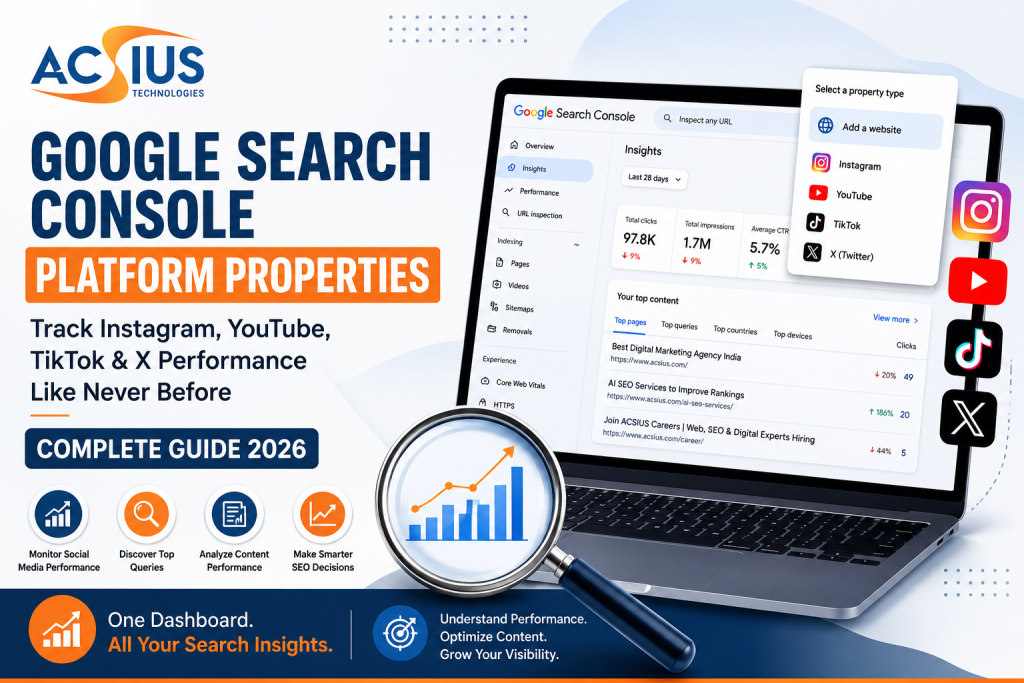
Recognizing this shift, Google has introduced Platform Properties in Google Search Console—a feature that allows eligible creators and businesses to monitor the search performance of supported social platforms from within the Search Console ecosystem.
This update represents more than just another reporting feature. It signals Google’s growing focus on integrating website SEO with social media visibility, helping marketers understand how different digital assets contribute to their overall online presence.
In this guide, we’ll explain everything you need to know about Platform Properties, how they work, why they matter, and how businesses can use them to strengthen both SEO and social media strategies.
What Are Google Search Console Platform Properties?
Platform Properties are a new property type available inside Google Search Console.
Unlike traditional properties that track websites or domains, Platform Properties are designed to help users connect supported social media accounts and view their performance within Google Search Console.
Instead of monitoring only webpages, Google can now provide insights into how content published on supported platforms performs across Google’s search ecosystem.
At the time of writing, Google supports connecting the following platforms:
- YouTube
- TikTok
- X (formerly Twitter)
This allows creators, businesses, and marketing teams to manage website performance and supported social platform insights from one central dashboard.
For businesses with active content strategies, this creates a more complete picture of online visibility.
Why Did Google Introduce Platform Properties?
User behavior has changed dramatically over the last few years.
People no longer rely solely on traditional search engines to discover products, brands, or services.
Instead, they search everywhere.
A customer looking for a restaurant might browse Instagram before Google Maps.
Someone researching software may watch YouTube tutorials before reading blog articles.
A buyer comparing products may explore TikTok reviews before visiting an ecommerce website.
Google understands these changing habits.
Platform Properties reflect a broader trend toward unified digital visibility, where websites and social platforms work together rather than existing as separate marketing channels.
The feature also supports Google’s long-term direction toward AI-powered search experiences, where content from multiple sources contributes to search results and user journeys.
Supported Platforms
At launch, Google Search Console currently supports four major platforms.
Instagram has evolved far beyond a photo-sharing application.
Today, it functions as a visual search platform where users discover businesses, products, creators, and educational content.
Businesses that regularly publish high-quality Reels, carousels, and educational posts may now gain better visibility into how their Instagram presence contributes to discoverability.
YouTube
YouTube has always played an important role in Google’s ecosystem.
Since Google owns YouTube, integrating video performance into Search Console was a logical next step.
Businesses publishing tutorials, product demonstrations, educational videos, webinars, and customer success stories can better understand how video content supports their overall digital marketing efforts.
TikTok
TikTok has transformed how younger audiences search for information.
Instead of typing questions into traditional search engines, many users now begin their research directly on TikTok.
Google’s support for TikTok reflects the platform’s growing influence on consumer discovery and purchasing decisions.
X (Formerly Twitter)
X continues to be an important platform for real-time discussions, announcements, industry news, and thought leadership.
Businesses, publishers, and technology companies can use it to increase brand visibility while understanding how their public content contributes to online discovery.
How Platform Properties Work
Platform Properties function differently from traditional website properties.
Instead of verifying ownership through DNS records or HTML files, users connect eligible social accounts through Google’s supported verification process.
Once connected, Search Console begins collecting available performance data associated with the supported platform.
Users can then access performance reports within Search Console, helping them understand how their connected social presence contributes to visibility.
The goal isn’t to replace each platform’s native analytics.
Instead, Platform Properties provide additional search-focused insights within Google’s ecosystem.
Why This Update Matters for SEO
For many years, SEO focused primarily on websites.
Rank pages.
Earn backlinks.
Improve technical performance.
Optimize metadata.
While those fundamentals remain essential, digital visibility has expanded beyond webpages.
Search engines increasingly recognize signals from videos, creator content, brand mentions, and authoritative social profiles.
Businesses that publish valuable content across multiple channels often create stronger brand recognition, higher engagement, and more opportunities for discovery.
Platform Properties acknowledge this broader view of search.
Rather than treating websites and social platforms as completely separate marketing channels, Google is encouraging marketers to understand their combined impact.
For SEO professionals, this means thinking beyond rankings alone.
The future belongs to businesses that create helpful, authoritative content wherever their audiences are searching.
Benefits for Businesses
Businesses of every size can benefit from this feature.
Some of the biggest advantages include:
Better Visibility
Understand how your social content contributes to your overall digital presence.
Unified Reporting
Access website and supported platform insights from one familiar interface.
Smarter Content Planning
Identify which content formats generate greater visibility and engagement.
Improved Brand Consistency
Maintain a stronger connection between your website, social channels, and search presence.
Better Marketing Decisions
Use performance data to decide whether future investment should focus on blogs, videos, Reels, or educational content.
How to Add Platform Properties in Google Search Console
Setting up a Platform Property is designed to be straightforward, but before you begin, make sure you’re using the Google account associated with your business or creator profile.
While the exact interface may evolve as Google expands this feature, the general setup process follows these steps.
Step 1: Sign in to Google Search Console
Log in to your Google Search Console account using the Google account that manages your website.
If you already have website properties verified, you’ll see them listed in the property selector.
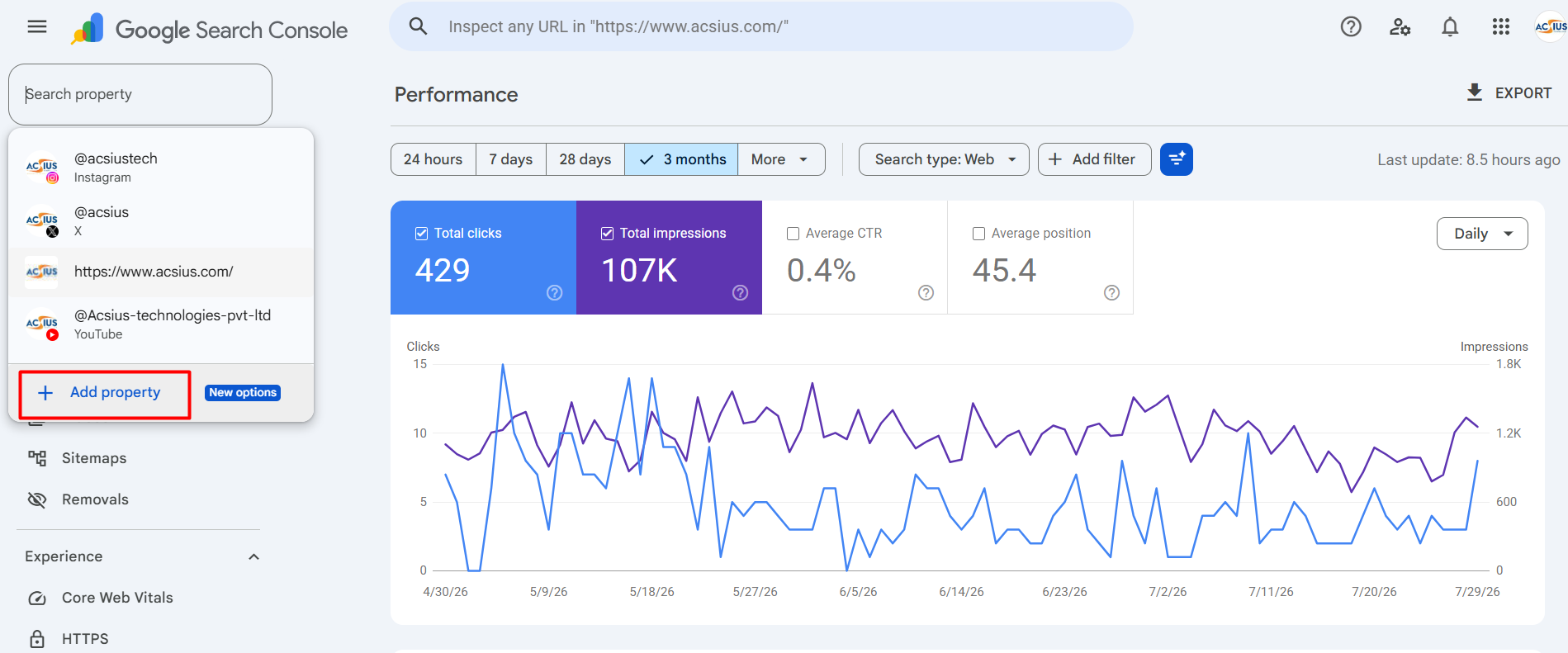
Step 2: Click “Add Property”
In the left-hand navigation, click the property selector and choose Add Property.
Along with traditional Website Properties, you’ll now notice options to connect supported social platforms.
Step 3: Choose Your Platform
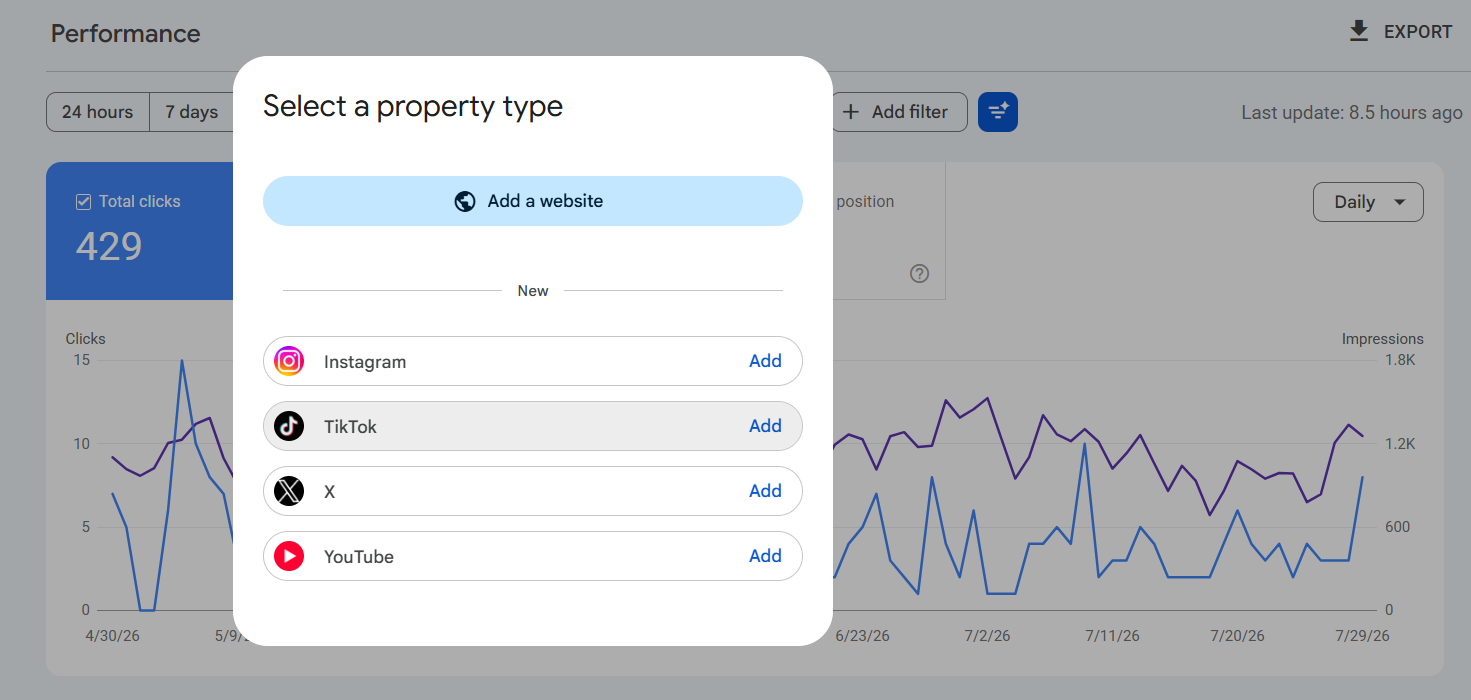
Select the platform you want to connect.
Available options currently include:
- YouTube
- TikTok
- X (formerly Twitter)
Choose the platform that matches your business account.
Step 4: Authenticate Your Account
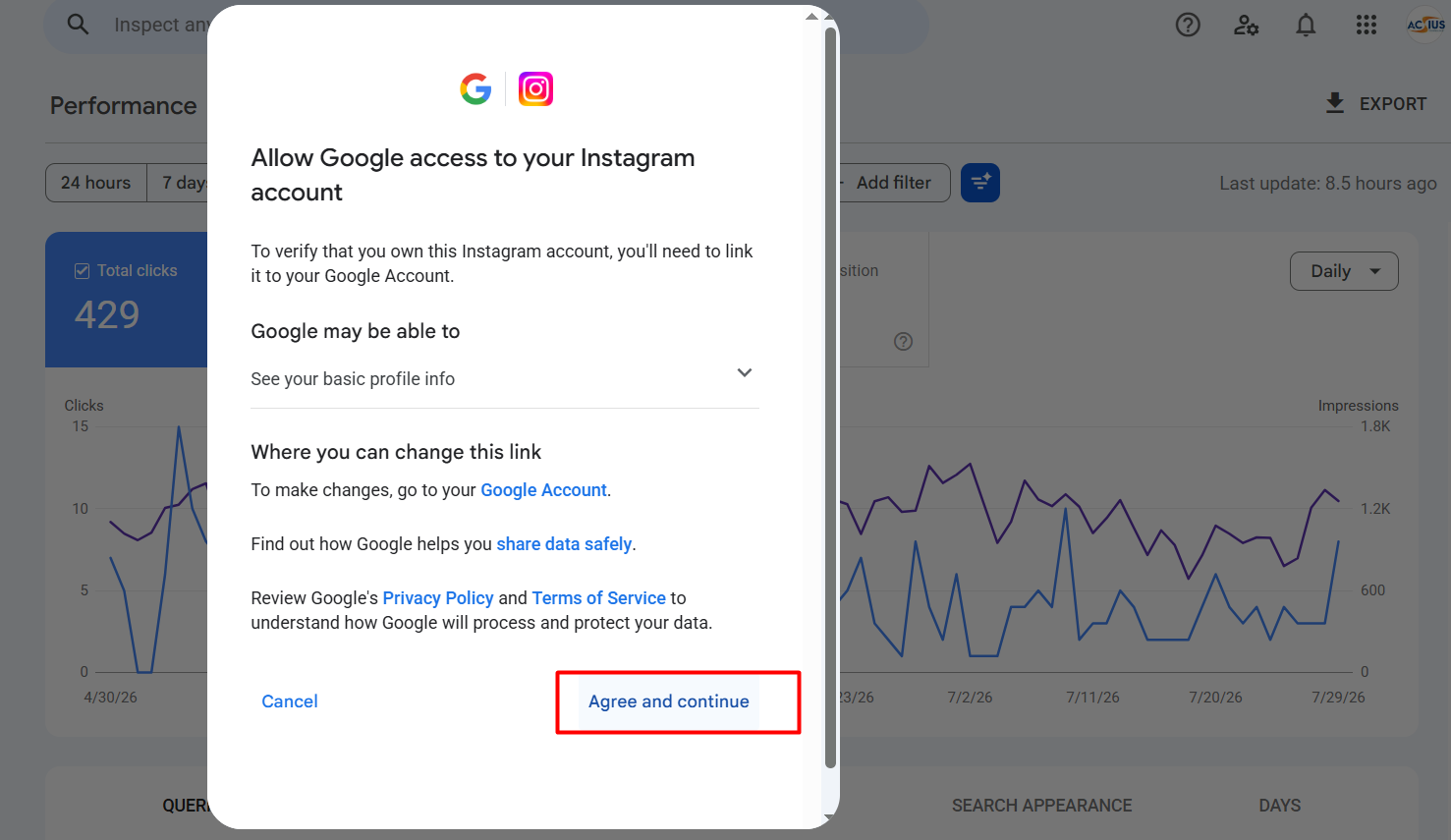
Google will redirect you to the selected platform.
You’ll be asked to:
- Sign in
- Grant the required permissions
- Confirm ownership of the account
This verification process helps ensure that only authorized users can access performance insights.
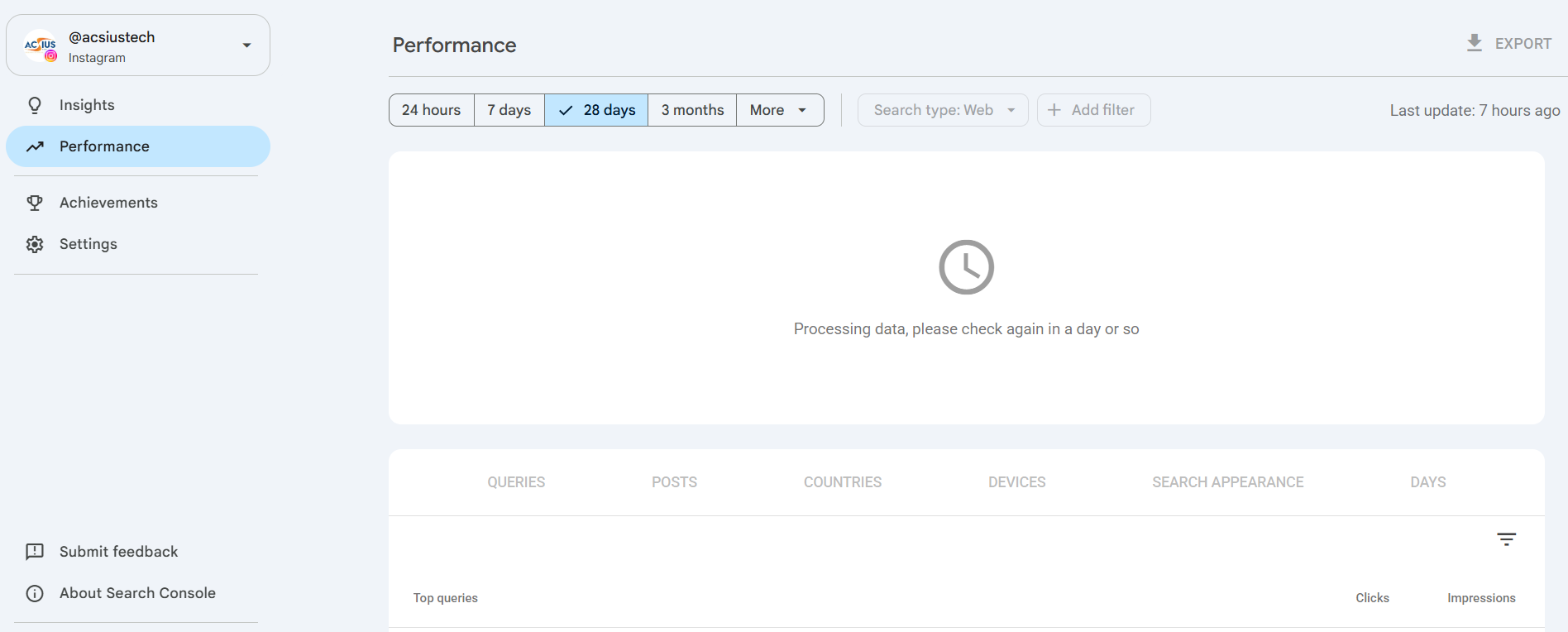
Step 5: Wait for Data Collection
Like traditional Search Console properties, data isn’t always available immediately.
Depending on the platform and account activity, performance reports may begin appearing after Google has processed sufficient data.
If you’re connecting a newly created social account, don’t expect instant reports. As your content gains visibility, the available insights will gradually become more meaningful.
Understanding the Available Reports
One of the biggest advantages of Platform Properties is that they present performance metrics in a format familiar to Search Console users.
If you’ve previously analyzed website traffic in GSC, you’ll already recognize many of these reports.
Let’s understand what each metric actually means.
Clicks
Clicks represent the number of times users selected your content after seeing it in Google Search.
For example:
Imagine someone searches for:
Google may display one of your YouTube videos.
If the user clicks the video, that interaction contributes to your click count.
Similarly, an Instagram Reel or TikTok video appearing in search results can generate clicks that contribute to your performance data.
Clicks remain one of the strongest indicators that your content is relevant to search intent.
Impressions
An impression is counted whenever your content appears in Google Search, regardless of whether someone clicks it.
Suppose your Instagram Reel appears for a search query.
Even if users don’t open it, Google still records an impression because your content was shown.
High impressions with low clicks often suggest an opportunity to improve titles, thumbnails, captions, or overall content appeal.
Click-Through Rate (CTR)
CTR measures how frequently people click after seeing your content.
The formula is simple:
CTR = Clicks ÷ Impressions × 100
For example:
- 1,000 impressions
- 120 clicks
CTR = 12%
A healthy CTR generally indicates that your content is attracting attention and aligns well with what users are searching for.
Average Position
Average Position estimates where your content typically appears within Google Search results.
Although rankings can fluctuate depending on the query and user context, this metric helps identify trends over time.
If your average position improves consistently, it’s often a sign that your content is becoming more visible.
Top Queries
This report answers one of the most valuable questions in digital marketing:
What are people actually searching for before they discover my content?
Instead of relying solely on keyword research tools, you gain real search data based on actual user behavior.
You may discover opportunities such as:
- Unexpected search terms
- New audience interests
- Emerging industry topics
- Seasonal trends
These insights can directly influence your future content strategy.
Top Content
This report highlights which posts, videos, or social content generate the strongest visibility.
Rather than guessing which content performs best, you’ll have data showing:
- Most viewed posts
- Highest-click videos
- Best-performing Reels
- Content attracting consistent impressions
This information helps marketers understand what resonates with their audience.
How Businesses Can Use Platform Properties
Many businesses still treat SEO and social media as completely separate marketing channels.
In reality, they increasingly support one another.
Here are several practical ways businesses can use Platform Properties to improve their digital strategy.
Measure Content Performance
Instead of evaluating success based only on likes or followers, businesses can understand how social content contributes to search visibility.
This shifts the focus from vanity metrics to meaningful discovery.
Discover New Content Opportunities
Suppose your Instagram posts about “AI SEO” receive significant search visibility.
That insight could inspire:
- A detailed blog article
- A webinar
- A YouTube tutorial
- A downloadable guide
One successful topic can be expanded across multiple content formats.
Improve Cross-Channel Marketing
High-performing social content can drive website traffic, while well-optimized website content can encourage visitors to engage with your social channels.
Rather than competing, these assets strengthen one another.
Understand Customer Interests
Search data often reveals questions customers ask before contacting your business.
By analyzing search queries, businesses can create content that answers those questions earlier in the buying journey.
This builds trust while improving organic visibility.
Why This Feature Matters for SEO Agencies
For agencies managing multiple client accounts, Platform Properties provide another layer of performance analysis.
Instead of reporting only website rankings, agencies can evaluate how social content contributes to search visibility.
This allows agencies to deliver more comprehensive digital marketing strategies.
At ACSIUS, we believe successful SEO is no longer limited to webpages. Modern optimization includes websites, videos, social media content, local business profiles, and AI-driven search experiences. Platform Properties reinforce this broader perspective by helping marketers connect search performance across multiple channels.
Social SEO Is Becoming a Competitive Advantage
The concept of Social SEO has grown rapidly over the past few years.
Search engines increasingly understand:
- Video content
- Social engagement
- Creator authority
- Brand mentions
- User-generated content
While backlinks, technical SEO, and quality content remain essential, businesses that consistently publish valuable content across multiple platforms often build stronger brand authority.
Platform Properties encourage marketers to evaluate this broader ecosystem instead of viewing each channel in isolation.
Common Mistakes to Avoid
As businesses begin using Platform Properties, avoid these common pitfalls:
Focusing Only on Followers
A large audience doesn’t automatically translate into meaningful search visibility.
Instead, pay attention to impressions, clicks, and the search queries driving discovery.
Ignoring Search Intent
Creating content solely to follow trends may generate short-term engagement, but long-term success depends on addressing real user needs.
Focus on solving problems, answering questions, and providing value.
Treating Every Platform the Same
Each platform serves a different audience and purpose.
A YouTube tutorial, an Instagram Reel, and a TikTok video shouldn’t all follow the same format.
Adapt your content while maintaining consistent messaging.
Forgetting Website Integration
Social media should complement your website—not replace it.
Guide interested users toward your website, service pages, resources, or contact forms to turn engagement into meaningful business results.
Platform Properties and the Future of AI Search
Search is no longer limited to blue links on a search engine results page. Over the past few years, AI-powered search experiences have transformed how people discover information. Google AI Overviews, conversational search, multimodal search, and AI assistants are changing user expectations.
Instead of clicking through multiple websites, users increasingly expect direct, trustworthy answers. To provide those answers, AI systems analyze information from a wide range of sources—not just websites, but also videos, images, social content, forums, and other publicly available resources.
This shift means businesses need to think beyond traditional SEO.
A strong website remains essential, but it’s no longer enough on its own. Brands that consistently publish valuable content across blogs, YouTube, Instagram, LinkedIn, and other trusted platforms are more likely to establish authority in their industry.
Google’s introduction of Platform Properties reflects this broader approach to digital visibility. It encourages businesses to see their website and social platforms as parts of one connected content ecosystem.
Building a Social SEO Strategy
Social SEO is not about replacing search engine optimization. Instead, it complements your existing SEO efforts by making your content easier to discover across multiple platforms.
A successful Social SEO strategy starts with understanding your audience. Identify the questions they ask, the platforms they use, and the types of content they engage with most.
For example, a digital marketing agency might publish:
- A detailed blog explaining a new Google update.
- A YouTube video demonstrating the feature.
- An Instagram carousel summarizing the key points.
- A LinkedIn article discussing business implications.
- A short video highlighting the most important takeaway.
Although the format changes, the core message remains consistent. This approach allows businesses to reach users wherever they prefer to consume information while reinforcing their expertise across channels.
How ACSIUS Recommends Using Platform Properties
At ACSIUS, we believe that modern SEO is about building a complete digital presence rather than focusing on rankings alone.
If you’re managing your own website or client projects, here’s a practical workflow we recommend:
-
Create Helpful Content First
Start by identifying genuine questions your audience is asking. Build comprehensive content that answers those questions clearly and accurately.
Helpful content is more likely to perform well in both traditional search and AI-powered search experiences.
-
Repurpose Content Across Platforms
Instead of creating completely different content for every channel, repurpose your existing resources.
For example:
- Convert a blog into a YouTube tutorial.
- Turn key insights into an Instagram carousel.
- Share quick tips through short-form videos.
- Publish expert commentary on LinkedIn.
This approach saves time while maximizing content reach.
-
Monitor Performance Regularly
Review Search Console data on a regular basis to identify:
- Which topics generate the most impressions.
- Which content receives the highest click-through rate.
- Which platforms drive the strongest visibility.
- Emerging search trends.
Use these insights to refine your content strategy rather than relying on assumptions.
-
Focus on User Intent
Don’t create content simply because a keyword has high search volume.
Instead, ask:
- What problem is the user trying to solve?
- What information are they looking for?
- What action are they likely to take next?
Content that satisfies user intent tends to perform better over the long term.
-
Keep Optimizing Existing Content
Many businesses publish content once and never revisit it.
Instead, review high-performing articles, videos, and social posts periodically. Update statistics, improve visuals, answer new questions, and expand sections where additional detail would benefit readers.
Regular updates help maintain relevance in a constantly evolving search landscape.
Best Practices for Maximizing Platform Properties
To get the most value from Platform Properties, consider the following best practices:
- Maintain consistent branding across your website and social profiles.
- Publish content on a regular schedule rather than in occasional bursts.
- Use descriptive titles and captions that accurately reflect the content.
- Encourage users to engage with valuable, informative content rather than relying on clickbait.
- Monitor performance trends over time instead of reacting to daily fluctuations.
- Use insights from Search Console to guide future content planning.
- Integrate website and social content into a unified marketing strategy.
Most importantly, prioritize quality over quantity. A smaller number of genuinely helpful posts will usually outperform a large volume of low-value content.
Frequently Asked Questions
Final Thoughts
Google Search Console has long been one of the most valuable tools for understanding website performance. The introduction of Platform Properties expands its role by acknowledging that digital visibility now extends beyond websites.
Businesses today compete across multiple platforms. Customers discover brands through blog articles, videos, social media posts, and AI-generated search experiences. Understanding how these channels work together is becoming increasingly important.
Platform Properties won’t replace your existing SEO strategy, but they provide another valuable source of insight that can help shape smarter content decisions.
For businesses that invest in educational content, thought leadership, and consistent publishing, this feature offers an opportunity to better understand audience behavior and strengthen long-term online visibility.
As search continues to evolve, the businesses that succeed will be those that focus less on individual platforms and more on creating helpful, trustworthy content wherever their audience is searching.
At ACSIUS, we believe the future of digital marketing lies in combining technical SEO, high-quality content, AI Search Optimization (AISO), and Social SEO into one integrated strategy. Businesses that embrace this holistic approach today will be better positioned to grow their visibility in the years ahead.
Ready to Future-Proof Your SEO Strategy?
Google Search is evolving rapidly, and businesses that adapt early gain a competitive advantage. Whether you’re looking to improve your website’s search visibility, strengthen your content strategy, or prepare for AI-powered search experiences, the right SEO approach makes all the difference.
ACSIUS helps businesses combine Technical SEO, Content Marketing, AI Search Optimization, and Social SEO into a single growth strategy. If you’re ready to stay ahead of the latest Google updates, our team is here to help.
👉 Contact ACSIUS today for a personalized SEO consultation and discover how we can help your business grow in the AI-first era.
