

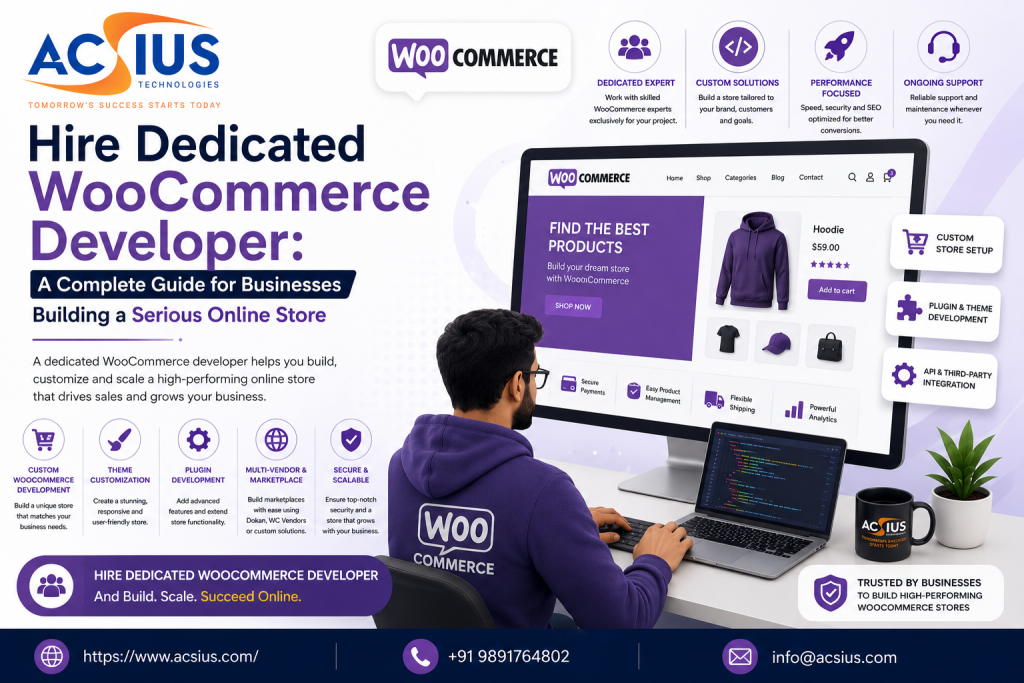
Running a WooCommerce store sounds simple on paper — install the plugin, pick a theme, add products, and start selling. In practice, most businesses hit a ceiling fairly quickly. Checkout flows break under real traffic, plugins conflict with each other, page speed drags as the catalog grows, and customizations that seemed straightforward turn into weeks of trial and error. This is usually the point where a business realizes it needs more than a freelancer working evenings between other gigs — it needs to hire a dedicated WooCommerce developer who treats the store as a serious, ongoing responsibility.
ACSIUS works with businesses at exactly this stage of growth. Beyond WooCommerce, the team also supports broader WordPress development and Shopify development, which means businesses get guidance on the right platform for their specific situation rather than a one-size-fits-all pitch. This article covers what dedicated WooCommerce development actually involves, how it compares to other platform options, what to look for in a development partner, and answers to the questions businesses ask most often before hiring.
Why WooCommerce Remains a Strong Choice for Serious Online Stores
WooCommerce isn’t just a plugin — it’s one of the most widely used e-commerce platforms in the world, built on top of WordPress’s flexible, and open-source foundation. That combination gives businesses a level of control that hosted platforms often can’t match.
Businesses tend to choose WooCommerce when they need:
- Full ownership of their store’s code, data, and hosting environment
- Deep content marketing integration, since WordPress handles blogging and SEO content natively
- Highly specific product configurations that off-the-shelf platforms struggle to support
- Long-term cost control, since there’s no mandatory monthly platform fee beyond hosting and extensions
That said, WooCommerce’s flexibility is a double-edged sword. The same openness that allows extensive customization also means a poorly built store can become slow, insecure, and difficult to maintain. This is precisely why the developer behind the build matters as much as the platform itself.
What “Dedicated WooCommerce Developer” Actually Means
The phrase gets thrown around loosely in the industry, so it’s worth clarifying what a genuine dedicated engagement looks like — and why it differs from hiring a general freelancer or a large, impersonal agency.
Full Attention on Your Store
A dedicated developer works specifically on a client’s project during agreed hours, rather than splitting focus across a dozen unrelated projects. This matters because WooCommerce troubleshooting often requires sustained focus — a developer jumping between five different codebases in a day is far more likely to miss subtle issues than one who’s fully immersed in a single project.
Direct Communication, Not a Support Ticket Queue
With a dedicated model, businesses typically get direct access to the developer or a small, consistent team — rather than routing every question through a generic support inbox and waiting days for a response. ACSIUS structures its engagements around this kind of direct access specifically because WooCommerce issues are often time-sensitive, especially during high-traffic sales periods.
Scalable Without Long-Term Risk
Businesses can adjust the scope of a dedicated developer engagement based on current needs — ramping up during a major redesign or sale season, and scaling back during quieter periods — without the legal and financial complexity of hiring and letting go of full-time staff.
Common WooCommerce Problems That Require Real Expertise
Understanding why dedicated development matters is easier when looking at the specific problems it solves.
Page Speed That Degrades as the Catalog Grows
WooCommerce stores are notorious for slowing down as product counts, images, and installed plugins increase. A skilled developer addresses this through database optimization, image handling strategies, caching configuration, and careful plugin selection — rather than simply adding more server resources as a band-aid fix.
Plugin Conflicts
WooCommerce’s extensibility comes from its plugin ecosystem, but plugins built by different developers don’t always play well together. Conflicts can silently break checkout functionality, corrupt order data, or introduce security gaps. Experienced developers know how to identify and resolve these conflicts, and often how to avoid them in the first place through careful plugin vetting.
Custom Product and Pricing Logic
Businesses with subscription models, tiered pricing, bundled products, or region-specific pricing often find that default WooCommerce functionality isn’t enough. Custom development bridges this gap, but it requires a developer who understands WooCommerce’s underlying data structure well enough to extend it safely.
Payment Gateway and Tax Complexity
Different markets require different payment gateways, currencies, and tax handling rules. Getting this wrong doesn’t just create a poor customer experience — it can create real compliance issues. A dedicated developer familiar with these requirements builds this complexity in correctly from the start.
Security Vulnerabilities
E-commerce stores are frequent targets for attacks, given the financial data involved. Outdated plugins, weak access controls, and unpatched vulnerabilities are common entry points. Professional WooCommerce development includes ongoing security maintenance, not just a one-time setup.
How ACSIUS Approaches Dedicated WooCommerce Development
ACSIUS’s approach centers on treating each WooCommerce store as a long-term business asset rather than a one-time build.
Discovery Before Development
Before writing any code, the team invests time understanding the business model, product catalog complexity, expected traffic patterns, and growth plans. This shapes decisions around hosting, plugin selection, and custom development scope — decisions that are far harder to reverse once a store is live.
Clean, Maintainable Code
Custom functionality is built with future maintainability in mind, avoiding the kind of tangled, undocumented code that becomes a liability the moment the original developer is unavailable. This matters enormously for WooCommerce stores, since businesses often need ongoing adjustments long after initial launch.
Performance as a Core Deliverable, Not an Afterthought
Rather than treating speed optimization as a separate project down the line, ACSIUS builds performance considerations into the development process from the start — efficient database queries, optimized image handling, and careful plugin selection all factor into the initial build.
Ongoing Support and Maintenance
A store doesn’t stop needing attention after launch. WordPress core updates, plugin updates, security patches, and seasonal adjustments all require continued oversight. ACSIUS structures its dedicated engagements to include this ongoing relationship rather than disappearing after delivery.
Hire Professional WordPress Developers: The Broader Foundation
WooCommerce runs on WordPress, which means a poorly built WordPress foundation limits what even the best WooCommerce customization can achieve. This is why many businesses looking to hire dedicated WooCommerce developers also need to hire professional WordPress developers who understand the platform at a deeper architectural level.
Professional WordPress development goes beyond installing themes and plugins. It involves:
- Custom theme development tailored to brand and functionality needs
- Careful plugin architecture that avoids bloat and conflicts
- Security hardening beyond default WordPress settings
- Performance optimization at the server and code level, not just surface-level caching
ACSIUS applies the same standards to WordPress projects broadly as it does to WooCommerce specifically — because a WooCommerce store is, at its core, a specialized WordPress build, and the underlying platform quality determines how well the e-commerce layer performs.
When Shopify Might Be the Better Fit
Not every business belongs on WooCommerce, and a genuinely helpful development partner should be honest about that. This is where ACSIUS’s ability to also hire professional Shopify developers becomes valuable — the team can guide businesses toward the right platform rather than pushing WooCommerce simply because that’s the immediate request.
Shopify tends to be a better fit for businesses that want:
- A more managed hosting environment with less server-level responsibility
- Faster initial setup for straightforward product catalogs
- Built-in scalability without needing to manage hosting infrastructure directly
WooCommerce tends to be the stronger choice for businesses that want:
- Full ownership and control over code, data, and hosting
- Deep integration between content marketing and the storefront
- Highly specific, complex product or pricing configurations that off-the-shelf platforms struggle to support
- Long-term cost predictability without recurring platform subscription fees
ACSIUS’s consultative approach means this decision gets made based on the business’s actual needs, not on which platform happens to be easiest to sell.
What to Evaluate Before Hiring a WooCommerce Developer
A few consistent evaluation criteria help separate a genuinely capable partner from one that simply looks capable on the surface.
-
Relevant Portfolio Evidence
Ask for examples of WooCommerce stores comparable in complexity to your own — a developer experienced with simple, low-SKU stores may struggle with a business running thousands of products, complex variations, or subscription models.
-
Clear Process and Communication
A reliable developer explains their approach to testing, staging environments, and deployment — rather than making changes directly on a live store, which risks costly downtime and lost sales.
-
Security-First Thinking
Ask specifically how security is handled: update schedules, backup protocols, and access control practices. A developer who can’t answer this clearly is a risk regardless of how polished their portfolio appears.
-
Performance Track Record
Request specifics on how past projects handled scaling — page speed benchmarks, caching strategies, and database optimization approaches all indicate whether a developer thinks beyond the initial launch.
-
Transparent Contract Terms
Clarity around hours, deliverables, revision policies, and intellectual property ownership protects both sides and prevents disputes later in the relationship.
E-E-A-T and Technical Hiring: Why It Applies Here Too
While Experience, Expertise, Authoritativeness, and Trustworthiness is typically discussed in the context of content and search visibility, the same framework is genuinely useful when evaluating a development partner. A business is trusting a developer with its revenue-generating storefront — a decision that deserves the same scrutiny as evaluating any other high-stakes vendor relationship.
ACSIUS reflects these principles in its WooCommerce engagements by:
- Assigning developers with demonstrable, verifiable WooCommerce and WordPress experience
- Maintaining clear documentation throughout the development process
- Avoiding unrealistic promises around timelines or guaranteed outcomes
- Providing continued support rather than one-time, disconnected delivery
This matters because the cost of a poorly built or poorly maintained store extends well beyond the initial development budget — lost sales during downtime, security incidents, and expensive rebuilds all tend to compound over time when the foundation wasn’t solid to begin with.
Common Mistakes Businesses Make When Hiring WooCommerce Talent
A few recurring mistakes tend to cause the most long-term pain.
- Prioritizing the lowest price — cheaper developers often cut corners on security, testing, or documentation, costs that surface later in more expensive ways
- Skipping a staging environment — changes tested directly on a live store risk downtime and lost revenue during the testing process itself
- Underestimating plugin bloat — installing too many plugins without a clear strategy is one of the most common causes of slow, unstable stores
- Ignoring post-launch maintenance planning — a store needs ongoing updates and monitoring, not a single handoff and no further contact
- Choosing a generalist over a specialist — a developer skilled in general web development isn’t automatically equipped to handle WooCommerce’s specific quirks and data structure
ACSIUS’s engagement model is built specifically to address these risk points from the outset rather than leaving them to be discovered the hard way.
Final Thoughts
Deciding to hire a dedicated WooCommerce developer is ultimately about protecting a business’s most important digital asset — its storefront. That decision often extends naturally into related needs, whether that’s broader WordPress development expertise or an honest conversation about whether Shopify might actually be the better long-term fit.
ACSIUS approaches these engagements with the same foundation across every platform: genuine technical expertise, transparent communication, and a commitment to building something that holds up well beyond launch day. For businesses evaluating where to hire dedicated WooCommerce, WordPress, or Shopify talent, the most important question isn’t which option sounds fastest or cheapest — it’s which partner can be trusted to build something that keeps working as the business grows.
FAQs
How long does it typically take to build a custom WooCommerce store?
Timelines vary significantly based on complexity, but a straightforward store with standard functionality might take four to six weeks, while highly customized builds with subscriptions, complex pricing, or extensive integrations can take considerably longer. A reliable developer should provide a realistic estimate after understanding your specific requirements.
Is WooCommerce a good choice for a large product catalog?
Yes, but it requires careful technical planning around database optimization, hosting infrastructure, and caching strategy. Without this planning, large catalogs can significantly slow down store performance, which is why experienced development matters more as catalog size increases.
What's the difference between hiring a WooCommerce developer and a general WordPress developer?
WooCommerce has its own data structures, plugin ecosystem, and e-commerce-specific considerations like payment gateways, tax handling, and inventory management. A general WordPress developer may not have deep familiarity with these specifics, even if they're skilled at WordPress development broadly.
Should I choose WooCommerce or Shopify for my business?
It depends on your priorities. WooCommerce offers greater control, customization depth, and long-term cost predictability, while Shopify offers a more managed environment with less server-level responsibility. A good development partner should help evaluate this based on your specific business needs rather than pushing one platform by default.
How much does it cost to hire a dedicated WooCommerce developer?
Costs vary based on project complexity, developer experience level, and engagement structure (hourly versus project-based). It's generally more useful to evaluate cost in the context of value delivered and long-term reliability, rather than comparing hourly rates alone.
Can an existing WooCommerce store be migrated to a new developer without starting over?
In most cases, yes. An experienced developer can review the existing codebase, identify what can be retained versus what needs rebuilding, and migrate the store without necessarily starting from scratch, though the scope depends on the current state of the code.
What ongoing maintenance does a WooCommerce store actually need?
Regular maintenance typically includes WordPress core and plugin updates, security monitoring, performance checks, and periodic backups. Skipping ongoing maintenance significantly increases the risk of security vulnerabilities and performance degradation over time.
How do I know if my WooCommerce store has performance issues that need fixing?
Common signs include slow page load times, especially on product and checkout pages, high cart abandonment rates, and noticeable slowdowns during traffic spikes. A technical audit from an experienced developer can identify the specific causes and recommend targeted fixes.
Does ACSIUS only work with WooCommerce, or can they help with WordPress and Shopify projects too?
ACSIUS supports WooCommerce, broader WordPress development, and Shopify development, allowing businesses to get honest guidance on the right platform for their needs rather than being steered toward a single option regardless of fit.
