

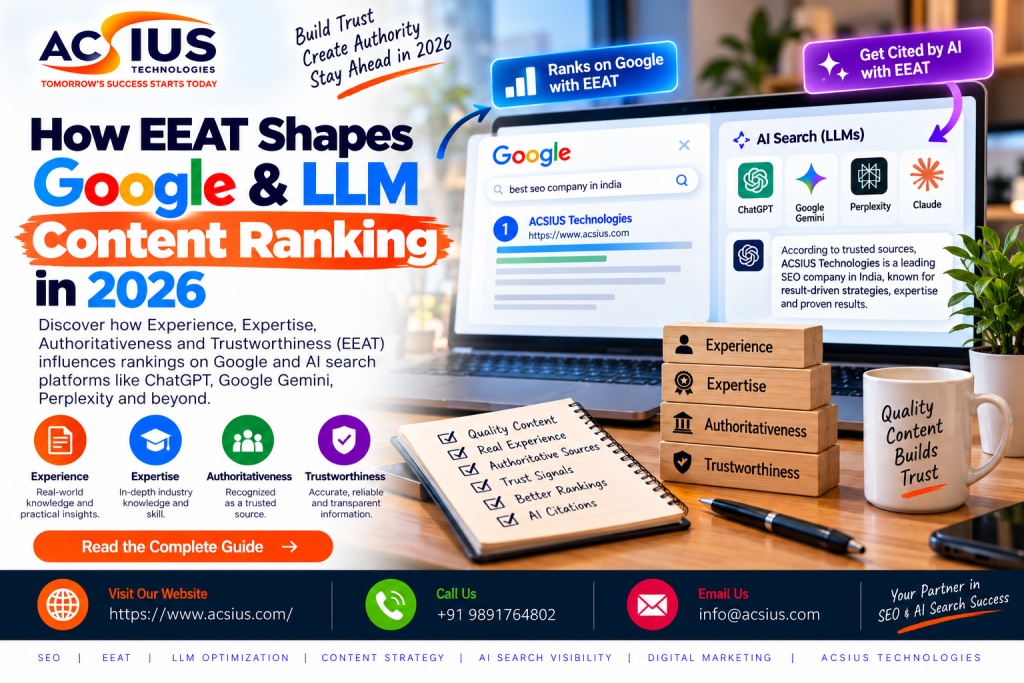
Search has changed more in the last three years than in the ten before them. Google now answers many queries with AI Overviews, and ChatGPT, Perplexity, Gemini, and Copilot answer questions directly without sending anyone to a results page. In this environment, one question decides which brands get seen: why should anyone, human or machine, trust your content? That question is what EEAT (Experience, Expertise, Authoritativeness, and Trustworthiness) is built to answer.
For years, marketers treated EEAT as a checklist for medical and financial websites. In 2026 it is the foundation of visibility everywhere. Google’s systems reward content that shows real-world knowledge, and large language models (LLMs) are more likely to cite sources that look credible, consistent, and verifiable. Businesses investing in AI SEO Services India are already seeing that optimizing for traditional rankings and AI-generated answers means building the same thing: demonstrable trust.
What EEAT Really Means in 2026
EEAT comes from Google’s Search Quality Rater Guidelines, the document human raters use to judge whether search results meet user needs. The original E-A-T framework (Expertise, Authoritativeness, Trustworthiness) gained a second “E” for Experience in late 2022. The addition recognized that a person who has actually used a product, visited a place, or handled a situation often gives more useful information than someone who only researched it.
Each element has a distinct meaning. Experience is first-hand involvement with the topic. Expertise is the depth of knowledge or skill behind the content. Authoritativeness is the reputation of the author, the brand, and the website in its field. Trustworthiness is the accuracy, transparency, honesty, and safety of the page and the business. Google’s guidelines say trust is the most important of the four, and the other three feed into it. A page can be well written and still fail if the reader cannot tell who is behind it or whether it is reliable.
Trust is also concrete and local. A plumber in Ghaziabad, a dental clinic in Noida, and a coaching institute in Delhi all build it through visible signals: a real address, consistent business details across the web, genuine customer reviews, and clear contact information. This is why businesses that serve a specific geography rely on local seo services India to keep their name, address, phone number, and reputation signals consistent across Google Business Profile, directories, and their own website. For a local searcher, and increasingly for an AI assistant answering “best dentist near me,” that consistency reads as proof that the business exists and can be trusted.
Is EEAT Actually a Ranking Factor?
Google has said many times that EEAT is not a single ranking factor and there is no “EEAT score” attached to your pages. Rather, EEAT is a framework that describes what Google’s ranking systems try to reward. Those systems use many signals to estimate which content is helpful, reliable, and created for people rather than for search engines.
The distinction matters because it changes how you should work. You cannot add a plugin to raise your EEAT. You have to build the underlying qualities the framework describes and make them visible. Google’s helpful content guidance, now part of its core ranking systems, points the same way: original information, clear sourcing, demonstrated experience, and a satisfying experience for the reader.
There is one more nuance. EEAT matters more on some topics than others. Google groups these as “Your Money or Your Life” (YMYL) topics: health, finance, legal advice, safety, and news. A wrong answer in these areas can harm someone, so the bar is higher. A recipe blog and a page about medication dosage do not need the same level of proof, but the direction is identical. Better evidence and clearer accountability win.
How Google Evaluates EEAT Signals
Google cannot read a page and “feel” its credibility, so its systems rely on measurable proxies. Some are on the page: author names and bios, cited sources, original images, publication and update dates, and depth of coverage. Others are off the page: mentions from reputable sites, links from relevant publications, reviews, brand searches, and the wider reputation of the entity behind the content.
Technical and structural factors also count. Secure hosting, a clean layout without deceptive ads, clear policies, and structured data that helps search engines understand who wrote what and which organization published it all contribute. Because these signals span content, technical health, and off-page reputation, many brands work with the Best SEO Services India providers to audit all three areas together rather than fixing them in isolation. A single weak layer, like an anonymous blog with no author identity or a site with inconsistent business details, can undermine strong content elsewhere.
The takeaway is that Google evaluates the whole ecosystem around a page. The content is the visible part of an iceberg, and the reputation of the site, the author, and the brand sits underneath it.
Experience: The Signal AI Cannot Fake
The extra “E” has become the most strategically important in 2026, because generative AI can produce competent, generic content at almost no cost. What it cannot produce is real experience: the details that come only from actually doing something.
Content that demonstrates first-hand experience tends to include original photos or screenshots, specific numbers from real projects, honest mentions of what did not work, and observations a researcher wouldn’t find in existing top-ranking pages. A product review that says “the battery lasted 9 hours in my testing, but the fan got loud during video calls” carries more weight than one that restates the spec sheet.
To show experience on your pages:
- Use original visuals, such as screenshots, photos, and diagrams from your own work.
- Include case studies with real outcomes, including limits and lessons.
- Write in the first person where it is honest to do so (“we tested,” “in our audit”).
- Add process detail, like the tools used, timeframes, and decisions made.
- Answer the follow-up questions a genuine practitioner would know a reader will have.
Experience is also the hardest signal for competitors to copy, which makes it a durable advantage.
Expertise and Authoritativeness: Who Is Speaking?
Expertise asks whether the creator knows the subject. Authoritativeness asks whether others recognize that. The two work together, and both depend on identity. Anonymous content is at a structural disadvantage, since neither Google nor an LLM can connect it to a real body of knowledge.
Practical steps start with visible authorship. Every substantive article should name its author and link to a bio that states credentials, experience, and areas of focus. The author’s presence should extend beyond your site: a LinkedIn profile, speaking appearances, guest articles, and citations by other professionals all strengthen the entity behind the words. Use Person and Organization schema markup to make these connections machine-readable.
Authoritativeness is largely earned externally. Links and mentions from respected publications, industry associations, and other experts in your field act as third-party endorsements. This is why digital PR, original research, and contributions to industry conversations are now core parts of an SEO plan rather than optional extras. One well-cited original study can do more for perceived authority than dozens of generic blog posts.
Trustworthiness: The Center of the Framework
Trust is the layer where everything is confirmed or contradicted. A site can have experienced authors and strong links, but if it hides its ownership, publishes inaccurate claims, or makes refunds impossible, trust collapses.
Strong trust signals include:
- Clear “About” and “Contact” pages with real people and real addresses
- Transparent editorial policies and a visible process for corrections
- Accurate, up-to-date information with sources cited for claims
- Secure browsing (HTTPS), transparent privacy policy, and clear terms
- Genuine reviews and testimonials, including how you respond to criticism
- Honest disclosure of affiliate relationships, sponsorships, and AI assistance where relevant
Accuracy deserves special attention. AI-assisted content pipelines can introduce confident-sounding errors at scale. A strong editorial review process, in which a qualified human checks facts, statistics, and claims before publication, protects the trust you have spent years building.
How LLMs Decide Which Sources to Trust
LLMs do not rank pages the way search engines do, but they still make choices about what to surface and cite. Systems that use retrieval, such as AI Overviews, Perplexity, and ChatGPT with search, first fetch relevant documents and then generate an answer from them. Which documents get fetched and cited depends on relevance, clarity, and signals of reliability, and those overlap heavily with EEAT.
Models also learn patterns during training. Brands and authors that appear frequently and consistently across reputable sources become familiar entities, so the model associates them with certain topics. If your company is regularly mentioned alongside “technical SEO” in credible places, that association strengthens. If your name appears inconsistently or only on your own site, the model has little to go on.
No public formula exists for how each AI product picks sources, and behavior differs between platforms and changes often, so treat any claim of a guaranteed method with caution. What can be said with confidence is that clear, well-sourced, entity-consistent content from recognizable authorities is easier for these systems to use and more likely to be quoted.
Structuring Content So Both Search Engines and AI Can Use It
Trust has to be legible. Even excellent content can lose out if its structure makes the key information hard to extract. In 2026, writing for both search engines and LLMs means writing in a way that is easy to parse and quote.
Good practices include:
- Answer first. Put a direct, concise answer near the top of each section, then expand with detail.
- Use descriptive headings that match how people phrase questions.
- Keep paragraphs focused on a single idea so passages can stand alone when extracted.
- Define terms plainly the first time you use them.
- Use lists and tables for steps, comparisons, and specifications.
- Add schema mark up (Article, Organization, Person, FAQ, Local Business, and Product) to clarify the entities and relationships on the page.
- Show dates for publication and meaningful updates.
Think of each section as a piece that could be lifted out and shown to a user without context. If it still makes sense and is clearly attributed, it is well built for the AI era.
Building Entity Authority Across the Web
Search engines and LLMs increasingly think in terms of entities: distinct, identifiable things like brands, people, products, and places. Your goal is for your brand to be a clear, well-understood entity with a consistent identity and a recognized area of expertise.
This starts with consistency. Use the same brand name, description, and key facts everywhere: your website, social profiles, business listings, press mentions, and directory entries. Claim and complete your Google Business Profile. Create or maintain profiles on relevant industry platforms. Where appropriate and eligible, ensure knowledge sources like Wikidata or Wikipedia represent you accurately, without attempting to manipulate them.
Then reinforce the association between your entity and your topics. Publish in-depth content on a defined subject area, get mentioned in publications that cover it, and earn citations from experts. Over time, both search algorithms and language models come to link your brand with that expertise. This slow-building asset is far harder to replicate than any single optimized page.
Content Quality in the Age of AI-Generated Text
Google has stated that using AI to produce content is not against its guidelines in itself. What it targets is content created primarily to manipulate rankings, regardless of how it was produced. Its spam policies specifically cover scaled content abuse: mass-producing low-value pages with little original input.
The practical lesson is that AI is a tool for drafting, research, and organization, and not a substitute for judgment and experience. The winning workflow in 2026 typically looks like this: a subject expert defines the angle and supplies real insights, AI assists with outlines or first drafts, and a human editor verifies facts, adds original examples, sharpens the voice, and takes accountability for the final piece.
Ask of every page: what does this add that the top ten results don’t? If the answer is nothing, the page is unlikely to earn strong rankings or AI citations, however polished the prose. Original data, unique frameworks, honest opinions backed by evidence, and first-hand stories are the differentiators.
A Practical EEAT Checklist for 2026
Use this checklist to audit your own site:
Experience
- Do key pages include original images, data, or case examples?
- Does the content reflect real, hands-on involvement?
Expertise
- Does every article have a named author with a detailed bio?
- Is content reviewed by qualified professionals on sensitive topics?
Authoritativeness
- Are reputable third-party sites mentioning or linking to you?
- Is your brand consistently described across platforms?
Trustworthiness
- Are contact details, policies, and ownership clear?
- Are claims sourced and dates current?
- Are reviews genuine and responses professional?
Technical and structural
- Is the site secure, fast, and free of intrusive ads?
- Is schema markup implemented and validated?
- Are pages structured with clear headings and direct answers?
Work through the list section by section, fix the biggest gaps first, and re-audit every quarter.
Common EEAT Mistakes to Avoid
Several errors appear again and again. The first is treating EEAT as decoration: adding an author box without any real credentials behind it accomplishes nothing. The second is publishing anonymous or generic content, which offers no reason to trust it. The third is neglecting off-site reputation, focusing only on your own pages while ignoring reviews, mentions, and listings.
Other mistakes include letting information go stale, hiding commercial relationships, using fake or incentivized reviews, publishing unreviewed AI output, and making exaggerated claims that a knowledgeable reader would question. Each of these damages trust, and trust is slow to build and quick to lose. A single high-profile inaccuracy or a wave of suspicious reviews can set progress back significantly.
Measuring EEAT Progress
Because there is no EEAT score, measurement relies on indirect indicators. Track branded search volume and growth in direct traffic, which reflect rising recognition. Monitor the quantity and quality of referring domains and brand mentions. Watch review volume, ratings, and sentiment. Look at engagement metrics like time on page and return visits, and at rankings and impressions for your priority topics in Search Console.
For AI visibility, check manually and regularly whether your brand is cited in AI Overviews and in answers from ChatGPT, Perplexity, and Gemini for your key queries. Record which sources appear, what they say about you, and whether the information is accurate. Several tools now track AI citations, though their methods vary in reliability, so use them as directional and not definitive. Combine these signals into a simple quarterly report and you will see whether your credibility is compounding.
Final Thoughts
EEAT is no longer a niche concern for sensitive industries. It is the shared language of Google’s ranking systems and the AI assistants reshaping how people find answers. Content that shows real experience, comes from identifiable experts, is backed by a strong reputation, and is honest and easy to verify wins in both worlds.
Building that foundation is a long-term project spanning content, technical SEO, brand reputation, and local presence. If you want expert help turning these principles into results, ACSIUS can help you audit your EEAT signals, strengthen your authority, and prepare your content for both search engines and AI-driven discovery in 2026 and beyond.
FAQs
Does EEAT apply to AI chatbots like ChatGPT, or only to Google search?
EEAT principles increasingly apply to both. AI systems draw on similar trust and quality signals when selecting which sources to reference, cite, or represent favorably in their training data and real-time responses.
Can AI-generated content ever rank well or get cited by AI systems?
Yes, but it generally needs genuine human oversight, fact-checking, original insight, and editing to meet the same quality and trust standards expected of human-created content, rather than being published unedited.
How important are author credentials for EEAT?
Very important, especially for YMYL topics like health, finance, and legal advice, where formal credentials and demonstrated expertise carry significant weight in how trustworthy content appears.
Does EEAT matter for small, local businesses?
Yes. As AI systems and local search increasingly overlap, trust signals like authentic reviews, transparent business information, and accurate content matter for local visibility just as they do for larger websites.
How long does it take to see ranking improvements from strengthening EEAT signals?
This varies significantly, but genuine EEAT improvements — like building topical authority and earning quality backlinks — typically take months to show measurable results, since they depend on Google and AI systems recognizing consistent, sustained quality over time.
Can backlinks alone establish authoritativeness without other EEAT elements?
No. While backlinks remain valuable, they work best alongside genuine expertise, accurate content, and trustworthy business practices, rather than as a standalone signal.
Do customer reviews count toward EEAT for local businesses?
Yes, authentic customer reviews serve as a trust and credibility signal that influences both traditional local search rankings and how AI systems evaluate local business recommendations.
Should businesses prioritize traditional SEO or AI-specific optimization in 2026?
Both approaches increasingly overlap, since the same EEAT principles that support traditional search rankings also influence how AI systems evaluate and cite content, making a unified strategy more effective than treating them as separate efforts.
What's the single most important EEAT element to focus on first?
Trustworthiness is generally considered the foundation, since even genuinely expert content can be undermined by security issues, inaccurate information, or a lack of transparency, making it a sensible starting point for improvement efforts.
