
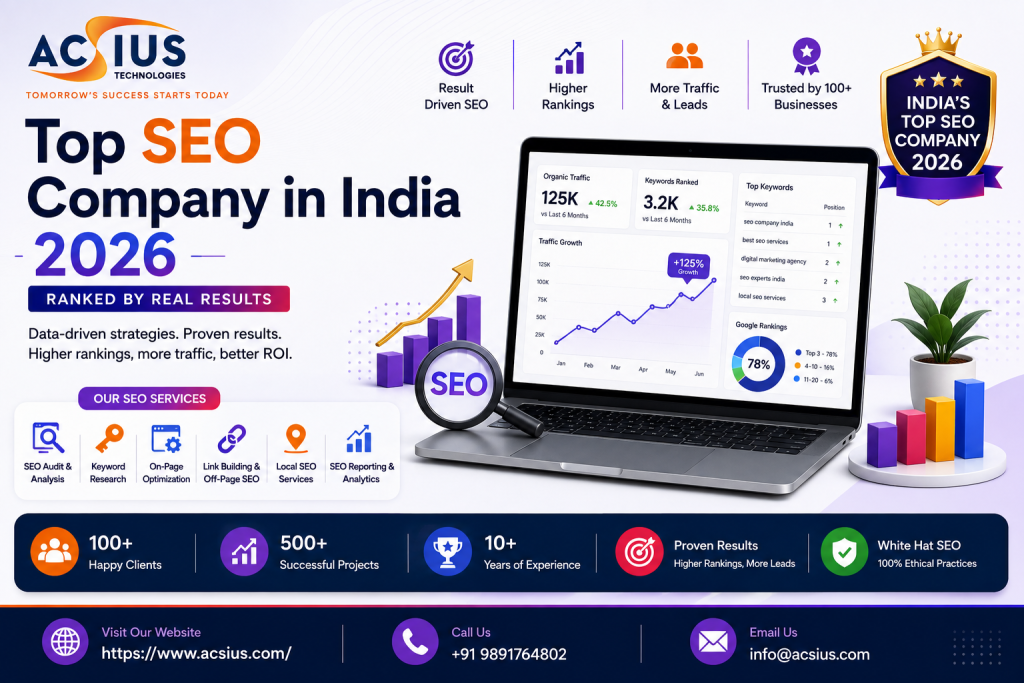
Search engine optimization has stopped being a nice to have line item in a marketing budget. In 2026, it has become the single biggest lever businesses pull when they want predictable, compounding growth from organic channels. Google’s algorithm has matured into something closer to an answer engine than a link directory, AI-generated overviews now sit above the fold on most queries, and voice and visual search have quietly become mainstream habits rather than novelties. Against this backdrop, choosing the right SEO partner is no longer about who promises the most keywords ranked on page one — it’s about who can actually move revenue, leads, and brand visibility in a search landscape that rewrites its own rules every few months.
This is exactly why ranked by real results matters more than ever. Anyone can show a screenshot of a keyword sitting at position one. Far fewer agencies can show a client’s organic revenue graph climbing quarter after quarter, or a local business doubling its footfall because it finally showed up correctly on Google Maps. When we talk about the top SEO Company in India for 2026, we’re talking about outcomes that survive an algorithm update, not vanity metrics that evaporate the moment Google tweaks its ranking signals. If you’re comparing agencies right now, it’s worth starting your shortlist with a genuinely capable Best seo company India team that has already adapted its playbook to the AI-first search era, rather than one still running a 2019 checklist.
Why the SEO Game Changed Completely by 2026
A few years ago, ranking well mostly meant good on-page optimization, a healthy backlink profile, and reasonably fast page speed. That formula still matters, but it’s no longer sufficient on its own. Three shifts have redefined what “good SEO” looks like today:
- AI Overviews and generative search results now sit above organic listings. Businesses that only optimize for traditional blue links are missing a huge chunk of visibility that AI-generated summaries now capture. Structuring content so it can be pulled into these summaries — clear entities, direct answers, well-labeled data — has become its own discipline.
- Search intent has become hyper-specific. People no longer type best restaurant Delhi. They ask conversational, long-tail questions the way they’d ask a friend. Content that doesn’t map to genuine intent gets buried, no matter how many keywords are stuffed into it.
- E-E-A-T (Experience, Expertise, Authoritativeness, Trust worthiness) is now enforced algorithmically, not just as a guideline. Google’s systems are far better at detecting thin, AI-spun content versus content written by someone who has actually done the thing they’re writing about. Real case studies, author credentials, and original data now carry more weight than generic blog filler.
Any agency claiming to be a market leader in 2026 has to be fluent in all three of these shifts simultaneously — not bolt AI on as an afterthought.
What Real Results Actually Means
Before ranking or recommending any agency, it helps to define the yardstick. Real results generally show up across five measurable areas:
- Organic traffic growth that holds steady, not a temporary spike followed by a decline after the agency stops actively managing the account.
- Keyword rankings for commercially relevant terms, not just easy, low-competition phrases that nobody actually searches for.
- Conversion and lead quality, because traffic without business impact is a vanity number.
- Local visibility and map pack presence for businesses that depend on nearby customers.
- Technical health of the website — crawlability, Core Web Vitals, structured data — because none of the above works on a broken foundation.
Agencies that can be transparent about all five, with client-facing dashboards and honest reporting (including the months growth was flat), tend to be the ones businesses stick with for years rather than months.
The Shift Toward Full-Funnel SEO Services
Standalone SEO — just link building and a few blog posts a month — is losing relevance. What’s replacing it is a more integrated approach that treats organic search as one channel inside a bigger growth engine, alongside content marketing, conversion rate optimization, and paid media retargeting. Businesses evaluating providers should look closely at how comprehensive their SEO Services India offering actually is — whether it stops at technical audits and backlinks, or extends into content strategy, UX recommendations, and ongoing performance testing that ties search visibility to actual pipeline.
This full-funnel mindset matters because ranking well for a keyword is only step one. If the landing page doesn’t load fast, doesn’t answer the visitor’s question clearly, or doesn’t guide them toward a next action, all that ranking effort is wasted. The agencies delivering genuinely strong ROI in 2026 are the ones auditing the entire journey — not just the search results page.
AI Is Rewriting the SEO Playbook
Artificial intelligence isn’t just changing how people search; it’s changing how SEO itself gets done. Machine learning models can now analyze thousands of SERP features, competitor gaps, and content patterns in minutes — work that used to take a strategist days. But there’s an important distinction between agencies using AI as a shortcut to mass-produce shallow content, and agencies using AI as a research and efficiency layer while keeping human judgment, brand voice, and strategic thinking in the driver’s seat.
The smarter approach blends predictive keyword modeling, automated technical audits, and AI-assisted content briefs with human editors who understand the nuance of a brand’s audience. This hybrid model is what separates agencies offering genuine growth from those chasing a short-term algorithm trick. If your business wants search visibility to compound rather than spike and fade, it’s worth specifically asking a prospective partner how their process for AI SEO Services India actually works — what’s automated, what’s human-reviewed, and how they measure whether the AI-assisted content is actually performing better than the old manual process.
There’s also a newer frontier emerging: optimizing for how large language models cite and summarize content, sometimes called generative engine optimization (GEO). This involves structuring information so that when someone asks an AI assistant a question, the assistant is more likely to pull an accurate answer — with attribution — from your site. It’s an early, fast-moving space, but the businesses experimenting with it now are positioning themselves for a search environment that looks meaningfully different from even two years ago.
Local SEO: Still the Most Underrated Growth Channel
While AI dominates headlines, one of the most consistently high-ROI areas of search remains deceptively simple: showing up correctly for local searches. Near me queries, Google Business Profile optimization, review management, and location-specific landing pages continue to drive outsized results for service businesses, clinics, restaurants, real estate firms, and retail chains.
What’s changed is the sophistication required to win locally. It’s no longer enough to just claim a Google Business listing. Agencies now need to manage citation consistency across dozens of directories, build location-specific structured data, generate and respond to reviews systematically, and track map pack rankings by neighborhood rather than city-wide. For any business with a physical location or a defined service area, evaluating a provider’s approach to local seo services India should be one of the very first conversations in the vendor selection process, because national rankings mean very little if a customer three kilometers away can’t find you when they search.
Content That Actually Earns Rankings in 2026
Content strategy has matured well past publish two blogs a week and hope for the best. Search engines increasingly reward content that demonstrates first-hand experience — original research, proprietary data, case studies with real numbers, and perspectives that couldn’t have been generated by simply summarizing the top ten existing articles on a topic.
This has practical implications for how content teams operate:
- Subject matter interviews are replacing generic research-and-write workflows. Talking to an actual expert produces insights that AI summarization can’t fabricate.
- Data visualization and original charts are being used to make content citable — both by other websites and by AI systems pulling in summaries.
- Content refreshes are becoming as important as new content. Updating an existing high-performing page with fresh data often outperforms publishing something brand new.
- Topic clusters built around pillar pages continue to outperform disconnected, one-off blog posts, because they signal topical depth to search engines.
None of this works without solid technical SEO underneath it. Site architecture, internal linking, schema markup, and page speed remain the plumbing that lets great content actually get discovered and indexed properly.
How to Actually Evaluate an SEO Agency in 2026
Given how much has changed, the old evaluation checklist — do they rank for their own keywords? — isn’t enough anymore. A more useful framework looks like this:
- Ask for anonymized before-and-after data. Traffic graphs, ranking distributions, and conversion trends across multiple past clients, not just one polished case study.
- Ask how they handle algorithm updates. A good agency should be able to describe a specific update, what happened to client rankings, and how they responded.
- Ask about their AI content process. Do they disclose when AI tools are used? Is there a human editorial layer? How do they verify factual accuracy?
- Ask about reporting cadence and transparency. Monthly reports should explain why metrics moved, not just present numbers.
- Ask about industry specialization. An agency with deep experience in your specific vertical will typically outperform a generalist, especially in competitive niches like healthcare, finance, or e-commerce.
- Check contract flexibility. Agencies confident in their results rarely need to lock clients into rigid, long-term contracts with heavy exit penalties.
Businesses that go through this kind of structured evaluation tend to end up with partnerships that last years rather than a few frustrating months.
Common Mistakes Businesses Make When Choosing an SEO Partner
Even experienced marketers fall into a few recurring traps when selecting an agency:
- Choosing based on price alone. The cheapest package is rarely the cheapest option once you factor in months of wasted spend on strategies that don’t move the needle.
- Ignoring technical due diligence. A beautifully written content strategy is worthless if the site has crawl errors, duplicate content issues, or broken canonical tags underneath it.
- Overvaluing keyword rankings, undervaluing revenue. Ranking first for a keyword nobody with buying intent searches for doesn’t help the business.
- Expecting instant results. SEO is a compounding channel. Agencies promising page-one rankings in two weeks are usually setting clients up for disappointment or, worse, using tactics that risk a penalty later.
- Not aligning SEO with broader marketing goals. Search visibility should feed into the same funnel as paid campaigns, email, and social — not operate as an isolated silo.
Avoiding these mistakes alone puts a business ahead of a large share of its competitors who are still making them.
What the Next Few Years Look Like
Looking beyond 2026, a few trends are worth watching closely. Search behavior is increasingly multimodal — people are searching by voice, by image, and through AI chat interfaces in addition to traditional text queries. Structured data and schema markup are becoming more important, not less, because they’re how machines understand and trust content well enough to feature it in AI-generated answers. And privacy-focused changes across the web mean that owned channels — a strong website, an engaged email list, organic search visibility — are becoming more valuable relative to rented, third-party ad platforms that keep getting more expensive and less predictable.
Businesses that treat SEO as a long-term infrastructure investment, rather than a short campaign, are the ones best positioned to benefit from these shifts rather than scramble to catch up with them.
Final Thoughts
Ranking an SEO company by real results in 2026 means looking past screenshots of keyword positions and asking harder questions: Did organic traffic translate into actual business growth? Did the strategy survive the last two algorithm updates? Is the agency’s use of AI making content genuinely better, or just faster and shallower? Does their local search strategy actually bring customers through the door?
For businesses in India navigating this increasingly complex search landscape, working with a team that understands both the technical depth SEO has always required and the AI-driven changes reshaping search right now makes a measurable difference. ACSIUS has built its approach around exactly that combination — transparent reporting, full-funnel strategy, and a genuine grasp of how AI is changing search behavior — which is why it continues to be one of the names businesses bring up when discussing agencies that deliver results that actually hold up over time. Whatever agency a business ultimately chooses, the standard for 2026 should be simple: results that are visible not just in a rankings tracker, but in the business bottom line.
FAQs
How is AI SEO different from traditional SEO?
Traditional SEO focuses on ranking for keywords in classic blue-link search results. AI SEO adds a layer on top of that — optimizing content structure, entities, and clarity so it can also be pulled into AI Overviews and cited by AI chat assistants. It relies more heavily on structured data, direct-answer formatting, and topical authority than keyword density alone.
Is local SEO still worth investing in if my business also sells online nationally?
Yes. Even nationally operating businesses often have location-specific pages, service areas, or regional offices where local search intent still drives significant traffic. Local SEO and broader national SEO aren't mutually exclusive; they work best when run together as part of one strategy.
What's the difference between SEO and digital marketing?
SEO is one channel within the broader discipline of digital marketing, which also includes paid ads, email, social media, and content marketing. SEO focuses specifically on earning visibility in organic search results, while digital marketing coordinates all channels together toward shared business goals.
How much should an SEO company in India charge for reliable results?
Pricing varies widely based on industry competitiveness, website size, and scope of work, ranging anywhere from modest monthly retainers for small local businesses to significantly larger packages for enterprise or e-commerce sites. Rather than anchoring purely on price, it's more useful to evaluate what's included — technical audits, content strategy, local optimization, and reporting transparency — and compare value against cost.
Can AI-generated content actually rank well on Google?
It can, but only when it's edited, fact-checked, and enriched with genuine expertise and original insight. Search engines are increasingly good at detecting thin, unedited AI output and tend to rank it poorly. The agencies getting the best results treat AI as a drafting or research tool, with a human editorial layer responsible for accuracy and depth.
What is Generative Engine Optimization (GEO), and do I need it?
GEO is the practice of structuring content so AI systems like chat assistants and AI Overviews are more likely to reference and cite it when answering user questions. It's still an emerging area, but businesses that start structuring content for clarity, direct answers, and strong entity signals now are better positioned as more search traffic shifts toward AI-mediated answers.
How do I know if my current SEO agency is actually delivering results?
Look beyond keyword ranking reports. Check whether organic traffic is translating into leads or sales, whether technical site health metrics are improving, and whether the agency can clearly explain what happened during recent algorithm updates. Transparent, outcome-focused reporting is a strong signal of a partner worth keeping.
Does Google Business Profile optimization still matter for local rankings?
Very much so. An accurate, fully optimized, and actively managed Google Business Profile — including consistent citations, regular review generation, and updated business information — remains one of the strongest ranking factors for map pack visibility and near me search results.
How often should SEO strategy be reviewed or updated?
Given how frequently search algorithms and AI features change, a quarterly strategy review is a reasonable minimum, with lighter monthly check-ins on performance data. Businesses in fast-moving or highly competitive industries may benefit from more frequent adjustments to stay ahead of shifts in search behavior.
