
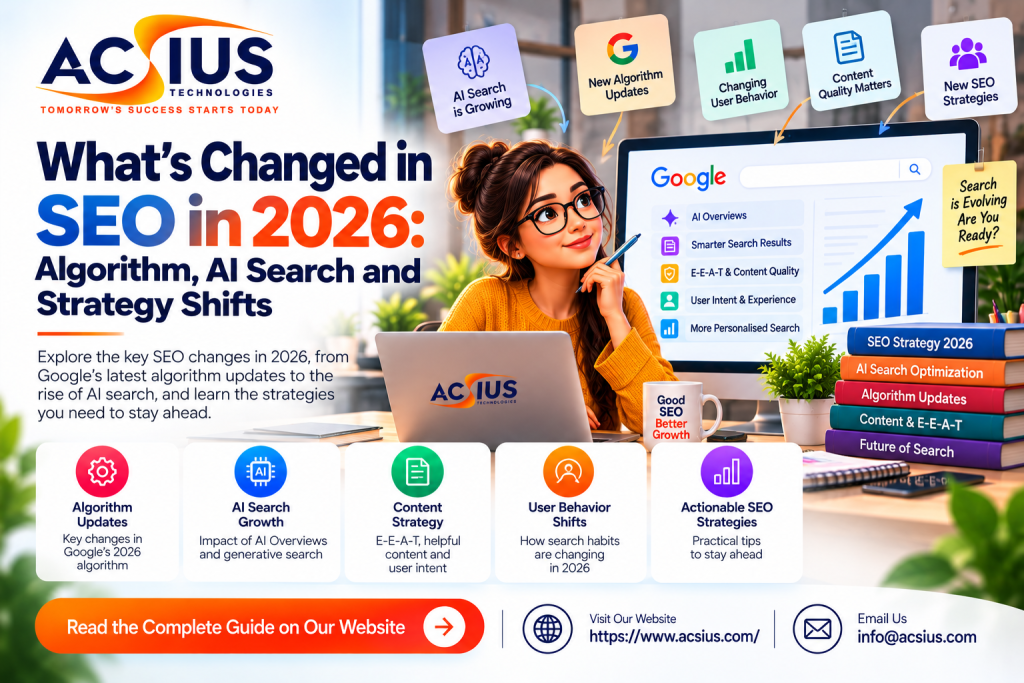
If SEO felt harder this year, you are not imagining it. Between February and September 2026, Google confirmed a rapid run of ranking updates, redesigned its search box around AI, and pushed AI Mode into the mainstream. Traffic patterns that held steady for a decade are now shifting month by month, and many site owners are asking the same question: what do we actually need to do differently?
The short answer is that the fundamentals still matter, but the way people find information, the way Google evaluates content, and the way brands earn visibility have all moved. This guide breaks down what changed in 2026, why it matters, and how to adjust your strategy with practical steps you can start applying today, whether you run a blog, a local business, or an online store.
A Year of Faster Algorithm Updates
The first thing you notice when you look at 2026 is the pace. Google began the year with a Discover-focused core update that ran from February 5 to February 27, the first time it labeled a core update as Discover-only. In late March it released a spam update that finished in under 20 hours, then launched the March 2026 core update on March 27, which completed on April 8 after 12 days. Only about six weeks later, on May 21, Google started the May 2026 core update, which finished on June 2.
That is four confirmed ranking updates in roughly 15 weeks, and the spam updates did not stop there. A further spam update began on September 24, with Google giving it a rollout window of up to two weeks. Google has also noted in its documentation that smaller core updates happen continuously between the big announced ones, which means rankings are now being tuned all the time rather than only a few times per year.
What this means for you. Do not panic over a single week of movement. Google advises waiting at least one full week after a core update finishes before analyzing performance in Search Console, and comparing against a baseline from before the rollout. A drop after a core update does not automatically mean you broke a rule; it often means Google reassessed which pages best satisfy a query. Build a habit of monthly reviews rather than reacting to every tremor.
What Google Says It Is Rewarding
Google described both the March and May core updates in the same words: regular updates designed to better surface relevant, satisfying content for searchers from all types of sites. That sounds vague, but the pattern across recent updates is consistent. Content that shows real experience, original thinking, and clear usefulness tends to hold or gain. Content that repeats what ten other pages already say, or that appears designed mainly to capture clicks, tends to slide.
Some analysts also observed that the March update was unusually volatile and hit sites that had not recovered from the December 2025 update. Others suspect that over-optimizing purely for AI citations can backfire. Treat those as informed opinions rather than confirmed facts, because Google did not publish update-specific goals. What you can rely on is Google’s long-standing advice: make content for people first, demonstrate expertise, and keep your pages accurate and up to date.
Google I/O 2026 and the Redesigned Search Experience
The biggest structural change arrived at Google I/O on May 19 and 20. Google announced a redesigned search box, which it described as its biggest upgrade in more than 25 years, along with a smoother handoff between traditional results, AI Overviews, and AI Mode. Users can now ask follow-up questions directly from an AI Overview and flow into a conversational back-and-forth without leaving the page.
Google also confirmed that Gemini 3.5 Flash became the default model inside AI Mode, and it reported that AI Mode has passed one billion monthly users. According to Google’s own usage data, queries in AI Mode run about three times longer than conventional searches, and follow-up questions are a major part of the behavior. These figures come from Google’s internal reporting and cannot be independently verified, but the direction is clear: people are asking longer, more conversational questions and expecting direct answers.
It is worth keeping perspective. Google’s own messaging says users will continue to get a range of results from Search, and that classic organic listings have not been removed. Google Search Central also states that AI features follow standard SEO fundamentals: pages must be indexed and eligible to appear with a snippet to be linked in AI responses. The change is not the end of SEO. It is a change in where, and how, your content gets seen.
AI Overviews, AI Mode and the Zero-Click Problem
For many informational queries, the answer now appears before the first organic result. When AI Overviews or AI Mode fully satisfy a question, fewer people click through, and publishers across industries have reported lower click-through rates on simple, factual searches. Pages built to answer one narrow question quickly are the most exposed, because an AI system can summarize them without sending the visitor anywhere.
The flip side is that being cited inside an AI answer can introduce your brand to people who might never have scrolled to your listing. That makes the goal broader than ranking position. You now want to be the source that AI systems pull from, and the brand that people remember and search for by name afterward.
In practice, this changes how you evaluate success. Impressions, branded search growth, assisted conversions, and citations in AI answers all deserve a place on your dashboard next to clicks. Because AI Mode data is not fully reported in public tools, expect to combine Search Console trends, analytics referral data, and third-party visibility tracking to see the whole picture.
From SEO to SEO Plus GEO and AEO
Two new acronyms dominate 2026 conversations. GEO (generative engine optimization) and AEO (answer engine optimization) describe the practice of structuring content so AI systems can understand, trust, and cite it. They are not replacements for SEO. Think of them as extensions of the same discipline, because AI answers draw on indexed, high-quality pages in the first place.
At the same time, AI citation patterns do not always mirror organic rankings. A page ranking fifth can be cited while the top result is ignored, usually because it answers the question more clearly or provides stronger evidence. That is why many teams now treat classic SEO and AI visibility as two connected jobs.
Businesses that want to adapt faster are increasingly turning to specialists in AI SEO Services India who can combine AI-assisted research, content structuring, and visibility tracking with traditional optimization. The value of that approach lies in speed and scale: modern tools can cluster thousands of queries, spot gaps in AI answers, and monitor brand mentions, while experienced strategists decide which opportunities are worth pursuing.
How to Optimize Content for AI Search
You do not need a secret formula. You need content that is easy for both people and machines to understand and trust. These tactics are working for many sites in 2026:
- Lead with the answer. Put a clear, direct answer near the top of each section, then expand with detail, examples, and evidence.
- Use question-based headings. Phrases like “How long does a core update take?” mirror the conversational queries people type into AI Mode.
- Write in natural, complete sentences. Short keyword fragments do not match the way people now phrase searches.
- Add original value. Include first-hand experience, case studies, data, screenshots, and expert quotes that cannot be copied from competitors.
- Keep facts fresh. Update statistics, screenshots, and dates regularly, and show a visible last-updated date on important pages.
- Use structured data where relevant. Schema markup for articles, products, FAQs, reviews, and organizations helps systems interpret your pages accurately.
- Make pages crawlable and snippet-eligible. If a page is blocked from indexing or restricted from snippets, it is unlikely to appear in AI features.
Authority, Brand Mentions and Trust Signals
As AI answers synthesize information from many sources, trust has become the deciding factor. Clear authorship, real credentials, transparent business details, and consistent mentions of your brand across respected websites all help AI systems and search engines decide whether you are a safe source to cite.
That makes brand building and digital PR more valuable than ever. Earn mentions through original research, expert commentary, partnerships, and genuinely useful tools. Participate where your audience actually talks, including industry forums, communities, and review platforms, because these conversations feed the wider web of signals that point back to you.
Backlinks still matter, but their role is broader. A link from a relevant, trusted site still helps rankings, and an unlinked mention in a reputable article can still help your brand become part of the topic’s conversation. Focus on relevance and credibility rather than volume.
Strategy Shift: Build Topical Depth, Not Isolated Pages
One of the clearest strategic lessons of 2026 is that single pages targeting single keywords are weaker than comprehensive topic coverage. When Google and AI systems evaluate a source, they favor sites that show deep expertise across a subject, not sites that touch it once.
Organize your content into clusters: a strong pillar page for each core topic, supported by detailed articles that answer specific questions, all connected with thoughtful internal links. Retire or merge thin posts that overlap, and expand the pages that already earn impressions. If you want a partner to handle audits, content planning, technical fixes, and authority building under one roof, dependable Organic SEO Services remain the foundation of lasting visibility, and they make every AI-focused tactic work better because they strengthen the pages AI systems depend on.
This approach also protects you from volatility. Sites with broad topical authority tend to recover more smoothly from core updates, because their value does not rest on a few fragile rankings.
Technical SEO Still Decides Who Gets Seen
With so much talk about AI, it is easy to overlook the technical layer, yet it is where many visibility problems begin. In 2026, make sure of the following:
- Indexing health. Important pages should be indexed, canonicalized correctly, and free of accidental noindex tags.
- Core Web Vitals and speed. Fast, stable pages keep users engaged, which supports every other signal.
- Mobile-first design. Most searches happen on phones, including long conversational AI queries.
- Clean architecture. Logical categories, descriptive URLs, breadcrumbs, and strong internal linking help crawlers and AI systems map your expertise.
- Rendering and accessibility. Content hidden behind heavy scripts may not be understood or cited reliably.
- Spam hygiene. With several spam updates this year, remove low-quality guest posts, scaled thin content, and manipulative link schemes before they cause problems.
You may also see talk about files such as llms.txt. Google’s teams have given mixed signals about it so far, so treat it as optional experimentation rather than a ranking requirement, and do not let it distract you from the basics.
What Changed for Local Search
Local SEO is changing quickly because many local searches are now conversational and action-oriented. People ask AI tools for the best dentist near them, a plumber who is available this evening, or a restaurant that suits a group. Google has also been expanding agent-style features that can help with tasks such as bookings, which means being selected by an AI system may soon matter as much as being listed.
A complete Google Business Profile is still essential, but it is no longer enough. Keep your hours, services, photos, and categories accurate, collect fresh reviews, respond to feedback, and publish location-specific pages with real, useful details. Structured data, consistent business information across directories, and clear policies on pricing, returns, or appointments also help systems trust your business. Companies targeting customers across cities can benefit from dedicated local seo Services India support to manage profiles, citations, reviews, and location pages at scale while adapting to the new AI-driven discovery habits.
For multi-location brands, make each location page unique. Copying the same text with only the city name changed rarely performs well and can look like low-quality, scaled content.
Search Agents and What Comes Next
Google also previewed search agents, AI systems that monitor topics in the background and update users when something changes, without requiring them to search again. Google said the feature would arrive for certain subscription tiers this summer. If agents become common, search behavior becomes less about one-time queries and more about ongoing relationships between users, information sources, and brands.
It is too early to know exactly how agents will choose sources, but the likely requirements are familiar: accurate data, clear structure, reliable updates, and strong reputation. Brands that publish consistently, keep information current, and make key facts easy to extract will be better positioned. E-commerce sites should pay particular attention to product data, shipping details, availability, and return policies, because AI-mediated shopping can favor the store with the clearest information over the store with the most backlinks.
Measurement: Rethinking SEO Reporting
Clicks alone no longer tell the full story. Update your reporting to include the following:
| Metric | Why it matters in 2026 |
| Organic clicks and impressions | Still the core indicator of search visibility |
| Branded search volume | Shows whether AI exposure and PR are building recognition |
| AI citations and mentions | Reveals visibility inside AI Overviews and AI-style answers |
| Assisted conversions | Captures users who discovered you through one channel and converted through another |
| Engagement and return visits | Signals content satisfaction and loyalty |
| Share of voice by topic | Shows how you compare with competitors across a whole subject |
Set quarterly goals around topics and outcomes, such as leads, sign-ups, or revenue, rather than single keyword positions. Leadership teams increasingly want to see business impact, and a broader scorecard makes that case more credibly.
A Practical 90-Day Action Plan
If you are not sure where to begin, use this simple roadmap:
- Days 1 to 30: Audit. Review indexing, speed, and architecture. Identify pages that lost traffic after the March and May updates, and group content by topic.
- Days 31 to 60: Improve. Rewrite weak pages to answer questions directly, add original insights, update outdated facts, and merge overlapping posts. Strengthen internal links around your most important topics.
- Days 61 to 90: Expand and promote. Publish new supporting content for gaps, add structured data, build digital PR and brand mentions, and set up reporting for AI visibility.
- Ongoing: Monitor. Check performance monthly, wait out update rollouts before judging results, and refresh top pages every quarter.
Common Mistakes to Avoid in 2026
- Chasing every update. Constant rewrites based on short-term movement can do more harm than good.
- Publishing mass AI-generated content without oversight. Unedited, generic pages add little value and increase spam risk.
- Ignoring the click-through impact of AI answers. If your pages only repeat basic facts, expect declining traffic and plan differently.
- Treating GEO as a trick. There is no shortcut to being cited; quality, clarity, and authority remain the path.
- Neglecting technical health. The best content cannot win if it is slow, hard to crawl, or poorly structured.
- Measuring only rankings. Visibility now spans classic results, AI answers, and brand searches.
Final Thoughts: Adapt Without Abandoning the Fundamentals
SEO in 2026 is not dying; it is expanding. Algorithms update faster, AI answers sit at the top of many results, and users expect conversational, complete responses. Yet the winners are still the sites that publish genuinely helpful content, build real expertise, keep their technical foundations strong, and earn trust across the web. Adjust your structure, update your measurement, and focus on being the most reliable answer in your niche, and you will be ready for whatever Google announces next.
If you want a trusted partner to navigate these shifts with a clear, results-focused plan, ACSIUS can help you strengthen your search foundations, adapt to AI-driven discovery, and grow sustainable visibility across the channels that matter. Talk to ACSIUS today and turn the changes of 2026 into an advantage for your brand.
FAQs
Does a ranking drop after a core update mean my site was penalized?
No. Core updates are not penalties or targeted actions. A drop usually means Google reassessed which pages best satisfy a query. Wait at least a week after the rollout ends, then compare Search Console data with the period before the update.
Is SEO dead because of AI Mode and AI Overviews?
No. Google says classic results still appear and that AI features follow standard SEO fundamentals. Pages still need to be indexed and eligible for snippets to be linked in AI answers. What has changed is that visibility now includes being cited, not only ranking.
What is the difference between SEO, GEO, and AEO?
SEO focuses on ranking in traditional search results. GEO (generative engine optimization) and AEO (answer engine optimization) focus on being understood and cited by AI answer systems. They overlap heavily, and strong SEO is the base for both.
How can I get my content cited in AI answers?
Lead each section with a direct answer, use question-based headings, add original data or first-hand experience, keep facts current, and use structured data where it fits. Clear authorship and a trustworthy brand presence also help.
Should I still target keywords in 2026?
Yes, but think in topics and natural questions rather than short fragments. AI Mode queries are reported to be much longer and more conversational, so cover the full set of related questions around each subject.
Do I need an llms.txt file?
It is optional. Google's teams have sent mixed signals about it, so treat it as an experiment rather than a ranking requirement. Spend your time on content quality, technical health, and authority first.
What should local businesses do differently this year?
Keep your Google Business Profile complete, collect fresh reviews, and publish unique location pages, and state prices, hours, and policies clearly. As AI tools handle more local searches and bookings, clear, consistent business data becomes more important.
Which metrics should I track now?
Track organic clicks and impressions, branded search volume, AI citations and mentions, assisted conversions, engagement, and share of voice by topic. Clicks alone no longer show the full impact of search.
How often should I update my content?
Review important pages every three to six months and refresh statistics, examples, and screenshots. Pages that answer fast-changing questions, such as updates, pricing, or regulations, may need more frequent checks.
