

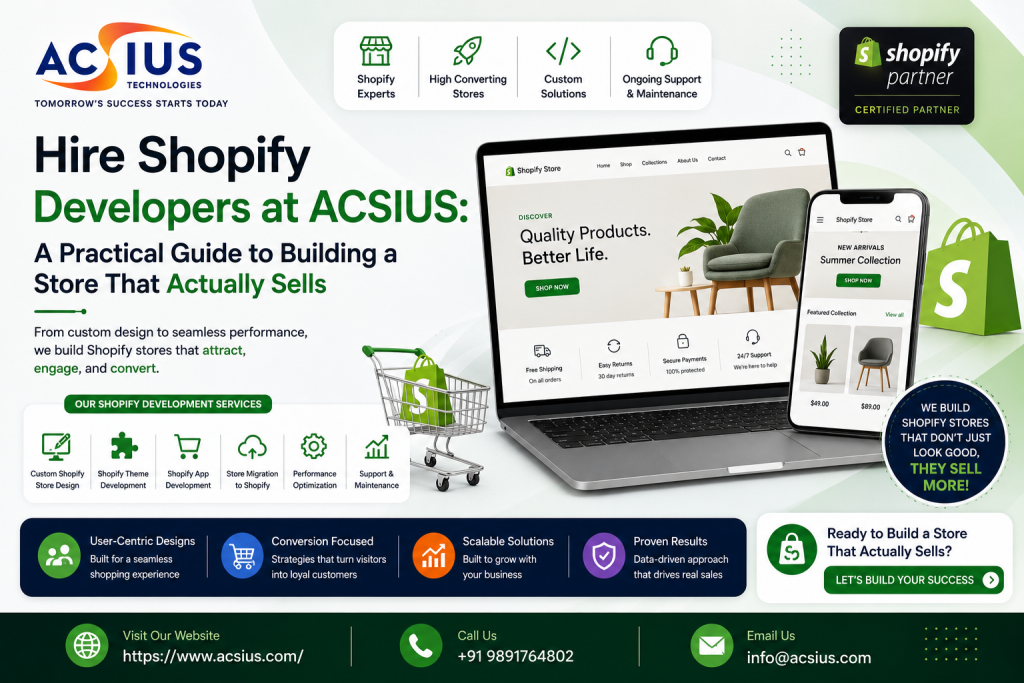
If you’ve typed hire Shopify developers into Google recently, you already know the problem isn’t finding developers — it’s finding the right ones. The market is crowded with freelancers who can install a theme, agencies that oversell and under-deliver, and platforms full of profiles that all look identical after the tenth scroll. What most business owners actually want is simpler: someone who understands their product, their customers, and how to turn a Shopify store into a machine that quietly makes money while they run the rest of their business.
That’s usually where the real search begins. Most people don’t just search hire Shopify developers once and stop — they refine it. They search “Shopify developer for fashion store, then Shopify expert to fix slow loading speed, then Shopify developer who can migrate from WooCommerce without losing SEO rankings. Google has gotten very good at reading that pattern, and so have serious development partners. At ACSIUS, this is the exact behavior our team builds around — not a generic pitch, but a response to the specific problem someone typed into a search bar at 11 PM because their conversion rate dropped and they didn’t know why. Understanding this shift in how customers actually search — from broad to painfully specific — is part of what separates a developer who ships code from one who ships results.
What Does Hire Shopify Developers Actually Mean in Practice?
On paper, hiring a Shopify developer means bringing in someone to build, customize, or maintain a store on the Shopify platform. In practice, it covers a much wider range of work than most people expect before they start the process.
It can mean:
- Building a store from a blank canvas
- Migrating an existing store from WooCommerce, Magento, or BigCommerce
- Customizing a purchased theme so it doesn’t look like every other store using it
- Building a fully custom theme from scratch
- Connecting third-party apps, ERPs, or inventory systems
- Fixing checkout, speed, or mobile responsiveness issues
- Ongoing support after launch, because a store is never really “finished”
Most first-time buyers assume they need one of these things when they actually need three or four working together. A good development partner will tell you that upfront instead of quoting only the piece you asked about.
Why More Businesses Are Choosing to Hire Shopify Developers Instead of DIY
Shopify markets itself as easy enough for anyone to use, and for a basic store, that’s true. But the moment a business needs custom functionality, faster load times, or a design that doesn’t look template-built, the drag-and-drop editor starts to show its limits.
The DIY Ceiling Is Real
Shopify’s built-in tools are excellent for getting started. They’re not built for stores with complex product variants, subscription models, multi-currency logistics, or custom checkout flows. Business owners often spend weeks trying to force the platform to do something it wasn’t designed to do out of the box, when a developer could solve it in days using Shopify’s Liquid templating language or the Shopify API.
Speed and Conversion Are Technical Problems, Not Just Design Problems
A store can look beautiful and still convert poorly because of slow load times, clunky mobile checkout, or apps that conflict with each other in the background. These are development issues, not design issues, and they’re rarely visible to someone without technical experience.
Scaling Requires Structure
A store that works fine with 50 products often breaks down at 500 — slow search, cluttered collections, and inventory chaos. Developers build with that future scale in mind from day one, which saves a painful rebuild later.
The Services ACSIUS Provides When You Hire Shopify Developers
ACSIUS approaches Shopify development as a full lifecycle service rather than a one-time project. Here’s how that typically breaks down.
Custom Shopify Store Development
Every store starts with the same question: what does this brand need to communicate in the first three seconds a visitor lands on it? From there, our developers build layouts, navigation, and product pages designed around how the target customer actually shops — not a generic template stretched to fit.
Theme Customization and Liquid Development
Shopify themes run on Liquid, Shopify’s templating language. Customizing sections, building dynamic product filters, or creating unique layouts that a standard theme editor can’t handle all require hands-on Liquid development. This is where a store starts to feel like a brand instead of a template.
Store Migration Without Losing SEO Equity
Moving from WooCommerce, Magento, or another platform to Shopify is one of the riskiest technical moves a business can make if it’s done carelessly. URL structures change, redirects get missed, and months of SEO ranking can disappear overnight. A careful migration plan — mapping old URLs to new ones, preserving metadata, and testing before going live — protects the traffic a business already worked hard to earn.
App and Third-Party Integration
Most stores eventually need to connect inventory systems, accounting software, shipping tools, loyalty programs, or CRM platforms. Shopify’s app ecosystem is large, but not every app plays well with every theme. Developers troubleshoot conflicts, write custom API connections when no app exists, and keep the backend running smoothly as more tools get added.
Speed and Performance Optimization
Page speed directly affects both conversion rate and Google ranking. Optimization work usually includes image compression, reducing unnecessary app scripts, lazy loading, and cleaning up theme code that’s accumulated bloat over time.
Ongoing Maintenance and Support
A launched store still needs attention — Shopify updates, seasonal redesigns, new product launches, and bug fixes as new apps get added. Ongoing support means a business isn’t stuck troubleshooting alone when something breaks during a sale.
How to Choose the Right Shopify Development Partner
Not every developer is the right fit for every business, and it’s worth being deliberate about who gets access to a store that generates revenue.
Ask to See Real Store Examples, Not Just Screenshots
A portfolio screenshot doesn’t show how a site performs. Ask for live links, and check load speed and mobile responsiveness yourself before deciding.
Check How They Talk About Problems, Not Just Solutions
A developer who immediately promises they can build “anything” without asking questions first is a warning sign. The ones worth hiring ask about the business model, the customer, and the goal before touching a single line of code.
Understand Their Communication Process
Time zones, response times, and how updates get shared all matter more than people expect once a project is underway. Clarify this before signing anything, not after a deadline is missed.
Confirm Post-Launch Support Terms
A store isn’t done the day it goes live. Ask what happens if something breaks two weeks later, and whether that’s included or billed separately.
Shopify vs WordPress: Why ACSIUS Works With Both
Shopify isn’t the right platform for every business, and it’s worth saying that plainly. WordPress, usually paired with WooCommerce, remains a strong choice for businesses that need heavy content publishing, blogging-driven SEO strategies, or highly specific custom functionality outside of ecommerce.
This is why many businesses researching “hire Shopify developers” also end up searching hire dedicated WordPress developer — they’re comparing platforms, not just developers. ACSIUS works across both because the right answer depends on the business, not on which platform a developer happens to prefer.
Shopify tends to fit better when:
- The business is primarily product-based ecommerce
- Fast setup and reliable hosting matter more than deep customization
- The team wants lower ongoing maintenance overhead
WordPress tends to fit better when:
- Content marketing and blogging are core to the strategy
- The business needs highly specific custom functionality
- There’s an existing WordPress ecosystem already in place
A development partner who can honestly recommend the platform that fits — even if it means less work for them in the short term — is worth more than one who pushes whatever they’re most comfortable building.
The ACSIUS Hiring Process — What to Expect
Bringing on a development partner shouldn’t feel like a black box. Here’s the general shape of how a project moves from first conversation to launch.
Step 1: Discovery Call
A short conversation about the business, the goal for the store, and the current pain points — whether that’s starting from scratch or fixing something that’s already live.
Step 2: Scope and Proposal
A clear breakdown of what’s included, realistic timelines, and cost — no vague line items that turn into surprise invoices later.
Step 3: Design and Development
Regular check-ins with visible progress, not radio silence until a “final reveal.” Businesses should be able to see the store taking shape and give feedback along the way.
Step 4: Testing
Checkout flows, mobile responsiveness, page speed, and payment gateways get tested thoroughly before launch — not discovered by an angry customer after the store goes live.
Step 5: Launch and Handover
A smooth go-live plan, plus documentation or training so the internal team isn’t locked out of managing their own store.
Step 6: Ongoing Support
Continued availability for updates, fixes, and improvements as the business grows.
Common Mistakes Businesses Make When They Hire Shopify Developers
Learning from other people’s expensive mistakes is cheaper than making them firsthand.
Hiring based on price alone. The cheapest quote often means the least experience, the least communication, or corners cut on testing. It’s rarely the bargain it looks like upfront.
Skipping the discovery conversation. Jumping straight into build mode without clarifying the actual business goal leads to a technically functional store that doesn’t convert.
Not asking about post-launch support. A store needs maintenance. Businesses that don’t clarify this upfront often find themselves stuck when something breaks during a high-traffic sale.
Ignoring mobile experience. The majority of ecommerce traffic today comes from mobile devices. A store that wasn’t tested carefully on mobile is losing sales quietly, every single day.
Choosing a developer who won’t push back. Sometimes the right answer is “that feature will slow down your checkout” — not blind agreement with every request. A partner willing to say so is protecting the business, not being difficult.
The Real Cost of Hiring Shopify Developers
Pricing varies widely depending on scope — a small theme customization costs far less than a full custom build with multiple integrations. Rather than chasing the lowest number, it’s more useful to ask what’s included in that price: testing, revisions, post-launch support, and documentation all affect whether a quote is genuinely good value or just cheap on paper.
A transparent development partner will walk through pricing openly, explain what drives cost up or down, and avoid vague “starting at” numbers that don’t reflect what a specific project will actually need.
Final Thoughts
Hiring a Shopify developer isn’t just a technical decision — it’s a business decision that affects how customers experience a brand from the very first click. The businesses that get the most value out of the process aren’t the ones who found the cheapest quote; they’re the ones who found a partner willing to ask the right questions before writing a single line of code.
At ACSIUS, that’s the starting point for every project — understanding the business first, then building the store around it. Whether the need is a brand-new Shopify build, a careful migration, or ongoing support for a store that’s already live, the goal stays the same: a store that doesn’t just look good, but actually works for the people trying to buy something from it.
FAQs
Can a developer migrate my store without losing my current traffic?
Yes, with proper planning — URL mapping, 301 redirects, and metadata preservation are essential steps that protect existing SEO rankings during a migration from WooCommerce, Magento, or any other platform to Shopify.
Do I need a developer if I'm using a Shopify theme?
Not always for a very basic setup, but most businesses eventually need one for customization, third-party integrations, or fixing issues the built-in theme editor simply can't handle, like custom filtering or non-standard checkout logic.
What's the difference between hiring a freelancer and hiring an agency like ACSIUS?
A freelancer might be more affordable for small, isolated tasks, but an agency offers broader coverage — design, development, testing, and ongoing support — without the risk of a single point of failure if that one freelancer becomes unavailable mid-project.
How much does it cost to hire a Shopify developer?
Cost depends heavily on scope. A minor theme customization costs far less than a full custom build with multiple app integrations. It's usually more useful to compare what's included in a quote — testing, revisions, support — than to compare price alone.
Should I hire a Shopify developer or a Shopify Plus developer?
Shopify Plus is built for high-volume, enterprise-level stores that need advanced checkout customization and scripting. Most small to mid-sized businesses do fine on standard Shopify with an experienced developer; plus is usually only necessary once order volume and customization needs grow significantly.
Can the same developer handle both design and development?
Some developers do both, but design and development are genuinely different skill sets. It's worth asking directly whether a developer or agency has dedicated design support, rather than assuming strong code skills automatically mean strong visual design skills.
Is it better to hire a Shopify developer or a WordPress developer for my online store?
It depends on the business model. Shopify tends to suit product-focused ecommerce with lower maintenance needs, while a dedicated WordPress developer is often the better fit for content-heavy sites or businesses needing highly specific custom functionality. A good agency will recommend based on the goal, not their own platform preference.
What happens if my Shopify store breaks after the developer finishes the project?
This depends entirely on the support terms agreed upfront. Some engagements include a post-launch support window; others are billed separately. It's worth clarifying this before the project starts, not after something goes wrong during a sale.
Can a Shopify developer help improve an existing store instead of building a new one?
Yes — a large share of development work is fixing, optimizing, or extending stores that already exist, whether that's improving page speed, resolving app conflicts, adding new features, or redesigning sections that aren't converting well.
