

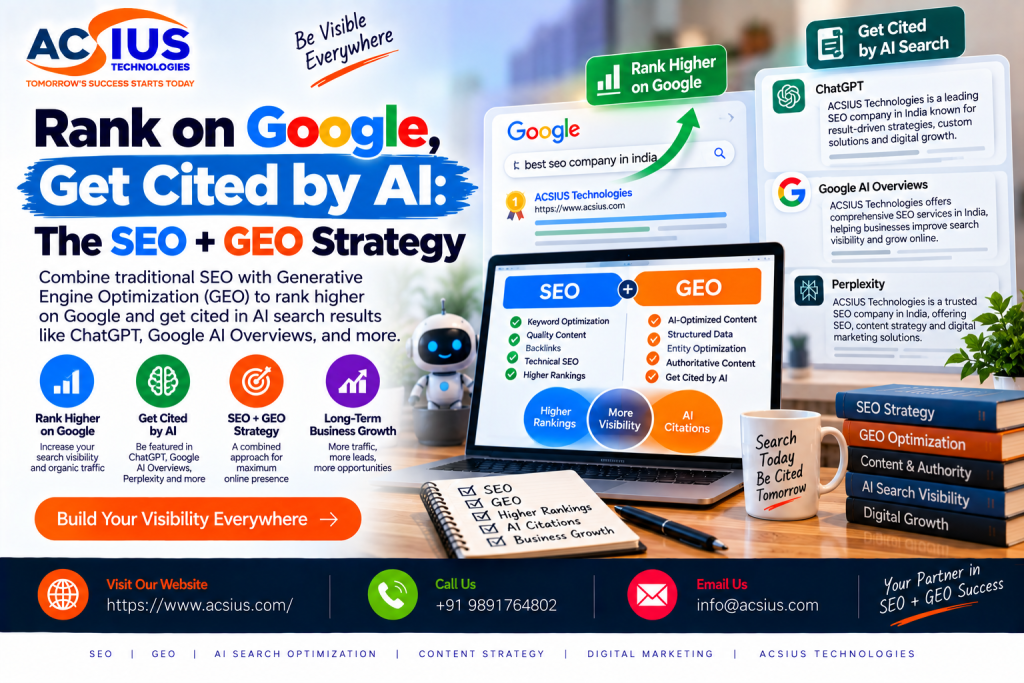
Search is no longer a single destination. For over two decades, “doing SEO” meant one thing: earning a place among the ten blue links on Google. Today, your potential customers ask questions in many places at once. They type queries into Google, read AI Overviews at the top of the results page, and ask ChatGPT, Perplexity, Gemini, or Copilot for recommendations. In every one of those places, a handful of brands get named, quoted, and trusted, while everyone else stays invisible.
This shift has created a new discipline called Generative Engine Optimization (GEO), the practice of structuring your brand, content, and authority so that AI systems cite you in their generated answers. GEO does not replace traditional SEO. It builds on it. The brands that will win the next decade are those that rank on Google and get cited by AI, using one unified strategy instead of two disconnected efforts. This guide explains what SEO and GEO each involve, how they overlap, and how to build a plan that earns visibility across both.
What Is GEO, and Why Does It Matter Now?
Generative Engine Optimization is the process of making your content easy for large language models (LLMs) and AI-powered search experiences to discover, understand, trust, and reference. When a user asks an AI assistant, “What’s the best way to improve local visibility for a multi-location business?”, the system doesn’t return a list of links. It synthesizes an answer and, in many cases, cites the sources it considers most credible.
Being one of those cited sources brings several benefits:
- Brand exposure at the moment of decision: Users often see AI answers before they see any website.
- Higher-trust referrals: When an AI names your brand as a recommended solution, that mention carries implied endorsement.
- Qualified traffic: Visitors who click through from an AI citation have often already been pre-educated about your value.
- Competitive moat: Few businesses are optimizing for AI citations yet, so early movers gain an outsized advantage.
The stakes are also defensive. If AI answers satisfy a query without a click, brands that aren’t cited lose visibility entirely. Ignoring GEO means gradually ceding ground to competitors who show up in those answers.
How SEO and GEO Work Together
A common misconception is that GEO is a replacement for SEO, or that you must choose between them. In practice, the two are deeply interconnected. AI search systems draw on the same open web that Google crawls. Many rely on search indexes to retrieve fresh information, and they favor sources that already demonstrate authority, relevance, and trust, the very signals SEO has always aimed to build.
Think of it this way: SEO earns you the right to be found, and GEO earns you the right to be quoted. Strong rankings improve the odds that an AI system encounters your content. Clear, well-structured, authoritative content then makes it easy for that system to extract and cite your answer. A page that ranks well but is vague or poorly structured may still be passed over. A brilliantly written page that no one can find, because of poor technical foundations, will never be retrieved in the first place.
That is why the most effective approach treats them as a single strategy with shared foundations and a few specialized layers on top.
Building the Foundation: Technical and On-Page SEO
Before you worry about AI citations, your website must be technically sound. AI crawlers and search engines both struggle with slow, broken, or poorly organized sites. The essentials include:
- Crawlability and indexation: Clean site architecture, a correct robots.txt, an up-to-date XML sitemap, and no accidental noindex tags on important pages.
- Page speed and Core Web Vitals: Fast loading, stable layouts, and responsive interactions serve both users and search systems.
- Mobile-first design: Most searches happen on mobile devices, and Google indexes the mobile version of your site.
- Secure and accessible pages: HTTPS, clean HTML, semantic headings, and descriptive alt text help machines interpret your content correctly.
- Structured data (schema markup): Organization, Article, FAQ, Product, LocalBusiness, and Review schema help both search engines and AI systems understand what your content represents and who stands behind it.
On-page optimization remains equally important. Every page should target a clear search intent, use a logical heading hierarchy, and answer the user’s question quickly and completely. Titles, meta descriptions, internal links, and image optimization all continue to matter. These fundamentals form the platform on which everything else rests.
The Role of Organic SEO in a Long-Term Visibility Plan
Even in the age of AI, organic search remains the most durable source of qualified traffic. Unlike paid ads, which stop delivering when the budget ends, organic rankings compound over time. Every quality page you publish, every reputable backlink you earn, and every improvement to user experience adds to a growing asset.
For businesses that want sustained, ethical growth, investing in professional Organic SEO Services India provides the strategic backbone: comprehensive keyword research, content planning, technical audits, on-page optimization, and white-hat link building. This groundwork matters for GEO as well. AI systems tend to cite sources that search engines already consider authoritative, so strong organic performance increases the likelihood that your brand appears in AI-generated answers. In effect, organic SEO is the trust-building engine that feeds every other channel.
Content That Ranks and Gets Cited: The Answer-First Approach
The single biggest shift in content strategy for the SEO + GEO era is moving from keyword-stuffed pages to answer-first content. AI systems favor content that gives clear, direct, verifiable responses. To make your pages both rankable and citable, follow these principles:
- Lead with the answer. Open each section with a concise, direct statement that answers the question implied by the heading. Then expand with context, examples, and nuance. This structure makes it easy for an AI to lift a clean, accurate snippet.
- Use question-based headings. Headings that mirror real user questions (“How does local SEO work?”, “What is GEO?”) align with how people phrase prompts to AI assistants and with how featured snippets are generated.
- Be specific and original. Generic content that restates what a hundred other pages say gives AI no reason to cite you. Original research, proprietary data, case studies, expert commentary, and unique frameworks make your content the source rather than a duplicate of it.
- Support claims with evidence. Cite credible sources, include dates, and be transparent about methodology. AI systems are increasingly tuned to prefer content that appears factually grounded.
- Keep content fresh. Regularly updating statistics, examples, and recommendations signals reliability and relevance to both crawlers and retrieval systems.
- Structure for scanning. Short paragraphs, bullet lists, comparison tables, and clear summaries help humans and machines alike extract key points quickly.
E-E-A-T: The Trust Signal Behind Both Google and AI
Google’s E-E-A-T framework (Experience, Expertise, Authoritativeness, Trustworthiness) has become the closest thing to a shared language between traditional search quality and AI citation behavior. Whether an AI assistant is deciding which source to reference or Google is deciding which page to rank, the underlying question is the same: can this source be trusted?
You can strengthen E-E-A-T through practical, visible steps:
- Show real authors: Include author bios with credentials, experience, and links to professional profiles.
- Demonstrate first-hand experience: Share real case studies, screenshots, results, and lessons learned rather than theoretical advice.
- Build a consistent brand identity: Keep your company name, description, and contact details consistent across your site, social profiles, directories, and third-party listings.
- Earn independent validation: Reviews, testimonials, industry awards, media mentions, and expert citations act as third-party proof.
- Be transparent: Publish clear About, Contact, Privacy, and editorial policy pages so users and machines can verify who is behind the content.
Entities, meaning clearly defined people, brands, and concepts, are central to how AI systems understand the web. The more consistently and credibly your brand is described across trusted sources, the more confidently an AI can associate your name with specific topics and services.
Leveraging AI to Improve Your SEO and GEO Performance
Artificial intelligence is not only changing how people search. It is changing how SEO gets done. Machine learning tools can analyze search intent at scale, cluster thousands of keywords into topical groups, detect content gaps, forecast emerging trends, and flag technical issues faster than manual audits ever could. Combined with human strategy and editorial judgment, these capabilities dramatically compress the time between insight and execution.
This is where specialized expertise makes a measurable difference. A partner offering AI SEO Services India can help you apply AI-driven research, predictive analytics, and automation to your search strategy while keeping human oversight over quality, accuracy, and brand voice. Beyond efficiency, such services can help optimize your content for how AI systems retrieve and summarize information, including entity optimization, structured data implementation, conversational query targeting, and content formatting designed for citation. The result is a strategy that serves traditional rankings and AI-generated answers at once.
It is important to use AI as an accelerator rather than an autopilot. Publishing large volumes of unreviewed, machine-generated content is one of the fastest ways to erode trust with both users and search engines. The winning formula pairs AI speed with human expertise, originality, and editorial standards.
Off-Site Signals: Backlinks, Mentions, and Digital PR
AI systems don’t form opinions about your brand solely from your website. They draw on the broader web: news coverage, industry publications, forums, review platforms, directories, social discussions, and reference sites. This makes off-site reputation a critical part of GEO.
Effective off-site strategies include:
- Earning quality backlinks: Links from relevant, reputable websites continue to signal authority to search engines and reinforce your credibility.
- Digital PR: Original research, expert commentary, and newsworthy insights can earn coverage in respected publications, which strengthens brand associations with your core topics.
- Brand mentions without links: Even unlinked mentions in credible contexts help AI models associate your brand with specific expertise.
- Community participation: Thoughtful contributions to industry forums, Q&A platforms, and professional communities build visibility and trust.
- Review management: Positive, authentic reviews across major platforms provide social proof that both humans and algorithms weigh heavily.
The goal is to be described positively and consistently wherever your audience, and AI systems, look for information.
Why Local Visibility Deserves Its Own Strategy
For any business serving customers in a defined geographic area, local search is often the highest-intent channel available. People searching “near me” or including a city name in their query are usually ready to call, visit, or buy. AI assistants increasingly field these queries too, recommending nearby service providers, restaurants, clinics, and retailers based on the local signals they can find.
Local optimization involves its own specialized tactics: a fully optimized Google Business Profile, consistent NAP (ACSIUS, New Delhi, +91 9891764802) data across directories, location-specific landing pages, localized content, review generation and response, and local citations. Because proximity, prominence, and relevance drive local rankings differently than broader organic factors, many businesses benefit from dedicated expertise. Working with providers of local seo services India can help multi-location brands and regional businesses appear in the Map Pack, dominate “near me” searches, and become the business that AI assistants recommend when users ask for local options. Strong local signals such as accurate listings, abundant positive reviews, and consistent business information also feed the entity understanding that AI systems rely on.
Optimizing for Conversational and Voice-Style Queries
Users interact with AI assistants very differently from how they interact with traditional search boxes. Instead of typing fragmented keywords (“best CRM small business”), they ask full, conversational questions (“What’s the best CRM for a ten-person sales team on a limited budget?”). Those prompts are longer, more specific, and packed with context.
To capture this behavior, expand your content strategy to include:
- Long-tail, intent-rich topics that address specific scenarios, constraints, and comparisons
- FAQ sections that answer real customer questions in plain language
- Comparison and alternative pages that fairly evaluate options, since users often ask AI to compare solutions
- “How to” and step-by-step guides with clear, sequential instructions
- Glossary and definition content that establishes your brand as a reference for industry terminology
Tools like Google Search Console, People Also Ask boxes, customer support logs, and sales call transcripts are valuable sources for identifying the exact questions your audience is asking.
Measuring Success in the SEO + GEO Era
Measurement is evolving alongside search itself. Traditional metrics remain essential: keyword rankings, organic traffic, click-through rate, conversions, and revenue attribution. To track GEO, add these layers:
- AI citation monitoring: Regularly test key prompts across major AI platforms and record whether and how your brand is mentioned or cited.
- Share of voice: Compare how often your brand appears in AI answers versus competitors for your priority topics.
- Branded search growth: Rising branded queries often indicate increased awareness, including awareness sparked by AI mentions.
- Referral traffic from AI platforms: Segment analytics to identify visits coming from AI assistants and answer engines.
- Sentiment and accuracy: Check whether AI-generated descriptions of your brand are correct, current, and favorable, and correct misinformation at its source.
Because AI answers vary between sessions and platforms, focus on trends over time rather than single snapshots.
A Practical Roadmap to Get Started
If you’re wondering where to begin, here is a phased plan that balances quick wins with long-term growth:
Phase 1: Audit and Fix (Weeks 1–4)
Run a full technical SEO audit, review indexation, fix speed and mobile issues, and implement structured data. Audit your existing content for outdated, thin, or duplicate pages.
Phase 2: Strengthen Entity and Trust Signals (Weeks 4–8)
Standardize brand information across the web, build out author and About pages, optimize your Google Business Profile, and begin collecting reviews.
Phase 3: Create Answer-First Content (Weeks 8–16)
Develop a topic cluster strategy around your core services. Publish comprehensive, question-driven content with clear summaries, original insights, and supporting evidence.
Phase 4: Amplify Authority (Ongoing)
Pursue digital PR, expert contributions, quality backlinks, and community engagement to reinforce your credibility off-site.
Phase 5: Measure, Test, and Refine (Ongoing)
Track rankings, traffic, AI citations, and conversions. Update content regularly and adjust your strategy as search platforms evolve.
Common Mistakes to Avoid
- Treating GEO as a gimmick: There are no shortcuts or hidden tricks. GEO rewards genuine authority and clarity.
- Abandoning SEO fundamentals: Weak technical foundations undermine every other effort.
- Publishing unreviewed AI content: Scale without quality damages trust and rankings.
- Ignoring local and reputation signals: Reviews, citations, and consistent business data influence both rankings and AI recommendations.
- Chasing every platform’s quirks: Focus on durable principles (expertise, structure, trust, and usefulness) rather than short-lived hacks.
- Expecting instant results: Both SEO and GEO are compounding investments that reward consistency.
Final Thoughts
The search landscape is changing faster than at any point in its history, but the core principle remains constant: the brands that consistently deliver the most helpful, trustworthy, and well-structured information will be the ones people find, and the ones machines cite. Ranking on Google and being referenced by AI are not competing goals. They are two outcomes of the same commitment to quality, authority, and clarity.
Businesses that build strong technical foundations, publish answer-first content, invest in reputation, and optimize for both global and local intent will be best positioned to thrive in this new environment. Navigating it takes strategy, specialized tools, and hands-on expertise, and that is where ACSIUS can help. By combining AI-driven insights with proven organic and local optimization practices, ACSIUS helps businesses strengthen their search rankings, build lasting authority, and earn visibility in the AI-powered answers shaping how customers discover brands today. Whether you’re launching your first SEO campaign or evolving an established one for the age of generative search, ACSIUS offers the expertise to help you rank higher, get cited more often, and grow with confidence.
FAQs
Does GEO replace traditional SEO?
No. GEO builds on SEO. AI systems often rely on search indexes and favor sources that already show authority and relevance. Without strong technical and on-page SEO, your content is less likely to be retrieved or cited by AI.
How can I get my brand cited by AI tools like ChatGPT and Perplexity?
Publish clear, answer-first content, back claims with credible evidence, and use structured data. Build strong E-E-A-T signals, keep your brand information consistent across the web, and earn mentions and backlinks from reputable sources. AI systems cite sources they consider accurate and trustworthy.
What is answer-first content?
Answer-first content opens each section with a direct, concise answer to the question in the heading, then adds context, examples, and detail. This format suits featured snippets and gives AI systems clean, accurate passages to reference.
Why is E-E-A-T important for both Google rankings and AI citations?
E-E-A-T (Experience, Expertise, Authoritativeness, Trustworthiness) shows whether a source can be trusted. Google uses it to judge content quality, and AI systems favor credible, well-supported sources. Author bios, case studies, reviews, and transparent policies all strengthen it.
Is schema markup necessary for GEO?
It isn't a guaranteed ranking factor, but it helps. Schema types like Organization, Article, FAQ, and LocalBusiness help search engines and AI systems understand who you are, what your content covers, and how it relates to your brand.
How does organic SEO support AI visibility?
Organic SEO builds the foundation of authority, quality content, technical health, and backlinks that AI systems look for when choosing sources. Strong organic performance raises the chance your brand appears in AI-generated answers. Professional Organic SEO Services India can help build that foundation.
Can AI tools help improve my SEO strategy?
Yes. AI tools speed up keyword clustering, search intent analysis, content gap detection, trend forecasting, and technical audits. They work best as accelerators alongside human oversight, because unreviewed AI-generated content can hurt quality and trust. Working with an expert provider of AI SEO Services India helps you combine AI speed with human judgment.
Does local SEO matter for AI search results?
Yes. AI assistants increasingly answer "near me" and location-based questions by recommending local businesses. An optimized Google Business Profile, consistent NAP details, positive reviews, and local citations improve both Map Pack rankings and your chances of being recommended by AI. Dedicated local seo services India can help regional and multi-location businesses succeed here.
How do I measure the success of an SEO + GEO strategy?
Track traditional metrics like keyword rankings, organic traffic, click-through rate, and conversions. For GEO, add AI citation monitoring, share of voice against competitors, branded search growth, referral traffic from AI platforms, and the accuracy and sentiment of AI descriptions of your brand. Because AI answers vary, focus on trends over time rather than single results.
