
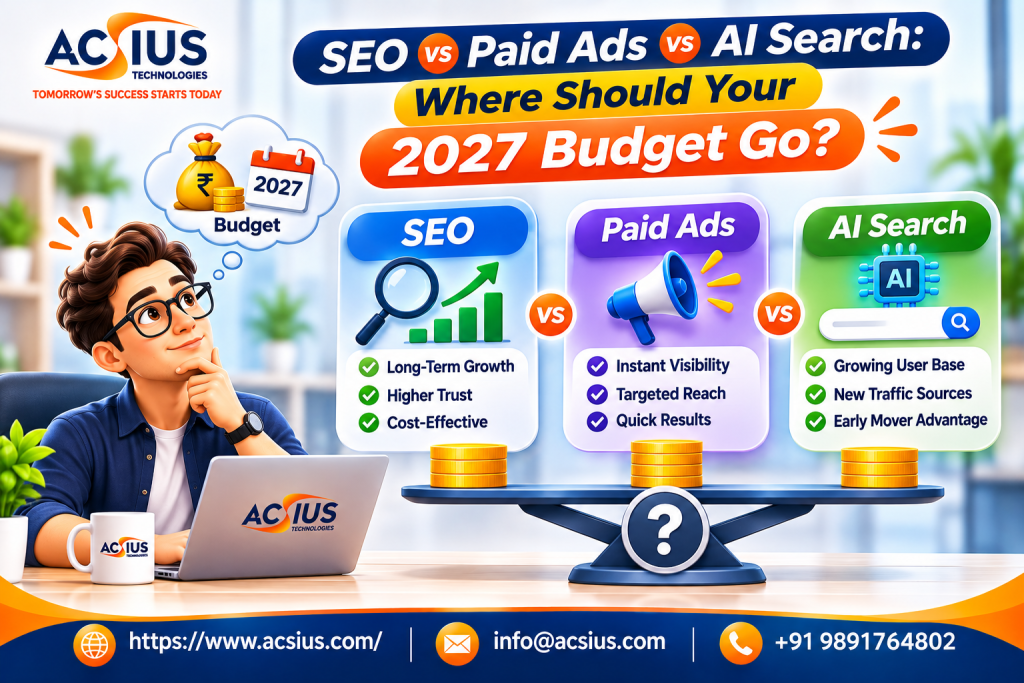
Budget season has a way of turning a simple question into a stressful one. Should you put more money into SEO, which takes months to show results? Should you keep paying for ads, which work quickly but get more expensive every year? Or should you start investing in visibility inside AI tools like ChatGPT and Google’s AI Mode, even though nobody agrees on how to measure them?
The honest answer is that there is no single split that suits every business. But the question is easier to answer when you understand what each channel does well, what the 2026 data actually shows, and how to match spending to your own goals and risk. This guide walks through each option with current evidence, gives you a practical framework for deciding, and offers sample allocations you can adapt. It is general marketing guidance, not financial advice, so test any plan against your own numbers.
The Short Version
If you only have a minute, here is the summary:
- Paid ads buy fast, controllable traffic, but costs keep rising and the traffic stops when spending stops.
- Organic SEO builds compounding visibility and still drives the majority of search-related traffic, but it needs patience and steady investment.
- AI search visibility is small in volume today, growing quickly, and mostly built on the same foundations as strong SEO.
For most businesses, the smartest 2027 plan is not choosing one winner. It is deciding how much to protect, how much to grow, and how much to test.
What Has Changed in Search Since You Last Planned
Two changes make this year’s budget discussion different from previous ones.
First, AI-generated answers have changed how people click. Studies in 2025 and 2026, including research from Ahrefs and a randomized experiment by academics at the Indian School of Business and Carnegie Mellon, found that organic click-through rates fall on queries where Google shows an AI Overview. The size of the drop varies widely by study and topic, and some recent data shows partial stabilization, but the direction is consistent. A separate analysis by SEOcrawl of more than 16,000 sites reported that Google organic clicks fell about 15 percent year over year.
Second, AI assistants have become a measurable, if small, source of website visits. SE Ranking’s 2026 research found that AI platforms account for about 0.32 percent of all website traffic, up from roughly 0.24 percent in 2025 and 0.02 percent in 2024, while organic search accounts for roughly 42.75 percent. In other words, Google organic still sends well over a hundred times more visitors than all AI assistants combined, but the gap is narrowing quickly. Other studies measure slightly different slices, and one report covered by Business Standard put AI-driven traffic at about 0.7 percent in the first quarter of 2026, with shopping the leading category for AI referrals, including in India.
These numbers will keep changing, so treat them as a snapshot. What they suggest is a balanced approach: do not abandon proven channels, but do not ignore the new one either.
Option 1: Organic SEO
Organic SEO means earning visibility in unpaid search results through technical health, helpful content, and a trustworthy reputation. It remains the backbone of most digital strategies, for a few reasons.
Strengths:
- Compounding value. A strong page can bring visitors for years without a cost per click.
- Trust. Many people trust organic results more than ads, especially for research and comparison.
- Foundation for everything else. Google says its AI features rely on indexed, high-quality pages and follow standard SEO fundamentals. Research also suggests that much of what earns AI visibility overlaps with strong traditional SEO.
- Lower long-term cost per visit, if you maintain and improve your assets.
Weaknesses:
- Slow start. Meaningful results often take six to twelve months.
- Less predictable. Algorithm updates and competition can shift rankings.
- Click pressure. Informational queries are the most exposed to AI summaries.
If your goal is steady, defensible growth, organic search deserves a firm place in your budget. A balanced plan usually spends on technical fixes, content upgrades, topic coverage, internal linking, and earning credible mentions. Experienced providers of Organic SEO Services can audit your current position and show which of these areas will give the best return first, so your money goes into the work most likely to move results.
Option 2: Paid Ads
Paid search and social advertising let you appear in front of the right people quickly. You control the audience, the message, the budget, and the timing.
Strengths:
- Speed. Campaigns can bring traffic within days.
- Control. You can test offers, landing pages, and audiences quickly.
- Targeting. Ads can reach people by keyword, location, interests, and behavior.
- Measurability. Cost per lead and return on ad spend are easy to track.
- Useful for launches and promotions, when time matters.
Weaknesses:
- Rising costs. According to WordStream and LocaliQ’s 2026 benchmarks, the average search cost per click across industries is about $5.42, up from about $5.26 the previous year, while the average conversion rate was about 8.18 percent and cost per lead about $66.69. Other benchmark studies report larger increases, so numbers vary by source, industry, and country. Indian costs differ from US figures, so check your own account data.
- No lasting asset. When spending stops, visibility and traffic stop.
- Competition and fatigue. More advertisers bid for the same clicks, and audiences tire of repeated messages.
- Quality risks. Poor targeting or weak landing pages can waste large amounts of money quickly.
Because cost per click alone can mislead, judge paid campaigns by cost per lead, cost per customer, and return on ad spend. A higher click cost can still be profitable if conversion rates and customer value are strong.
Option 3: AI Search Visibility
AI search visibility means making sure your brand is understood, trusted, and cited when people ask questions in AI Overviews, AI Mode, ChatGPT, Gemini, Perplexity, and similar tools. You may see it called answer engine optimization or generative engine optimization.
Strengths:
- Early-mover advantage. Fewer brands are working on it deliberately.
- Brand exposure. Being cited introduces your brand to people who may never scroll through traditional results.
- Possible quality of visits. Some studies report that AI-referred visitors engage longer and convert at higher rates, though sample sizes and methods vary, and results from one site may not apply to yours.
- Overlap with SEO. Clear structure, original insight, credible authorship, and strong reputation help in both places.
Weaknesses:
- Small volume today. AI referrals are still a tiny share of most sites’ traffic.
- Hard to measure. Google reports clicks from AI Overviews and AI Mode as ordinary organic clicks, and third-party tools use sampling, so numbers are estimates.
- Changing quickly. Platform shares and behaviors shift from month to month.
- No guarantees. Nobody can promise that an AI system will cite you.
Because the field is new, many brands choose to work with a specialist AI SEO Company India to track brand mentions across AI platforms, find content gaps, and structure pages so they are easier to understand and cite. The best providers are candid about uncertainty, explain what they measure and how, and tie the work to business outcomes rather than vanity metrics.
How the Three Channels Work Together
It helps to stop thinking of these as competitors. Each plays a different role in the customer journey.
| Channel | Best at | Time to impact | Main risk |
| Paid ads | Fast demand capture, launches, testing | Days to weeks | Rising costs, no lasting asset |
| Organic SEO | Durable visibility, trust, compounding growth | Months | Slow start, update volatility |
| AI search visibility | Brand presence in AI answers, early positioning | Months, uncertain | Small volume, unclear measurement |
They also feed each other. Paid campaigns reveal which keywords and messages convert, and those insights improve your SEO content. Strong organic content gives paid landing pages credibility and reduces cost per acquisition over time. Clear, trustworthy content gives AI systems something to cite, and AI mentions can raise branded searches that help both organic and paid results.
A Framework for Deciding Your Split
Instead of copying a generic percentage, work through these five questions.
-
What is your main goal for 2027?
If you need leads next month, paid media deserves more weight. If you want lower acquisition costs in two years, organic investment matters more. If your brand is new, awareness and trust may require a mix.
-
How competitive is your market?
In very competitive industries, paid clicks can be expensive and organic rankings hard-won. In niche markets, organic content can capture demand at low cost. Check what a click or a lead costs you today.
-
How strong is your current website and content?
If your site has technical problems or thin content, spending on ads will send expensive traffic to a weak experience. Fix the foundation first. If your site is solid, you can build on it with more content and promotion.
-
How long can you wait for results?
Businesses with tight cash flow often need faster returns and may keep a larger share in paid media. Businesses with a longer horizon can invest more in assets that compound.
-
What does your data say?
Look at the last twelve months: which channels produced profitable customers, which pages drive conversions, how branded search is trending, and where traffic dropped? Budget follows evidence, not trends.
Sample Allocations for Different Situations
The following examples are illustrations to help you think, not recommendations. Adjust them to your own numbers and risk tolerance.
Established business with steady organic traffic. A larger share on organic content and technical health, a moderate share on paid to protect high-intent searches, and a small test budget for AI visibility, such as tracking citations and improving key pages. A common pattern might look like 45 percent organic, 40 percent paid, and 15 percent AI and brand visibility.
New business that needs leads quickly. More weight on paid media to generate early demand, a meaningful share on organic foundations so costs fall over time, and a small share on AI visibility. For example, 55 percent paid, 35 percent organic, and 10 percent AI and brand work.
Local service business. Strong emphasis on local search and reviews, targeted paid campaigns around high-intent keywords, and modest investment in AI visibility. For example, 50 percent local and organic, 40 percent paid, and 10 percent AI and brand work.
Ecommerce brand. Organic category and product page improvements, product feed and shopping ad management, and an experimental budget for AI discovery, since AI referrals have shown strength in shopping categories. For example, 40 percent organic, 45 percent paid, and 15 percent AI and brand work.
Content or publisher site. Because informational clicks are most exposed to AI summaries, shift toward original research, brand building, email and community, and measured experiments with AI citations. Paid media may play a smaller role unless monetization supports it.
Review any split every quarter and adjust based on results, rather than locking in a full-year plan.
Do Not Forget Local Search
If you serve customers in specific areas, local visibility deserves its own line in your plan. Local searches often show maps, business profiles, and reviews, which makes them more resilient to AI summaries than general informational queries. Investing in an accurate Google Business Profile, consistent business details, genuine reviews, and unique location pages can produce steady, high-intent enquiries.
Businesses with multiple branches or service areas often use dedicated local seo services India to manage profiles, citations, reviews, and location content at scale. For many small and mid-sized companies, this is one of the most cost-effective parts of the whole budget.
How to Choose Partners Wisely
Whether you spend on SEO, ads, or AI visibility, the quality of the partner matters as much as the amount. When comparing providers, look for these signs:
- Clear methods. They explain what they will do and why.
- Honest expectations. They avoid guarantees of rankings, citations, or specific results.
- Relevant proof. They share case studies, references, and results you can verify.
- Transparent reporting. They report on business outcomes, not just traffic and impressions.
- Ownership. You keep control of your accounts, data, and content.
- Alignment. They ask about your customers, margins, and goals before proposing tactics.
If you are comparing options for long-term search work, a reputable SEO Agency India can help you connect the pieces, from technical and content strategy to authority building and measurement, so spending on one channel supports the others instead of competing with them.
Measuring Results Across All Three Channels
A fair comparison needs consistent measurement. Build a simple dashboard that includes:
- Cost per lead and cost per customer for each channel.
- Revenue or pipeline value connected to each source where possible.
- Organic impressions, clicks, and branded search growth from Search Console.
- Conversion rate by channel and page type.
- AI citations and AI referral visits, using tracking tools and analytics settings that separate AI sources where available.
- Assisted conversions, which show how channels work together.
Be cautious about attribution. People often discover a brand through one channel and buy through another, so last-click reports can undervalue organic and AI visibility. Compare trends over months, not days, and look for patterns across channels.
Common Budgeting Mistakes to Avoid
- Cutting SEO to fund ads, or the reverse. Starving either side usually hurts the other over time.
- Chasing AI hype with large budgets. Start with testing and measurement, since volumes are still small.
- Judging paid media by cost per click. Focus on cost per customer and profit.
- Ignoring website quality. Weak pages waste both paid and organic traffic.
- Expecting instant organic results. Plan for a longer timeline.
- Skipping brand building. Brand demand protects you across every channel.
- Locking in a rigid annual plan. Search is changing quickly, so build in quarterly reviews.
- Relying on a single study. Compare sources and check your own data.
A Simple 2027 Planning Checklist
- Review the last twelve months of cost, leads, and revenue by channel.
- Identify your most profitable pages, keywords, and campaigns.
- Audit your website for technical, content, and trust gaps.
- Decide your goals for the next quarter, six months, and year.
- Set a core budget for proven channels and a test budget for new ones.
- Define the metrics that will decide whether each channel earns more or less next quarter.
- Schedule quarterly reviews and a mid-year reset.
Final Thoughts: Build a Portfolio, Not a Bet
The 2027 budget question is not really about picking SEO, paid ads, or AI search. It is about building a portfolio that balances speed, durability, and experimentation. Paid media captures demand now, organic search builds assets that keep working, and AI visibility positions your brand for where search is heading. Review your data, protect what is profitable, test carefully, and be ready to adjust as the evidence changes.
If you would like expert help building a balanced search strategy for 2027, ACSIUS can support you with audits, content planning, technical optimization, local visibility, and AI-focused improvements through clear, ethical, and results-driven methods. Contact ACSIUS today to plan a budget that is grounded in your data and ready for what comes next.
FAQs
Should I move my budget from SEO to AI search?
Generally no. AI visibility is small today and overlaps heavily with SEO. A modest test budget layered on top of a strong SEO base is usually more sensible.
Are paid ads getting too expensive?
Costs have risen in many industries, though the amount varies by source and market. Judge ads by profit per customer, and compare costs in your own account.
How much should I spend on each channel?
There is no universal ratio. Use your goals, margins, competition, and data, and revisit the split each quarter.
Can I track traffic from AI tools?
Partly. Some AI assistants send referral traffic that analytics tools can identify, but clicks from Google's AI Overviews and AI Mode appear as ordinary organic clicks, so tracking is imperfect.
How long before AI search work pays off?
It varies, and there are no guarantees. Content and structure improvements may show effects within a few months, while brand recognition and authority build more slowly.
What if my budget is small?
Focus on the basics: a technically sound website, content for your highest-value topics, local visibility if relevant, and a small, carefully tracked paid campaign. Add experiments only when the core is working.
