

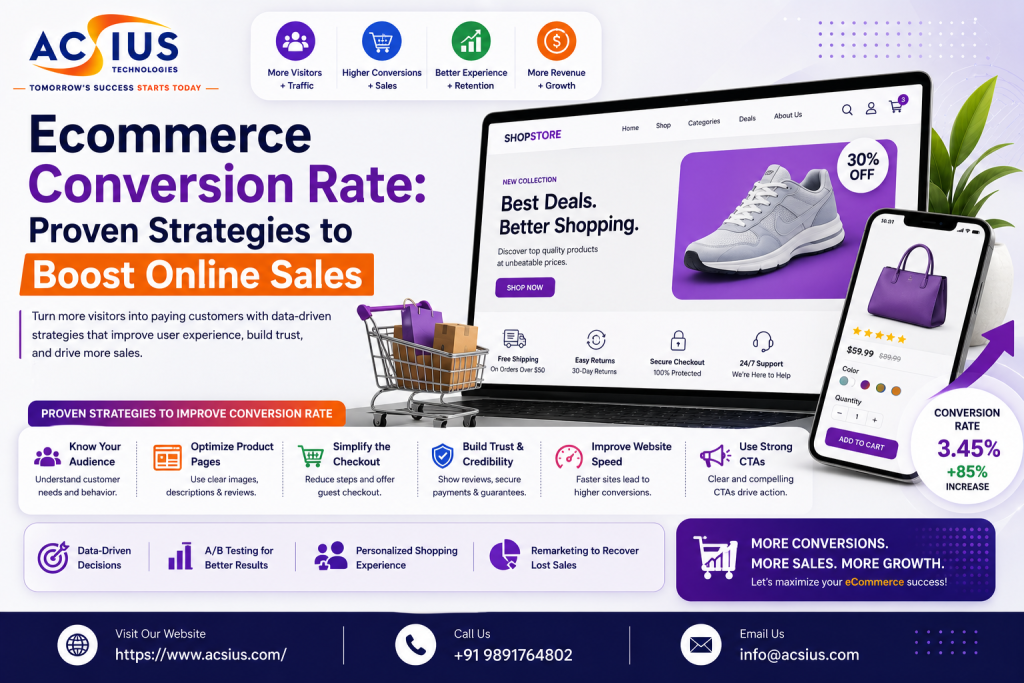
In ecommerce, attracting visitors is only half the battle. The real challenge is turning those visitors into paying customers. A website can receive thousands of visitors every month and still generate disappointing revenue if shoppers leave without completing a purchase. This is where the ecommerce conversion rate becomes one of the most important performance indicators for an online business. A strong conversion rate means your store is doing a better job of turning traffic into revenue, while a weak rate often signals problems with user experience, product presentation, pricing, trust, checkout, or marketing.
Improving an ecommerce conversion rate is not about adding more pop-ups or forcing customers through aggressive sales messages. Modern shoppers expect speed, clarity, convenience, personalization, security, and useful information before they buy. Businesses therefore need a customer-first approach supported by data, technical optimization, SEO, AI SEO, digital marketing, and continuous experimentation. In this guide, we explore proven strategies that can help ecommerce brands increase conversions, reduce cart abandonment, improve customer experience, and build sustainable online sales.
What Is Ecommerce Conversion Rate?
Ecommerce conversion rate is the percentage of website visitors who complete a desired action, usually making a purchase. The basic formula is:
Ecommerce Conversion Rate = (Number of Purchases ÷ Number of Website Visitors) × 100
For example, if an online store receives 20,000 visitors in a month and 500 of them complete a purchase, the conversion rate is 2.5%.
Although purchases are the most common conversion, ecommerce businesses can also track micro-conversions such as product views, account registrations, newsletter subscriptions, wishlist additions, add-to-cart actions, checkout starts, and payment completions.
Looking only at the final purchase rate can hide valuable information. If many people add products to their carts but very few complete checkout, the problem may not be your products or traffic. It could be shipping costs, complicated checkout forms, payment failures, unexpected charges, or a lack of trust.
Why Ecommerce Conversion Rate Matters
Traffic alone does not guarantee ecommerce success. You can invest heavily in SEO, paid advertising, social media, influencer campaigns, and content marketing, but poor conversion performance can waste much of that investment.
Suppose two ecommerce stores each receive 50,000 visitors per month. Store A converts at 1.5%, while Store B converts at 3%. If both have an average order value of $60, Store A generates approximately $45,000 in sales, while Store B generates approximately $90,000.
The difference is not necessarily more traffic. It is better conversion performance.
This is why conversion rate optimization, commonly called CRO, should work alongside acquisition strategies. The goal is to make every qualified visitor more likely to take the next step.
-
Improve Website Speed and Core User Experience
Website performance has a direct relationship with ecommerce usability. When pages take too long to load, customers may leave before seeing your products.
Mobile users are especially sensitive to slow experiences. Compress large images, reduce unnecessary scripts, optimize code, use browser caching, improve server response times, and review third-party applications that may slow down your store.
Modern SEO should also consider real user experience rather than focusing only on keywords. Search engines increasingly reward websites that provide useful, accessible, and technically sound experiences.
Review your website using real-device testing rather than relying exclusively on desktop performance. A page that looks fast on a powerful office computer may perform very differently on a mobile connection.
-
Build Product Pages That Answer Buyer Questions
A product page should remove uncertainty.
Customers typically want to know:
- What does the product do?
- Why should I buy it?
- What makes it different?
- What are the dimensions or specifications?
- How does it look in real life?
- How much does delivery cost?
- When will it arrive?
- Can I return it?
- Is payment secure?
- What do previous customers think?
Instead of writing product descriptions purely for search engines, create useful content for humans first. Explain benefits, practical use cases, specifications, compatibility, materials, care instructions, and important purchasing information.
Use high-quality images from different angles and, where appropriate, videos, demonstrations, comparison charts, and customer-generated content.
-
Make Navigation Simple and Predictable
Customers should not have to work to find what they need.
A clear navigation structure can improve both usability and SEO. Organize products into logical categories and subcategories. Avoid overwhelming users with dozens of menu options.
A strong ecommerce navigation system may include:
Home → Category → Subcategory → Product
Search functionality is equally important. Users who already know what they want should be able to find it quickly.
Add filters for relevant attributes such as price, size, color, brand, availability, rating, material, compatibility, or product type. Make sure filters work properly on mobile devices.
-
Invest in Professional Ecommerce Website Design
Your website design communicates credibility before a customer reads your sales copy. A visually attractive store is useful, but conversion-focused design goes beyond aesthetics.
Effective ecommerce Website Design Services India should combine clean layouts, intuitive navigation, mobile responsiveness, strong product presentation, fast performance, accessible interfaces, and frictionless purchasing journeys.
Every design element should have a purpose. Buttons should be easy to identify, important information should not be hidden, and unnecessary distractions should be removed from high-intent pages.
-
Strengthen Your CMS and Ecommerce Content Structure
A scalable ecommerce business needs more than attractive product pages. It needs a content structure that allows teams to manage categories, products, landing pages, blogs, promotions, customer information, and SEO elements efficiently.
Using professional CMS Website Design India can help businesses build flexible digital experiences around their specific operational requirements.
A well-structured CMS can make it easier to update product descriptions, optimize metadata, publish helpful guides, create promotional pages, manage internal links, and keep content consistent across the website.
-
Create High-Converting Landing Pages
Sending paid traffic directly to a generic homepage is often inefficient. Visitors arriving from a specific advertisement or campaign should ideally reach a page that closely matches the message they clicked.
Effective Landing Page Design Services can help businesses create focused experiences for individual products, promotions, seasonal campaigns, lead-generation offers, or specific audience segments.
A strong landing page should have one clear objective. Use a compelling headline, relevant product or service benefits, persuasive visuals, trust signals, concise copy, a prominent call to action, and minimal distractions.
The message should also remain consistent from advertisement to landing page. If an advertisement promises a particular discount or product benefit, visitors should immediately see that same promise when they arrive.
-
Make Mobile Commerce a Priority
Mobile shopping is no longer an optional part of ecommerce. Customers increasingly discover products, compare prices, read reviews, and make purchases from smartphones.
A mobile-first ecommerce experience should include:
- Easy-to-tap buttons
- Simple menus
- Fast-loading images
- Mobile-friendly product galleries
- Short checkout forms
- Digital payment options
- Readable typography
- Sticky or clearly visible purchase actions
- Minimal unnecessary pop-ups
Test the complete buying journey on multiple devices. Do not only test the homepage. Check category pages, search, product pages, cart, checkout, payment, confirmation, and account areas.
-
Improve Your Calls to Action
A call to action tells shoppers what to do next. Common ecommerce CTAs include:
Add to Cart, Buy Now, Shop Now, Get the Deal, Start Checkout, and Complete Purchase.
The best CTA depends on the customer’s stage in the buying journey.
Make important CTAs visually prominent without making the page look aggressive. Place them close to relevant information and ensure they remain usable on mobile.
Testing different CTA wording can reveal surprising differences in performance. Instead of assuming what customers prefer, use actual data.
-
Build Trust Before Asking for the Sale
Trust is one of the biggest factors influencing ecommerce purchases.
A new visitor may wonder whether your business is legitimate, whether the product will match the description, and whether their payment details are secure.
Add appropriate trust signals such as:
- Customer reviews
- Verified purchase indicators
- Product ratings
- Secure payment information
- Clear return policies
- Shipping details
- Warranty information
- Business contact information
- Frequently asked questions
- Authentic product images
- Customer testimonials
Avoid fake urgency, misleading countdown timers, fabricated reviews, or exaggerated claims. Short-term conversion gains from deceptive tactics can damage long-term customer trust.
-
Use Reviews and User-Generated Content
Customers trust experiences from other customers because they provide context that a brand’s own marketing may not.
Encourage buyers to submit honest reviews and, where appropriate, photos or videos. Display relevant reviews close to the product decision area.
Do not hide negative reviews automatically. A realistic collection of feedback can appear more credible than a product page showing nothing but perfect ratings.
You can also analyze review language to discover common customer questions and use those insights to improve product descriptions and FAQs.
-
Reduce Cart Abandonment
A customer who adds a product to their cart has already demonstrated purchase intent. Losing that customer at checkout is expensive.
Common causes of cart abandonment include:
- Unexpected shipping charges
- Complicated checkout
- Forced account creation
- Limited payment options
- Slow pages
- Payment errors
- Unclear delivery timelines
- Complicated return policies
- Security concerns
Make the checkout process as straightforward as possible. Allow guest checkout, minimize unnecessary fields, clearly display total costs, provide multiple payment options, and show delivery information before the final payment step.
-
Offer Multiple Convenient Payment Methods
Different shoppers prefer different payment methods. Depending on your target market, consider cards, bank transfers, digital wallets, UPI, cash-on-delivery where appropriate, buy-now-pay-later options, or other trusted payment solutions.
Payment failures should be monitored carefully. A technically excellent website can still lose sales if customers repeatedly encounter transaction problems.
Track payment errors by device, browser, payment method, and location to identify patterns.
-
Use Personalization Carefully
Personalization can make ecommerce experiences more relevant.
Examples include:
- Recently viewed products
- Related products
- Personalized recommendations
- Frequently bought together
- Location-based shipping information
- Personalized offers
- Relevant email recommendations
However, personalization should feel helpful rather than intrusive.
Use customer data responsibly and provide value in exchange for personalization. The goal is not to show customers everything you know about them; it is to make their shopping journey easier.
-
Use AI to Improve Ecommerce Conversion
Artificial intelligence is becoming increasingly valuable in ecommerce. AI can help businesses analyze customer behavior, identify patterns, generate product recommendations, classify customer questions, improve search, and personalize experiences.
AI-powered tools can also help marketers analyze large amounts of data faster. For example, an ecommerce business could identify products with high traffic but low conversion, discover pages with unusual abandonment rates, or analyze customer reviews to identify repeated objections.
AI should support human decision-making rather than replace it completely. Automated recommendations still need testing, monitoring, and quality control.
-
Apply AI SEO to Product Discovery
Traditional SEO remains important, but search behavior is changing. Customers increasingly use conversational queries and AI-powered search experiences to discover products and compare options.
AI SEO focuses on creating content that is easy for search engines and AI systems to understand while maintaining strong usefulness for human readers.
Instead of creating pages around isolated keywords, build topical depth around customer questions, product categories, use cases, comparisons, problems, and solutions.
For ecommerce brands, this may include:
- Product comparison guides
- Buying guides
- Detailed FAQs
- Product use cases
- Category explainers
- Expert insights
- Original research
- Helpful troubleshooting content
Structured product information can also help search systems understand price, availability, specifications, ratings, and other relevant attributes.
-
Move Beyond Keyword Stuffing
Modern SEO is not about repeating a keyword as many times as possible.
Search engines have become significantly better at understanding topics, context, intent, entities, and relationships between concepts.
An ecommerce content strategy should therefore target different types of search intent:
Informational: What should I look for when buying running shoes?
Commercial: Best running shoes for beginners
Transactional: Buy men’s running shoes online
Navigational: Brand name running shoes
Create content that matches each stage rather than forcing every visitor toward an immediate purchase.
-
Build Topic Clusters Around Products
A single product page may rank for specific commercial terms, but supporting content can help build topical authority.
For example, an online furniture store could create a content cluster around office chairs:
- Best office chair for long working hours
- Ergonomic office chair buying guide
- Office chair height guide
- Mesh vs leather office chairs
- How to maintain an office chair
- Best office chair for small spaces
These pages can internally link to relevant category and product pages.
This approach creates a stronger information architecture and gives customers more useful resources before they purchase.
-
Improve Internal Linking
Internal links help visitors discover related content and help search engines understand website relationships.
Instead of adding links randomly, connect pages based on genuine relevance.
For example:
Buying Guide → Category Page → Product Page
You can also connect product pages with related products, complementary accessories, buying guides, FAQs, and educational resources.
Use descriptive anchor text that explains what the visitor will find.
-
Use Affordable Design Without Sacrificing Conversion
A limited budget does not mean an ecommerce store should compromise on usability.
Professional Affordable Web Design Services can focus resources on the elements that matter most to business performance: responsive design, clear navigation, conversion-focused layouts, mobile usability, technical performance, and customer trust.
The objective should not simply be to build the cheapest website. It should be to create a website that provides strong value relative to investment and supports long-term growth.
-
Strengthen Ecommerce SEO
SEO remains one of the most sustainable ways to attract purchase-ready visitors.
Important ecommerce SEO activities include:
- Optimizing product titles
- Writing useful meta descriptions
- Improving category pages
- Creating unique product content
- Optimizing images
- Using descriptive image alt text
- Improving internal links
- Fixing broken links
- Managing duplicate content
- Creating logical URLs
- Implementing structured data
- Improving Core Web Vitals
- Optimizing mobile experience
Do not treat SEO as a one-time project. Ecommerce websites change frequently, and new products, discontinued products, promotions, filters, and category structures can create technical SEO issues.
-
Use Digital Marketing to Bring Better Traffic
Conversion optimization and digital marketing should work together.
If your advertising attracts people who have no interest in your products, even a beautifully designed website may have a low conversion rate.
Use audience segmentation to understand:
- Who buys from you?
- What problems do they have?
- What products do they need?
- What content influences them?
- Which channels produce the highest-value customers?
- What device do they use?
- What stage of the buying journey are they in?
Combine SEO, paid search, social media, email marketing, remarketing, content marketing, influencer partnerships, and other appropriate channels based on your audience and business model.
-
Create Better Retargeting Campaigns
Not every visitor will buy on their first visit.
Retargeting can bring interested shoppers back to your website. However, repeating the same advertisement endlessly can become annoying.
Segment audiences based on behavior. Someone who viewed a product once may need educational content, while someone who abandoned checkout may respond better to a reminder or additional purchase information.
Frequency control is important. Retargeting should be relevant rather than repetitive.
-
Use Email Marketing to Recover Lost Opportunities
Email remains useful for ecommerce retention and recovery.
Consider automated campaigns for:
- Abandoned carts
- Welcome sequences
- Post-purchase education
- Product recommendations
- Back-in-stock notifications
- Replenishment reminders
- Customer feedback
- Loyalty campaigns
Good email marketing provides useful information rather than sending constant promotional messages.
Personalize content based on customer behavior where appropriate and ensure customers have clear choices about communication preferences.
-
Test Everything With A/B Experiments
Conversion optimization should be based on evidence.
You can test:
- Headlines
- Product images
- CTA wording
- CTA placement
- Product descriptions
- Checkout layouts
- Reviews placement
- Shipping messages
- Discounts
- Forms
- Navigation
- Page layouts
Do not change dozens of elements simultaneously if you want to understand what caused an improvement.
A/B testing works best when you have a clear hypothesis, sufficient traffic, a defined primary metric, and a consistent testing period.
-
Track the Right Ecommerce Metrics
The ecommerce conversion rate is important, but it is not the only metric that matters.
Track:
| Metric | What It Helps You Understand |
| Conversion Rate | Percentage of visitors who purchase |
| Add-to-Cart Rate | Product purchase intent |
| Checkout Rate | Checkout progression |
| Cart Abandonment Rate | Lost purchase opportunities |
| Average Order Value | Revenue generated per order |
| Customer Acquisition Cost | Cost of acquiring customers |
| Revenue Per Visitor | Value generated by website traffic |
| Customer Lifetime Value | Long-term customer value |
| Return Rate | Product/customer satisfaction signals |
| Repeat Purchase Rate | Customer retention |
Looking at these metrics together gives you a more complete picture of ecommerce performance.
-
Optimize for Revenue, Not Just Conversion Percentage
A higher conversion rate does not always mean higher profitability.
For example, a major discount might increase conversions while significantly reducing margins. Similarly, promoting low-value products could increase order numbers without improving revenue.
Measure conversion alongside average order value, gross margin, customer acquisition cost, repeat purchases, and customer lifetime value.
The real objective is sustainable and profitable ecommerce growth.
-
Improve Average Order Value
Increasing average order value can have a major impact on ecommerce revenue.
Useful techniques include:
- Product bundles
- Cross-selling
- Upselling
- Volume discounts
- Free shipping thresholds
- Frequently bought together sections
- Premium product recommendations
- Complementary accessories
Recommendations should remain relevant. Customers should feel that you are helping them complete their purchase rather than simply trying to increase the bill.
-
Make Search More Intelligent
Internal website search is often underestimated.
A visitor who uses site search may have strong purchase intent. If search results are inaccurate, slow, or poorly organized, that customer may leave.
Improve search with:
- Autocomplete
- Typo tolerance
- Synonym recognition
- Product filters
- Relevant ranking
- Popular search suggestions
- Stock awareness
AI-powered search can further improve ecommerce discovery by understanding conversational queries and user intent.
-
Optimize for Voice and Conversational Search
Search is becoming more conversational.
Customers may ask:
“Which laptop is best for graphic design under my budget?”
or:
“What is the best skincare product for dry skin?”
Ecommerce websites can prepare by creating clear, natural-language content that directly answers customer questions.
FAQs, comparison pages, buying guides, product explainers, and expert content can all support this strategy.
-
Make Content Helpful After the Purchase
Conversion does not end when payment is completed.
Post-purchase content can improve satisfaction and encourage repeat business. Provide customers with product instructions, maintenance advice, setup guides, troubleshooting information, warranty details, and useful recommendations.
A positive post-purchase experience can lead to reviews, referrals, repeat purchases, and stronger customer lifetime value.
Common Ecommerce Conversion Mistakes to Avoid
Many businesses make avoidable mistakes when trying to improve conversions.
Too Many Pop-Ups
Pop-ups can be useful, but excessive interruptions can frustrate visitors.
Weak Product Photography
Customers cannot physically touch ecommerce products, so visual presentation matters.
Hidden Costs
Unexpected shipping or taxes near checkout can cause abandonment.
Complicated Checkout
Every unnecessary step creates another opportunity for customers to leave.
Poor Mobile Experience
A desktop-first website can lose mobile shoppers.
Generic Product Descriptions
Thin or copied content does little to answer customer questions or differentiate products.
Fake Urgency
Manipulative scarcity can damage trust and brand reputation.
Ignoring Existing Customers
Acquiring new customers is important, but retention can be equally valuable.
A New 2026 Approach: Combine CRO, SEO, AI SEO, and Digital Marketing
The next generation of ecommerce growth will not depend on one marketing channel. Successful brands will connect conversion optimization with search visibility, AI-driven discovery, content, customer data, and digital marketing.
Instead of asking only, “How can we rank this product page?”, marketers should ask:
How can we become the most useful answer for customers researching this product?
Instead of asking only, “How can we get more traffic?”, ask:
Are we attracting people with genuine purchase intent?
Instead of asking only, “How can we increase conversions?”, ask:
What prevents qualified visitors from feeling confident enough to buy?
This change in thinking leads to better SEO and better customer experiences.
AI can help identify patterns, but human expertise remains essential. Businesses should combine analytics with customer interviews, support conversations, reviews, sales feedback, and real-world observations.
Future-Proof Your Ecommerce SEO Strategy
Search engines and AI systems are becoming better at evaluating usefulness, context, trust, and information quality. Ecommerce brands should therefore build digital assets that demonstrate genuine expertise.
Create original research where possible. Publish practical buying advice. Demonstrate products. Answer difficult questions. Keep product information accurate. Build credible author and brand information. Earn relevant mentions and links. Keep technical SEO clean.
This approach is much stronger than producing hundreds of thin pages designed only to capture keywords.
Final Thoughts
Improving your ecommerce conversion rate is an ongoing process rather than a one-time website project. From faster pages and stronger product content to better checkout experiences, personalization, AI SEO, technical SEO, digital marketing, and continuous testing, every improvement can contribute to better online sales.
The most successful ecommerce businesses understand that conversion optimization starts before a customer reaches the website and continues long after the purchase. Search visibility brings qualified visitors, compelling content builds interest, professional design creates confidence, useful information removes objections, and a frictionless checkout completes the journey.
Businesses that combine customer-first UX with modern SEO, AI SEO, analytics, content marketing, and digital marketing can create a stronger foundation for sustainable ecommerce growth. For businesses looking to improve their online store through strategy, design, development, SEO, and digital growth, ACSIUS can help create conversion-focused digital experiences designed around real customer needs and measurable business objectives.
FAQs
What is a good ecommerce conversion rate?
There is no single conversion rate that is considered good for every ecommerce business. Performance can vary depending on the industry, product type, price, traffic source, audience, device, and buying journey. Instead of focusing only on an industry benchmark, businesses should monitor their own historical performance and continuously work to improve it.
How can I increase my ecommerce conversion rate?
You can improve your ecommerce conversion rate by optimizing website speed, improving product pages, simplifying navigation, strengthening trust signals, offering convenient payment options, reducing checkout friction, improving mobile usability, adding customer reviews, and conducting A/B tests. Combining CRO with SEO, AI SEO, and digital marketing can also help attract more qualified visitors.
Does website design affect ecommerce conversions?
Yes. Website design can significantly influence customer confidence and purchasing behavior. A clean, responsive, easy-to-navigate website helps visitors find products quickly and complete purchases with fewer obstacles. Clear calls to action, professional product presentation, intuitive navigation, and mobile-friendly layouts are especially important.
How does mobile optimization improve ecommerce sales?
Mobile optimization makes it easier for smartphone users to browse products, compare options, add items to carts, and complete checkout. Fast loading times, readable content, easy-to-use menus, large touch-friendly buttons, and simple payment processes can reduce friction and improve mobile conversions.
How can SEO help improve ecommerce conversion rates?
SEO helps attract users who are actively searching for products, solutions, and information related to your business. Optimizing product pages, category pages, buying guides, internal links, structured data, and helpful content can attract more relevant traffic. Better-targeted traffic can create more opportunities for conversions.
What is AI SEO, and how can it benefit ecommerce websites?
AI SEO focuses on improving content and website information so that modern search engines and AI-powered search systems can better understand and surface it. Ecommerce businesses can use conversational content, detailed product information, FAQs, comparison guides, structured data, and topical content to improve visibility across evolving search experiences.
How can I reduce ecommerce cart abandonment?
To reduce cart abandonment, make checkout simple and transparent. Display shipping costs and delivery information early, provide multiple trusted payment options, offer guest checkout, minimize unnecessary form fields, ensure the checkout works properly on mobile devices, and clearly explain returns and refunds. Abandoned-cart email campaigns can also help recover potential sales.
Does customer feedback help increase ecommerce conversions?
Yes. Reviews, ratings, testimonials, and user-generated content can reduce uncertainty and build trust. Customers often want to understand how a product performs in real-world situations before purchasing. Displaying authentic feedback near product information can help shoppers make more confident buying decisions.
How can ACSIUS help improve ecommerce conversion rates?
ACSIUS can support ecommerce businesses with website design and development, conversion-focused user experiences, SEO, AI SEO strategies, digital marketing, landing page optimization, and other digital solutions. The goal is to create a faster, more user-friendly ecommerce experience that attracts qualified visitors and turns more of them into customers.
