
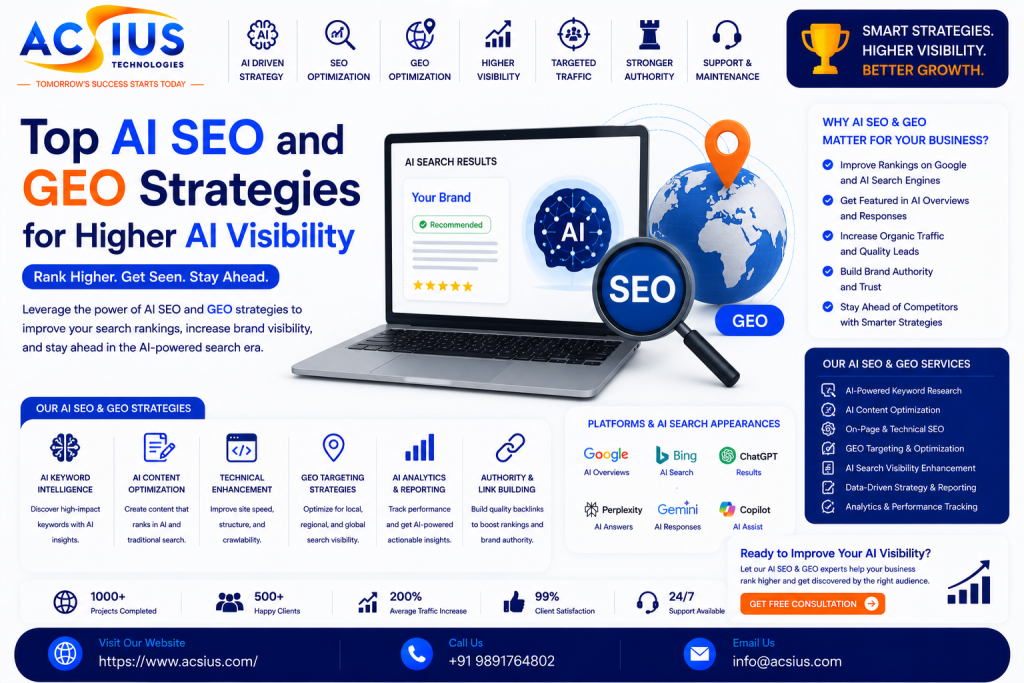
The digital landscape is undergoing its most significant transformation since the advent of the search engine. For years, businesses have focused on Search Engine Optimization (SEO) to climb the ranks of Google’s traditional search results. Today, a new paradigm is emerging. Artificial Intelligence (AI) is fundamentally changing how users discover information, shifting from a model of browsing lists of blue links to one of receiving direct, conversational answers.
This evolution means that traditional visibility is no longer enough. To thrive in this new era, brands must adopt a dual strategy that combines the fundamentals of AI SEO with the forward-thinking approach of Generative Engine Optimization (GEO). This comprehensive guide explores the top strategies to ensure your brand isn’t just visible but is the preferred source of information in an AI-first world.
The core of this shift lies in recognizing that AI-powered search engines—like ChatGPT, Perplexity, Google’s AI Overviews, and Microsoft Copilot—don’t just index web pages; they synthesize information from across the web to provide a single, comprehensive answer. If your content isn’t structured and optimized to be a clear, authoritative source for these AI engines, you risk becoming invisible, even if you rank well on traditional search results. This is where the integration of AI SEO Services India becomes critical for future-proofing your digital strategy. It’s no longer about ranking for a keyword; it’s about being cited in the answer.
Understanding the Shift: SEO vs. GEO vs. AEO
To build an effective strategy, it’s essential to understand the distinct roles of SEO, GEO, and AEO.
- Traditional SEO (Search Engine Optimization) focuses on improving a website’s visibility in traditional search engine results pages (SERPs). It involves keyword research, on-page optimization, technical SEO, and link building to improve rankings in a list of 10 blue links.
- Generative Engine Optimization (GEO) is a newer discipline that focuses on optimizing content to be cited as a source in AI-generated answers. While SEO aims for a click, GEO aims for a citation. It emphasizes clarity, structure, and authority to ensure Large Language Models (LLMs) identify and use your content as a trusted reference. Many brands are now exploring AEO services in India to gain an edge in this area, as the focus shifts to providing direct answers.
- Answer Engine Optimization (AEO) is often used interchangeably with GEO but specifically targets featured snippets, voice search, and “zero-click” answers. It’s about structuring content to directly answer a user’s question in a concise, extractable way.
In essence, a robust modern strategy uses a strong SEO foundation as the bedrock, upon which AEO and GEO strategies are built. Data from SE Ranking confirms that AI engines heavily rely on traditional SEO signals. For example, a website’s organic traffic to Google is the number one predictor of being cited by Google’s AI mode, and the number of referring domains is the strongest factor for being cited by ChatGPT.
-
The Technical Foundation: Optimizing for AI Crawlers
Before an AI engine can cite your content, it needs to find and read it. This requires a solid technical SEO base but with a new layer of complexity.
The SEO & GEO Intersection: While traditional technical SEO focuses on making your site crawlable for Googlebot, you must now ensure it is also accessible to AI-specific crawlers like GPTBot (OpenAI), OAI-SearchBot (ChatGPT Search), PerplexityBot, and Google-Extended.
Top Strategies:
- Check Your Robots.txt File: The first and most critical step is to ensure you haven’t accidentally blocked these AI crawlers. Many organizations inadvertently do so, making their content invisible to AI systems. Use your robots.txt file to grant access to these bots.
- Server-Side Rendering (SSR): Most AI bots cannot render JavaScript. If your content relies heavily on client-side JavaScript, the AI will see a blank page. To ensure your content is fully visible, implement server-side rendering or pre-rendering.
- Optimize Site Speed and Core Web Vitals: Both human users and AI bots value speed. A fast, responsive site with good Core Web Vitals is essential for accessibility.
- Sitemaps and Index Now: A clean, up-to-date XML sitemap helps crawlers find all your important pages. Adopting IndexNow, a protocol that instantly notifies search engines of updates, is a great practice to ensure AI systems have the latest version of your content.
Mastering these technical elements is a core offering of Top Organic SEO Services from any forward-thinking agency, as it ensures the foundation is solid for all forms of discovery.
-
Mastering Content for AI Consumption
Creating content for AI is about making the “meaning” as easy as possible for a machine to extract and interpret. This requires a shift in how we write.
The SEO & GEO Intersection: While traditional SEO focused on keyword density and placement, modern strategies for AI emphasize semantic clarity and structured information hierarchy. The goal is to create content that is both helpful for humans and machine-readable.
Top Strategies:
- Use Clear, Natural Language and Structure: Write in a conversational, question-answering style. Use clear, descriptive headings (H1, H2, H3) that map the logical flow of your content. Keep paragraphs and sentences concise.
- Structure for Answers: Use lists, tables, and bullet points to present data and key concepts clearly. This makes it easy for AI to parse and extract information. Crucially, include an FAQ section that directly asks and answers questions your target audience has. This is a powerful signal for AI looking for direct answers.
- Build Topical Authority: Instead of writing isolated articles, create interconnected topic clusters. A pillar page covering a broad topic, linking to several cluster pages that delve into specific subtopics. This reinforces your expertise in the eyes of both search engines and AI knowledge graphs.
- Demonstrate E-E-A-T (Experience, Expertise, Authoritativeness, and Trustworthiness): AI systems are designed to prioritize sources with high E-E-A-T. You can demonstrate this by:
- Citing credible, authoritative sources.
- Showcasing author expertise (e.g., author bios, credentials).
- Including original research, data, and case studies.
- Ensuring your brand and message are consistent across the web.
- Keep Content Fresh: AI systems are more likely to cite up-to-date information. Regularly review and update your most important content, ideally every 2-3 months.
While strategies like AEO India often include specific tactics for voice search, the principles above form the bedrock of all content designed for AI-driven discovery.
-
Building Authority: The Currency of AI Citations
In an AI-driven world, authority is your most valuable asset. Traditional link building remains crucial, but it’s part of a broader strategy to build your brand as a trusted entity.
The SEO & GEO Intersection: SEO has always used backlinks as a primary signal of trust. In the GEO landscape, this signal is amplified. AI models often start their knowledge from a curated base, and backlinks from reputable domains are a key indicator of whether a source is trustworthy.
Top Strategies:
- Earn High-Quality Backlinks: This remains the #1 ranking factor for ChatGPT. Focus on earning links from relevant, high-authority websites in your industry through great content, guest posting, and digital PR. This is a staple of professional AI SEO services.
- Strengthen Brand Recognition: AI favors brands with strong online recognition. Strong signals include high homepage traffic, high brand search volume, and mentions across the web (e.g., on Wikipedia, Wikidata, review sites like Trustpilot and G2, and social platforms like Reddit and Quora). Being active on other discovery channels like YouTube, TikTok, and Instagram also builds your overall brand footprint.
- Monitor Your Brand in AI Responses: Regularly search for your brand or relevant topics in AI tools like ChatGPT, Perplexity, and Google AI Overviews. Use incognito mode to avoid personalized results. This will help you understand what sources are being cited and identify content gaps. Consider using a tool to track your brand’s visibility across AI platforms.
-
What Doesn’t Work in the AI Era
It’s equally important to understand which strategies to avoid. Tactics that were once effective are now not only useless but potentially harmful in the new AI-driven search ecosystem.
Top Strategies:
- Stop Blocking AI Bots: As previously mentioned, accidentally blocking AI crawlers in your robots.txt is a critical error that immediately removes you from consideration.
- Don’t Rely Solely on Schema Markup: While schema markup (like structured data) is helpful for understanding context, recent data shows that it doesn’t directly impact AI citations. The structure and clarity of the content itself are far more important. FAQs, for example, are more valuable for the content they contain than for the FAQ schema tag applied to them.
- Avoid Thin, Generic Content: AI engines are sophisticated. They can easily detect and will deprioritize shallow, keyword-stuffed content. Focus on providing genuine value.
- Don’t Use Outdated “Shortcuts”: Methods like relying on llms.txt files or keyword-stuffed titles and URLs have no measurable impact on AI visibility. The technical foundation is a prerequisite, but it is the quality, authority, and structure of your content that truly Matters for citations.
The Future of Digital Visibility
The transition from SEO to a combined SEO and GEO strategy is not a fleeting trend; it’s a fundamental shift in how information is processed and delivered. To succeed, brands must adapt. The future belongs to those who can be both highly relevant and supremely authoritative, crafting content that is not only optimized for algorithms but is also the clearest, most trustworthy answer for human users.
This means adopting a holistic approach that balances the technical precision of Top Organic SEO Services with the forward-looking focus of GEO and AEO. Your digital presence must be built on a foundation of technical excellence, structured content, and a robust online reputation.
When you partner with a company that understands this entire ecosystem, you gain a significant strategic advantage. A leader in this space, ACSIUS, embodies this integrated approach, combining 16+ years of digital expertise with cutting-edge AI strategies. They offer a full suite of solutions, from powerful AI SEO services in India to specialized AEO services in India, ensuring your brand is optimized for the entire spectrum of search, from traditional listings to AI-generated answers, creating a future-ready digital presence built for sustainable growth.
By embracing these principles, you can ensure your brand doesn’t just survive the AI revolution but becomes its most trusted voice.
