

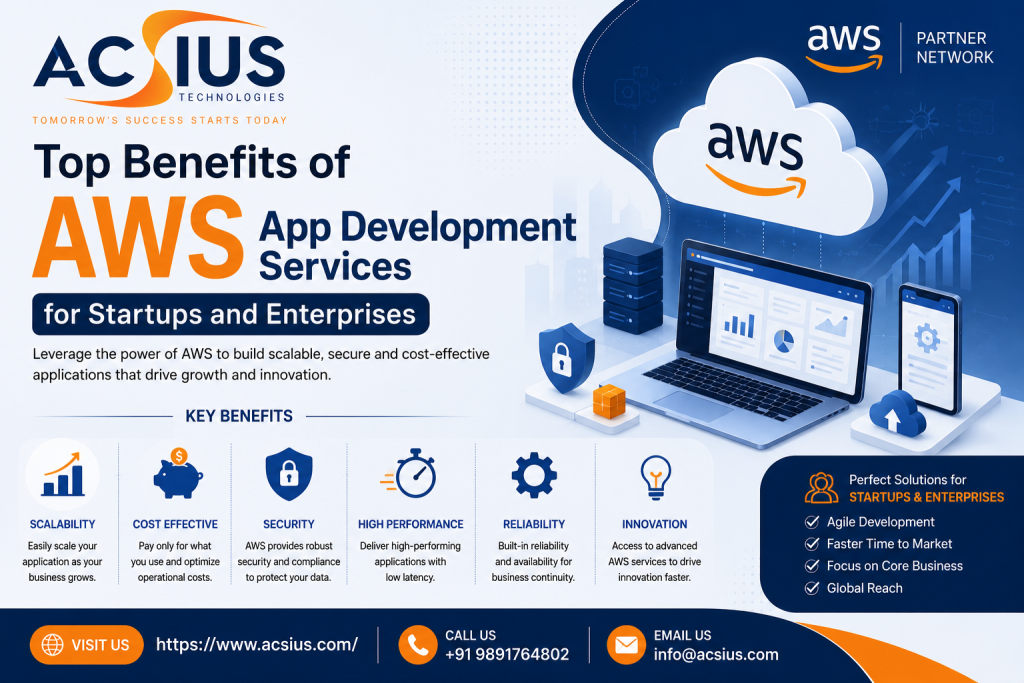
If you’ve ever tried to launch an app and watched it buckle under real-world traffic, you already know why cloud infrastructure matters more than most founders expect going in. It’s rarely the app idea that fails — it’s the foundation underneath it. That’s the gap AWS app development services are built to close.
At ACSIUS, we’ve sat across the table from founders who came to us after a launch went sideways: servers that couldn’t handle a traffic spike, a database that locked up during a product demo, or a security gap that only showed up after go-live. None of these are rare stories. They’re the reason more businesses are moving app development onto Amazon Web Services from day one, instead of retrofitting it later.
This guide walks through what AWS app development services actually involve, how the process works, what it costs, and how to evaluate a development partner — written for people who want a straight answer, not a sales pitch.
What Are AWS App Development Services, Really?
AWS app development services refer to the process of designing, building, deploying, and maintaining applications using Amazon Web Services’ cloud infrastructure and tools. This isn’t just “hosting an app on AWS.” It’s building the app around AWS from the architecture stage — using services like EC2, Lambda, RDS, S3, API Gateway, DynamoDB, and Amplify to create something that’s fast, secure, and built to grow.
Think of it like the difference between renting a generic apartment and having a home built around how your family actually lives. A generic cloud setup works until it doesn’t. A properly architected AWS application is designed for your specific traffic patterns, data needs, and growth plans from the start.
At ACSIUS, our engineers work across the full AWS ecosystem — serverless architecture, containerized deployments, mobile backends, IoT integrations, and enterprise-grade data pipelines — so the solution actually fits the business, not the other way around.
Why Businesses Are Choosing AWS Over Other Cloud Providers
There’s no shortage of cloud platforms. So why does AWS keep coming up as the default choice for serious app development?
-
It Scales Without Drama
AWS was built for elastic scaling. When your app gets a sudden spike in users — say, after a viral social post or a product launch — services like Auto Scaling and Elastic Load Balancing adjust capacity automatically. You don’t need to predict traffic perfectly; the infrastructure adapts.
-
Pay-As-You-Go Pricing
Unlike traditional infrastructure where you pay for servers whether you use them or not, AWS pricing is largely consumption-based. For startups watching runway closely, this matters. You’re not sinking capital into hardware you might outgrow — or never use.
-
A Mature, Battle-Tested Ecosystem
AWS has been running production workloads for well over a decade for companies ranging from three-person startups to Fortune 500 enterprises. That maturity shows up in reliability, documentation, and the sheer number of specialized services available — from machine learning tools to compliance-ready storage for healthcare and finance.
-
Security That Meets Regulatory Standards
For industries like healthcare, fintech, and e-commerce, compliance isn’t optional. AWS supports HIPAA, PCI-DSS, GDPR, and SOC 2 requirements through built-in tools like IAM (Identity and Access Management), KMS (Key Management Service), and CloudTrail for audit logging. A knowledgeable AWS development partner configures these correctly from the start — which matters, because misconfigured cloud security is one of the most common causes of data breaches today.
-
Global Reach, Local Speed
With data centers across dozens of regions worldwide, AWS lets you serve users with low latency no matter where they’re located — a real advantage for apps with an international audience.
Core AWS App Development Services Explained
Not every project needs every AWS service. Part of doing this well is knowing which tools actually solve your problem, rather than defaulting to whatever’s trendiest. Here’s a breakdown of the services that show up most often in real projects.
Custom Web & Mobile App Development on AWS
This covers full-cycle development — from UI/UX design to backend architecture — built specifically for AWS infrastructure. It typically includes:
- Frontend development (React, Angular, Vue, or native mobile frameworks)
- Backend logic hosted on EC2, Lambda, or Elastic Beanstalk
- Database design using RDS (relational) or DynamoDB (NoSQL)
- API development through API Gateway
Serverless Application Development
Serverless architecture, built primarily with AWS Lambda, lets you run code without managing servers at all. You pay only for the compute time you actually use, and the infrastructure scales automatically. This is a strong fit for:
- Event-driven applications
- Backend APIs with variable traffic
- Startups that want to minimize DevOps overhead early on
Cloud Migration Services
Many businesses don’t start on AWS — they migrate to it. This involves moving existing applications, databases, and workloads from on-premises servers or another cloud provider to AWS, ideally with zero or minimal downtime. A good migration plan includes a full audit of the current architecture before a single file gets moved, because migrating a poorly structured system just moves the problem somewhere more expensive.
DevOps & CI/CD Pipeline Setup
AWS DevOps services use tools like CodePipeline, CodeBuild, and CodeDeploy to automate testing and deployment. This means new features and bug fixes reach users faster, with fewer manual errors along the way — something that becomes increasingly important as a team and codebase grow.
AWS Application Modernization
Legacy applications often carry technical debt that slows everything down. Modernization services re-architect these systems into microservices, containerize them with Docker and Amazon ECS/EKS, and rebuild them to take advantage of cloud-native performance — without necessarily rebuilding from zero.
Data Analytics & Machine Learning Integration
AWS offers a genuinely deep bench of tools here — Amazon SageMaker for machine learning, Redshift for data warehousing, and QuickSight for business intelligence dashboards. For apps that need to surface insights from user data or build predictive features, these integrations turn raw data into something a business can actually act on.
Ongoing Support & Managed Services
Development doesn’t end at launch. Managed AWS services cover monitoring, patching, cost optimization, and scaling adjustments — the unglamorous work that keeps an application healthy for years, not just for its first few months.
The AWS App Development Process — Step by Step
A dependable AWS app development partner should be able to walk you through their process without vague answers. Here’s what that process generally looks like when it’s done right.
Step 1: Discovery & Requirement Analysis
This is where business goals, target users, and technical requirements get mapped out. Skipping this step — or rushing it — is the single biggest reason projects go over budget later. The questions asked here (What’s your expected user growth? What compliance requirements apply? What’s your data sensitivity level?) shape every decision that follows.
Step 2: Architecture Design
Engineers design the AWS infrastructure blueprint — deciding between serverless vs. server-based, choosing the right database type, and mapping out how services will communicate. This is also where cost estimates get more precise, since architecture decisions directly affect ongoing cloud spend.
Step 3: Development & Integration
The actual build phase, where frontend and backend development happen in parallel with third-party integrations (payment gateways, CRMs, analytics tools, etc.).
Step 4: Testing & Quality Assurance
This includes functional testing, load testing (simulating high traffic to check performance), and security testing. AWS-specific testing also checks IAM permissions, encryption settings, and failover behavior — the things that don’t show up in a casual demo but absolutely show up in a crisis.
Step 5: Deployment
Using CI/CD pipelines, the application goes live with minimal downtime. A well-structured deployment includes rollback plans in case something needs to be reversed quickly.
Step 6: Monitoring & Optimization
Post-launch, tools like Amazon CloudWatch track performance, errors, and usage patterns. This data feeds back into ongoing optimization — both for performance and for cost, since unused resources quietly add up on a monthly AWS bill if nobody’s watching.
What Does AWS App Development Cost?
This is usually the first question on everyone’s mind, and honestly, there’s no single number that applies across the board. Costs depend on:
- App complexity — a simple MVP costs far less than a multi-platform enterprise application
- AWS services used — serverless architectures can be more cost-efficient at lower traffic volumes; traditional EC2 setups may be more predictable at higher, steady traffic
- Development team structure — in-house teams, freelancers, and agencies like ACSIUS all carry different cost profiles
- Ongoing maintenance needs — post-launch support, monitoring, and scaling adjustments
Rather than chasing a fixed price upfront, it’s worth asking any development partner for a detailed cost breakdown tied to your specific requirements — and asking what happens to costs as your user base grows. A partner who can’t answer that clearly probably hasn’t planned for your growth either.
How to Choose the Right AWS App Development Partner
Search “aws app development services” and you’ll find no shortage of agencies claiming expertise. Here’s what actually separates a capable partner from one that’s just checking boxes.
Look for AWS-Certified Expertise
AWS certifications (Solutions Architect, Developer Associate, DevOps Engineer) aren’t just resume decoration — they indicate a working knowledge of AWS best practices, which directly affects how well your app performs and how securely it’s built.
Ask About Real Project Experience
A team that’s actually built and scaled applications on AWS will talk about specific challenges they’ve solved — not just list services they “offer.” Ask what went wrong on a past project and how they handled it. The answer tells you more than any portfolio page.
Check Their Approach to Security
Security shouldn’t be an afterthought bolted on before launch. Ask how they handle IAM roles, data encryption, and compliance requirements relevant to your industry from the earliest planning stages.
Evaluate Communication and Transparency
Cloud projects involve ongoing decisions — about architecture, cost trade-offs, and timelines. A partner who explains the “why” behind technical choices, rather than just delivering a black box, makes for a far less stressful working relationship.
Consider Post-Launch Support
An app isn’t “done” at launch. Ask what support looks like six months and a year down the line — because that’s usually when the real test of an architecture decision shows up.
Why Businesses Work With ACSIUS for AWS App Development
At ACSIUS, our approach starts with a simple principle: the cloud architecture should fit the business, not force the business to adapt to generic infrastructure. Our team works across serverless computing, mobile backend development, enterprise application modernization, and AWS-native DevOps pipelines — building systems that are secure, scalable, and genuinely cost-conscious rather than over-engineered.
We’ve supported businesses across healthcare, fintech, logistics, and e-commerce in migrating legacy systems to AWS, building new applications from the ground up, and untangling the kind of infrastructure issues that only surface once real users are on the platform. What that experience has taught us, consistently, is that the best AWS applications are the ones planned with tomorrow’s traffic in mind — not just tomorrow’s demo.
If you’re evaluating AWS app development services for a new build, a migration, or a modernization project, we’re glad to walk through your specific requirements and give you a straightforward view of what’s realistic — timeline, cost, and architecture included.
Final Thoughts
AWS app development services aren’t just about writing code that runs on Amazon’s servers — they’re about building applications that are architected to handle real growth, real security requirements, and real operational demands from day one. The businesses that get the most value out of AWS are the ones that treat infrastructure decisions as seriously as product decisions, right from the planning stage.
Whether you’re building something new, migrating an existing system, or modernizing legacy infrastructure, the right AWS development partner should be able to explain their reasoning clearly, show real experience solving the problems you’re likely to face, and stay involved well past launch day.
At ACSIUS, that’s the standard we hold ourselves to — and we’re happy to have that conversation whenever you’re ready to start one.
FAQs
How long does AWS app development typically take?
A simple MVP might take 6–10 weeks, while a more complex, multi-integration application can take several months. Timeline depends heavily on scope, integrations, and how much of the architecture needs to be custom-built versus using managed AWS services.
Can an existing app be migrated to AWS without downtime?
In most cases, yes — with proper planning. Techniques like blue-green deployment and phased migration allow businesses to move workloads to AWS while keeping the existing application live for users throughout the transition.
Do I need a dedicated DevOps team for an AWS application?
Not necessarily. Many managed AWS services and CI/CD automation tools reduce the day-to-day DevOps burden significantly. That said, having ongoing monitoring and optimization — whether in-house or through your development partner — is important for long-term performance and cost control.
