
Why Every Business Needs an AI Team Today
In today’s fast-moving digital world, speed, accuracy, and scalability define success. Businesses are under constant pressure to deliver more—faster and at lower cost—without compromising quality. Traditional teams and workflows, while still important, often struggle to keep up with this pace.
This is where Artificial Intelligence steps in.
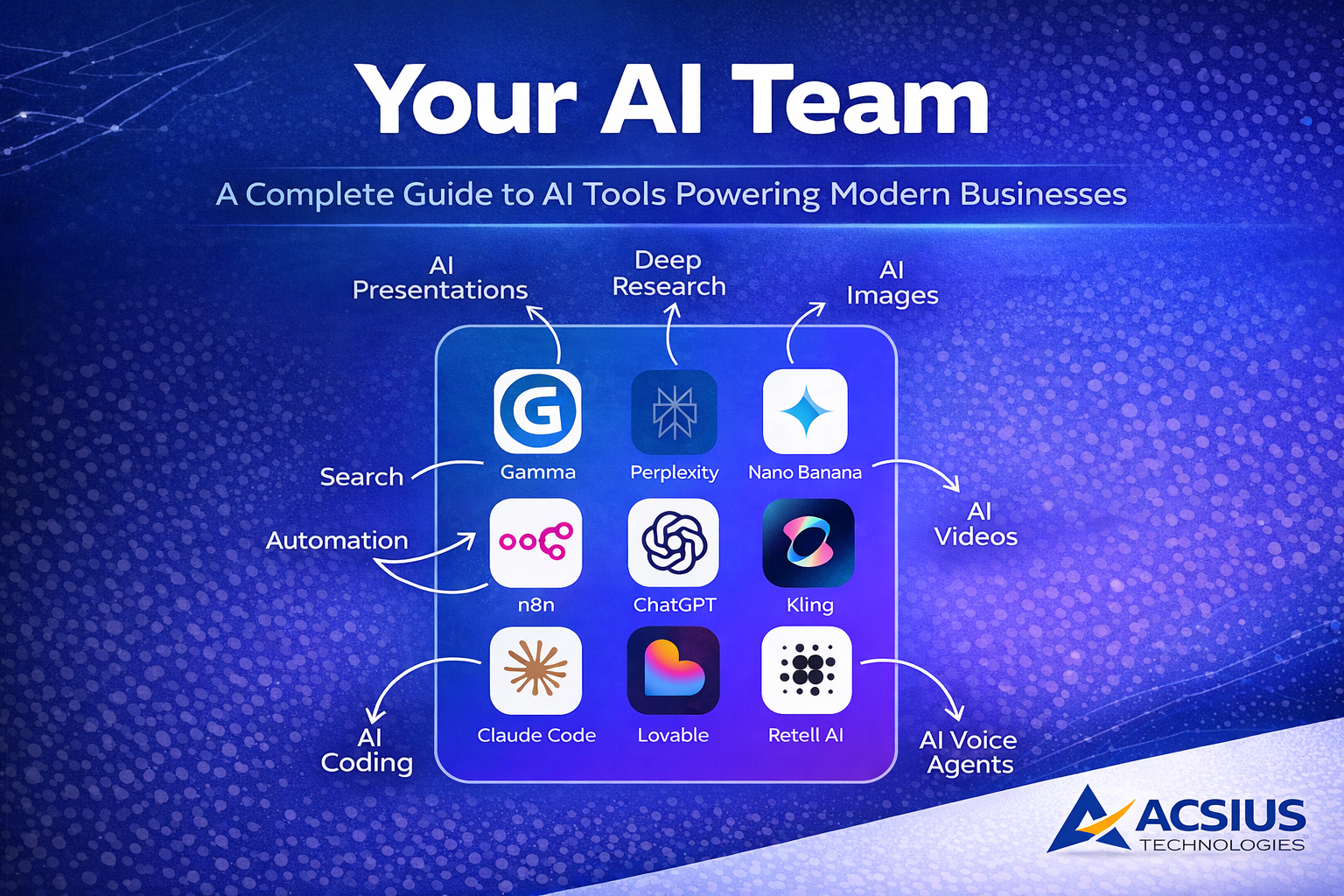
AI is no longer limited to experiments or side projects. It has become a core operational layer for modern businesses. Instead of hiring large teams for every function, companies are now building a virtual AI team—a collection of specialized AI tools, each acting like a dedicated team member.
At ACSIUS, we call this concept “Your AI Team.”
It’s a strategic approach where AI tools handle execution, automation, and acceleration—while humans focus on creativity, strategy, and decision-making.
In this guide, we’ll explore:
- What an AI team really is
- Why it matters in 2026 and beyond
- A detailed breakdown of each AI tool
- How businesses can use these tools together effectively
What Is an AI Team?
An AI Team is a structured ecosystem of AI-powered tools, each responsible for a specific business function—similar to how human teams operate.
Instead of one general-purpose tool doing everything, an AI team consists of specialists, such as:
- A researcher
- A designer
- A developer
- A marketer
- An automation manager
- A customer support agent
Each tool performs its role independently but works together as part of a unified workflow.
Why AI Teams Are Replacing Traditional Workflows
1. Speed at Scale
AI tools work instantly and simultaneously, dramatically reducing turnaround times.
2. Cost Optimization
Businesses save on hiring, training, and operational costs.
3. Always-On Productivity
AI tools work 24/7 without fatigue or downtime.
4. Data-Driven Decisions
AI processes massive amounts of data to deliver actionable insights.
5. Competitive Advantage
Organizations using AI effectively move faster than competitors still relying on manual systems.
The Complete Breakdown of Your AI Team Tools
Below is a detailed explanation of each tool commonly used in a modern AI team, along with its role and business impact.
1. Gamma – AI Presentation Specialist
Primary Role: AI Presentations & Visual Storytelling
Gamma helps businesses create professional presentations without starting from scratch.
What Gamma Does:
- Converts ideas and text into polished slide decks
- Automatically designs layouts and visuals
- Structures content logically for storytelling
Business Use Cases:
- Client proposals
- Sales decks
- Internal training presentations
- Strategy documentation
Value for Businesses:
Gamma saves hours of manual design work and ensures presentations look professional and consistent—especially useful for marketing and sales teams.
2. Perplexity – AI Deep Research Assistant
Primary Role: Research, Knowledge Discovery, and Analysis
Perplexity is an advanced AI research tool that provides direct, well-sourced answers.
What Perplexity Does:
- Conducts deep research across multiple sources
- Summarizes complex topics
- Provides real-time insights with citations
Business Use Cases:
- Market research
- SEO and content research
- Competitive analysis
- Technical documentation
Value for Businesses:
Instead of spending hours searching and reading, teams get clear answers instantly—leading to faster and smarter decision-making.
3. Nano Banana – AI Image Generation Tool
Primary Role: AI Image Creation & Visual Assets
Nano Banana helps generate custom images tailored to brand and marketing needs.
What Nano Banana Does:
- Generates AI-based visuals
- Creates social media graphics
- Supports UI/UX concept design
Business Use Cases:
- Marketing creatives
- Blog images
- Social media posts
- Ad creatives
Value for Businesses:
Designers and marketers can experiment freely without creative bottlenecks, speeding up content production.
4. ChatGPT – AI Content & Strategy Assistant
Primary Role: Content Creation, Ideation & Problem Solving
ChatGPT acts as a multi-functional assistant across departments.
What ChatGPT Does:
- Writes blogs, emails, scripts, and copy
- Helps with SEO content
- Assists with planning and strategy
- Explains complex concepts simply
Business Use Cases:
- Content marketing
- SEO optimization
- Client communication
- Internal documentation
Value for Businesses:
ChatGPT significantly reduces writing time while maintaining clarity and consistency across content.
5. n8n – AI Automation & Workflow Manager
Primary Role: Automation and System Integration
n8n connects tools, platforms, and processes into automated workflows.
What n8n Does:
- Automates repetitive tasks
- Connects APIs and apps
- Reduces manual operations
Business Use Cases:
- Lead management automation
- Reporting workflows
- CRM integrations
- SEO task automation
Value for Businesses:
Automation frees teams from repetitive work and improves operational efficiency.
6. Kling – AI Video Creation Tool
Primary Role: AI Video Generation
Kling enables businesses to produce videos without heavy editing or production teams.
What Kling Does:
- Converts text into videos
- Generates marketing visuals
- Automates video storytelling
Business Use Cases:
- Social media videos
- Promotional content
- Product explainers
Value for Businesses:
Video creation becomes faster, cheaper, and more scalable—ideal for digital marketing.
7. Claude Code – AI Coding Assistant
Primary Role: AI Development & Coding Support
Claude Code assists developers by improving productivity and code quality.
What Claude Code Does:
- Generates clean code
- Explains complex logic
- Helps debug issues
Business Use Cases:
- Web development
- App development
- Code review and optimization
Value for Businesses:
Developers work faster and focus on architecture and problem-solving rather than repetitive coding tasks.
8. Lovable – AI Website Builder
Primary Role: AI Website Creation & UX Design
Lovable helps businesses launch websites quickly with minimal effort.
What Lovable Does:
- Generates website layouts
- Writes website content
- Optimizes structure for UX
Business Use Cases:
- Landing pages
- Startup websites
- MVP launches
Value for Businesses:
Websites can be launched in days instead of weeks, accelerating go-to-market strategies.
9. Retell AI – AI Voice Agent Platform
Primary Role: Voice AI & Conversational Agents
Retell AI powers intelligent voice-based interactions.
What Retell AI Does:
- Handles customer calls
- Provides instant voice responses
- Operates 24/7
Business Use Cases:
- Customer support
- Appointment booking
- Lead qualification
Value for Businesses:
Businesses offer consistent, scalable voice support without increasing human workload.

How These Tools Work Together as One AI Team
Individually, each tool is powerful. Together, they create an AI-powered workflow:
- Research starts with Perplexity
- Strategy and content are shaped with ChatGPT
- Visuals come from Nano Banana
- Presentations are built in Gamma
- Videos are produced via Kling
- Websites are launched with Lovable
- Automation runs through n8n
- Code is accelerated using Claude Code
- Customer interactions are handled by Retell AI
This is what a fully functional AI team looks like.
How ACSIUS Helps Businesses Implement AI Teams
At ACSIUS Technologies, we don’t just recommend tools—we design AI-driven systems.
Our Process:
- Business requirement analysis
- AI tool selection
- Workflow integration
- Automation setup
- Team enablement & optimization
Our goal is simple: help businesses work smarter, faster, and more efficiently using AI.
The Future of Work Is AI-Augmented
AI will not replace people—but people who use AI will replace those who don’t.
Companies that build AI teams today will:
- Innovate faster
- Reduce costs
- Scale effortlessly
- Deliver better customer experiences
Final Thoughts
Building an AI team is no longer optional. It’s a strategic necessity for businesses that want to stay competitive in 2026 and beyond.
With the right tools and guidance, AI becomes a growth engine—not a complexity.
FAQs about AI Teams
How is an AI Team different from traditional teams?
Traditional teams rely heavily on manual processes and human effort. An AI Team augments human work by automating repetitive tasks, speeding up execution, and providing data-driven insights—allowing human teams to focus on strategy, creativity, and decision-making.
Are AI tools safe for business use?
Yes, most modern AI tools are designed with security, privacy, and compliance in mind. When implemented correctly and used responsibly, AI tools are safe and reliable for business operations, marketing, development, and customer support.
Does Google penalize AI-generated content?
No. Google does not penalize content simply because it is created using AI. Google focuses on content quality, originality, helpfulness, and user value. Well-written, informative, and user-focused AI-assisted content is fully acceptable.
Can AI-generated blogs rank on Google?
Yes. AI-assisted blogs can rank very well on Google if they:
- Provide original and useful information
- Match user search intent
- Are well-structured and readable
- Follow SEO best practices
Many high-ranking websites today use AI as part of their content creation process.
Which businesses benefit most from an AI Team?
AI Teams are useful for:
- Startups looking to scale quickly
- Marketing and SEO agencies
- SaaS and tech companies
- E-commerce businesses
- Enterprises aiming to reduce operational costs
Any business that values speed, efficiency, and scalability can benefit from AI tools.
Can AI tools replace human employees?
AI tools are not meant to replace humans entirely. They are designed to support and enhance human capabilities. The most successful businesses use AI to handle repetitive tasks while humans focus on creativity, strategy, and leadership.
How can small businesses use AI without a large budget?
Many AI tools offer affordable plans or free tiers. Small businesses can start with essential tools for content, automation, or research and gradually expand their AI stack as they grow.
Do AI Teams require technical expertise?
Not always. Many AI tools are designed to be user-friendly and require minimal technical knowledge. However, for advanced integrations and automation, expert guidance—like that provided by ACSIUS—can help maximize results.
How does ACSIUS help businesses implement AI tools?
ACSIUS Technologies helps businesses by:
- Identifying the right AI tools based on goals
- Integrating AI into existing workflows
- Automating processes
- Training teams to use AI effectively
- Optimizing AI-driven systems for performance and growth
Is using multiple AI tools better than using one?
Yes. A single AI tool cannot handle every business function effectively. An AI Team approach—using multiple specialized tools—delivers better results, flexibility, and scalability.
What is the future of AI Teams in business?
The future of work is AI-augmented, not AI-replaced. Businesses will increasingly rely on AI Teams to improve productivity, reduce costs, and stay competitive—while human teams focus on innovation and strategy.


Pingback: fluconazole 200 mg
Pingback: metoprolol tartrate
Pingback: is zoloft an ssri
Pingback: zudena
Pingback: clozapina
Pingback: voriconazole lab tube
Pingback: orlistat alli walmart
Pingback: can i use semaglutide for weight loss
Pingback: sildenafil cardiovascular risks
Pingback: sildenafil mechanism analysis