
The rise of artificial intelligence has transformed the way content is created. Businesses today are increasingly using AI tools to generate blog posts, website copy, product descriptions, and marketing content at scale. At the same time, Google continues to emphasize content quality, usefulness, and trust.
This has led to one critical question for marketers and business owners:
Does Google prefer AI-generated content or human-written content?
In this in-depth guide, we’ll break down how Google evaluates content, the strengths and weaknesses of AI and human writing, and how businesses can use both strategically to rank higher in search results.
Understanding Google’s Content Philosophy
Before comparing AI content and human content, it’s important to understand how Google evaluates content.
Google does not rank content based on who or what created it. Instead, Google focuses on:
- Content quality
- Search intent fulfillment
- Originality
- Experience, Expertise, Authoritativeness, and Trustworthiness (E-E-A-T)
- Helpfulness to users
Google has clearly stated that AI-generated content is not against its guidelines — as long as it is helpful, original, and created for users rather than just for search engines.
The real issue is quality, not the tool used.
What Is AI Content Writing?
AI content writing refers to content generated using artificial intelligence tools trained on large datasets. These tools analyze patterns in language and generate text based on prompts provided by users.
Common Uses of AI Content
- Blog drafts
- SEO content outlines
- Meta titles and descriptions
- Product descriptions
- Ad copy
- Social media captions
AI excels at producing content quickly, consistently, and at scale.
What Is Human Content Writing?
Human content writing involves content created by professional writers, marketers, subject matter experts, or business owners using real-world experience, creativity, and judgment.
Human writers bring:
- Contextual understanding
- Emotional intelligence
- Industry expertise
- Storytelling ability
- Ethical and strategic decision-making
This is where depth and authenticity come into play.
Google’s Official Stand on AI Content
Google has made one thing very clear:
“Using AI to generate content is not against our guidelines. Using AI to manipulate search rankings is.”
Google’s systems are designed to reward content that:
- Helps users
- Demonstrates experience and expertise
- It is written for people, not algorithms
If AI content is thin, repetitive, inaccurate, or keyword-stuffed, it may fail — not because it’s AI, but because it’s low quality.
AI Content Writing: Advantages and Limitations
Advantages of AI Content Writing
1. Speed and Scalability
AI can generate large volumes of content in minutes. This is extremely useful for:
- Large websites
- Ecommerce stores
- Content ideation
- SEO drafts
2. Cost Efficiency
AI reduces content production costs, especially for repetitive or data-driven content.
3. SEO Assistance
AI tools are excellent at:
- Keyword integration
- Structuring content
- Creating outlines
- Generating FAQs
4. Consistency
AI maintains tone and formatting consistency across multiple pages.
Limitations of AI Content Writing
1. Lack of Real Experience
AI does not have real-world experience. It cannot:
- Share firsthand insights
- Provide original case studies
- Understand nuanced business challenges
2. Generic Output
Without human refinement, AI content can feel:
- Predictable
- Repetitive
- Surface-level
3. Accuracy Risks
AI may generate:
- Outdated information
- Incorrect facts
- Assumptions presented as truth
This can harm credibility and trust.
4. Weak E-E-A-T Signals
AI alone struggles to demonstrate:
- Experience
- Authority
- Trust
Which Google values highly.
Human Content Writing: Advantages and Limitations
Advantages of Human-Written Content
1. Experience and Expertise
Human writers can:
- Share real experiences
- Offer expert opinions
- Include case studies and examples
This strongly supports Google’s E-E-A-T framework.
2. Emotional Connection
Humans write with:
- Empathy
- Persuasion
- Brand voice
- Emotional storytelling
This improves engagement and conversions.
3. Contextual Understanding
Human writers understand:
- Cultural nuances
- Industry trends
- Audience pain points
Which AI often misses.
4. Strategic Intent
Humans can align content with:
- Business goals
- Funnel stages
- Brand positioning
Limitations of Human Content Writing
1. Time-Consuming
High-quality human content takes time to research, write, and edit.
2. Higher Cost
Professional content writing requires skilled writers, editors, and strategists.
3. Scalability Challenges
Producing content at scale can be difficult without automation support.
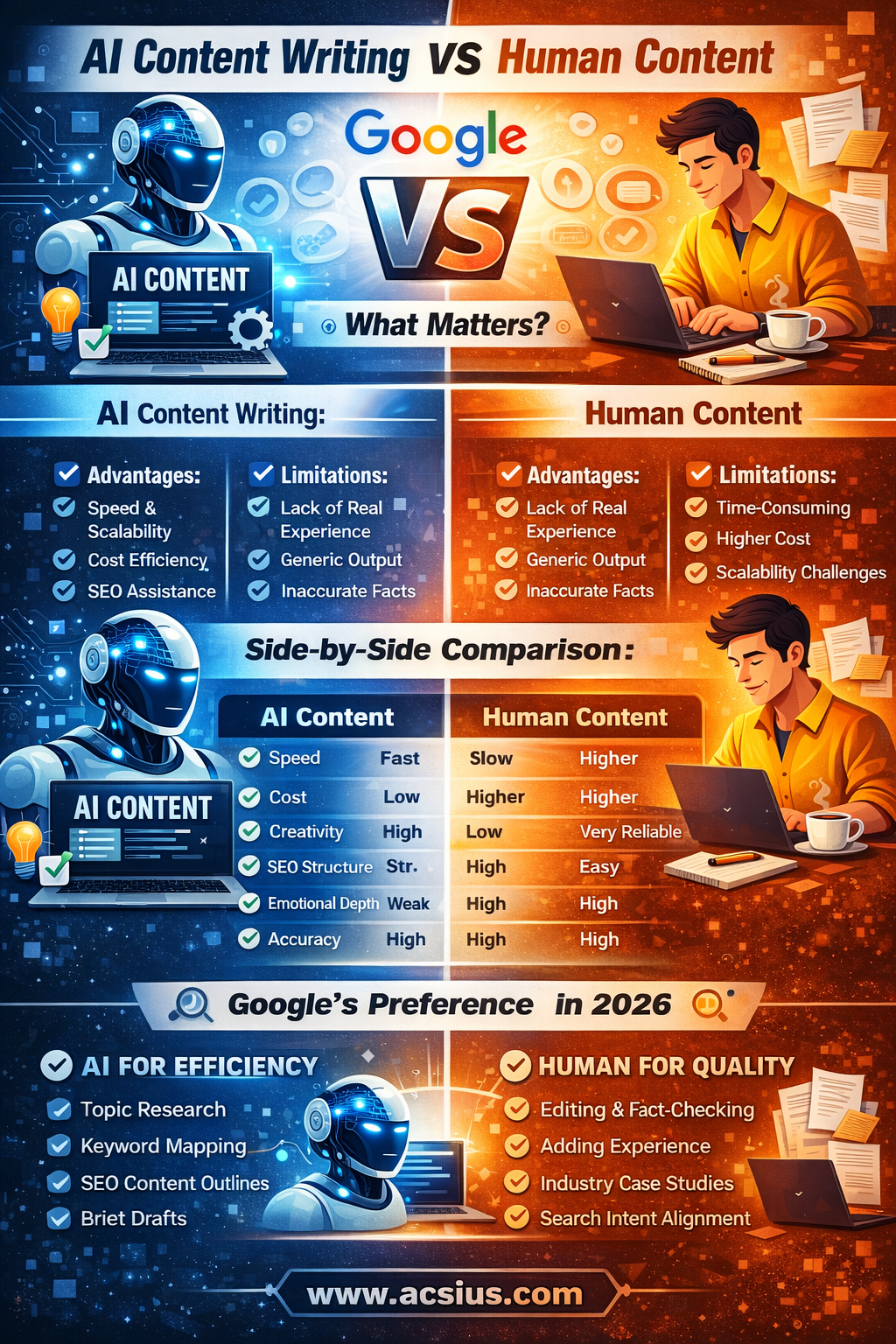
AI Content vs Human Content: A Side-by-Side Comparison
| Factor | AI Content | Human Content |
| Speed | Very Fast | Slower |
| Cost | Low | Higher |
| Creativity | Limited | High |
| Experience | None | Real-world |
| SEO Structure | Strong | Strong |
| Emotional Depth | Weak | Strong |
| Accuracy | Needs Review | More Reliable |
| Google Trust | Medium (alone) | High |
What Google Actually Prefers in 2026
Google does not prefer AI or humans.
Google prefers content that is:
✔ Helpful
✔ Original
✔ Accurate
✔ Experience-driven
✔ Trustworthy
✔ Intent-focused
If AI content meets these standards, it can rank.
If human content fails these standards, it won’t rank.
The winner is quality — not the creator.
The Best Strategy: AI + Human Content (Hybrid Model)
The most successful websites today use a hybrid content strategy.
How the Hybrid Model Works
- AI for Efficiency
- Topic research
- Keyword mapping
- Content outlines
- First drafts
- Humans for Quality
- Editing and fact-checking
- Adding experience and insights
- Improving tone and flow
- Optimizing for conversions
This approach combines speed + authenticity, which Google rewards.
How AI SEO and Content Writing Services Help Businesses Rank
Professional agencies don’t rely solely on AI or humans — they use both strategically.
An expert AI SEO and Content Writing Company ensures:
- Google guideline compliance
- E-E-A-T optimization
- Human editorial review
- Search intent alignment
- Conversion-focused content
This is especially important for:
- Service websites
- Ecommerce platforms
- SaaS businesses
- Local businesses
Common Mistakes Businesses Make with AI Content
- Publishing AI content without editing
- Overusing keywords
- Creating content only for rankings
- Ignoring accuracy and originality
- No human experience or authority
These mistakes often lead to poor rankings or content decay.
How to Make AI Content Google-Friendly
If you use AI, follow these best practices:
✔ Add human insights
✔ Include examples and case studies
✔ Verify facts
✔ Improve readability
✔ Focus on user value
✔ Avoid mass automation
AI should assist — not replace — strategy.
The Future of Content: Where Google Is Heading
Google is moving toward:
- AI-powered search
- Conversational results
- Experience-based ranking
- Brand authority signals
This means generic content will struggle, whether written by AI or humans.
Content that:
- Solves real problems
- Shows expertise
- Builds trust
will continue to win.
Final Verdict: AI Content Writing vs Human Content
Google does not choose sides.
It chooses:
Helpful, high-quality, experience-driven content.
Best Approach for Businesses
✔ Use AI for speed and scalability
✔ Use humans for trust and depth
✔ Follow Google’s guidelines
✔ Focus on users first
When AI and humans work together, content performs better — in rankings, engagement, and conversions.
FAQs About AI Content Writing vs Human Content
Does Google prefer human-written content over AI content?
Google does not prefer human or AI content specifically. Google prefers high-quality, helpful, and trustworthy content that satisfies user intent. Both AI and human content can rank if they meet Google’s quality guidelines.
Can AI-written content rank on Google?
Yes, AI-written content can rank on Google if it is:
- Well-structured
- Accurate
- Original
- Edited by humans
- Optimized for search intent
Unedited, generic AI content usually struggles to rank long-term.
Is AI content bad for SEO?
AI content is not bad for SEO when used correctly. However, publishing AI content without human review, fact-checking, and optimization can harm SEO performance. The best results come from a hybrid AI + human strategy.
How does Google detect AI-generated content?
Google does not rely on simple AI-detection tools. Instead, it evaluates content quality using signals such as usefulness, originality, engagement, accuracy, and E-E-A-T. Poor-quality content fails regardless of whether it is written by AI or humans.
What is the best content strategy for SEO in 2026?
The best content strategy in 2026 is a hybrid approach, where:
- AI is used for research, outlines, and drafts
- Humans add expertise, experience, and editing
This ensures scalability without compromising quality or trust.
Is human-written content still important for SEO?
Yes, human-written content is extremely important, especially for:
- Service pages
- Authority blogs
- Case studies
- Thought leadership content
Human experience and expertise strongly support Google’s E-E-A-T guidelines.
Should businesses use AI content writing services?
Yes, businesses can use AI content writing services, but only when combined with human editing and SEO strategy. Professional agencies ensure AI content is accurate, helpful, and aligned with Google’s ranking factors.
Can AI replace human content writers completely?
No, AI cannot fully replace human writers. AI lacks real-world experience, creativity, emotional intelligence, and strategic thinking. Human writers are essential for trust-building, conversions, and authority-driven content.
How can AI SEO and content writing services improve rankings?
AI SEO and content writing services help by:
- Improving keyword targeting
- Enhancing content structure
- Scaling content production
- Optimizing for search intent
When combined with human expertise, they deliver long-term SEO success.
