

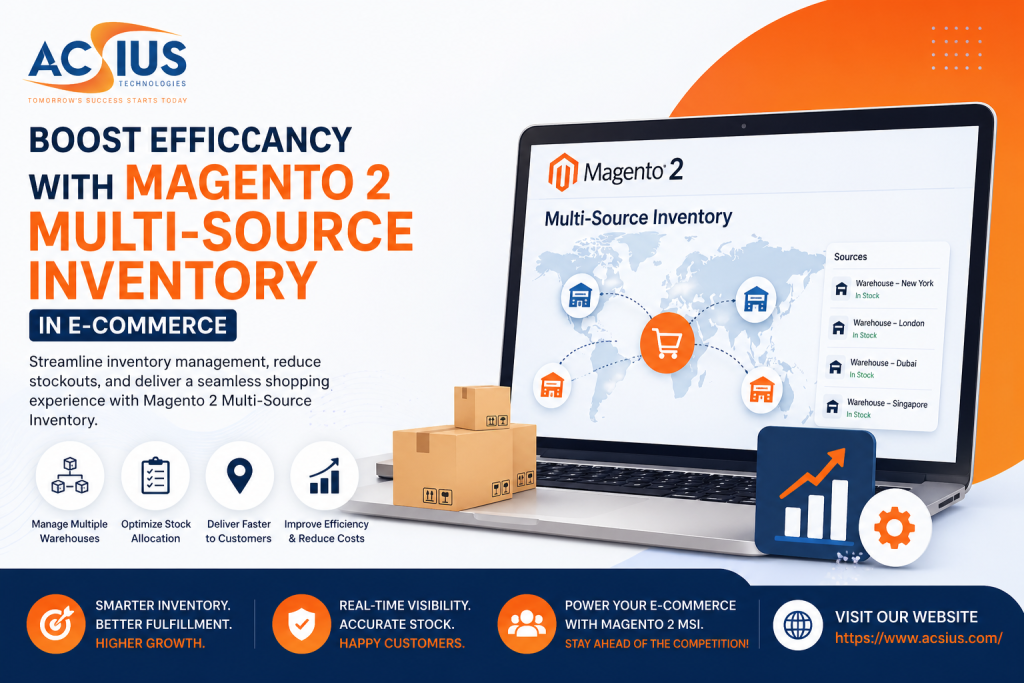
In the fast-paced world of e-commerce, efficiency isn’t just a goal—it’s the foundation of customer satisfaction and profitability. As online stores scale, one of the biggest operational nightmares becomes inventory management. Nothing frustrates a modern customer more than clicking “buy” on an in-stock item, only to receive a “partial shipment” notification or, worse, a delayed cancellation email because the nearest warehouse ran out of stock.
This is where Magento 2 Multi-Source Inventory (MSI) becomes a game-changer. For merchants transitioning from Magento 1 or rigid legacy systems, MSI is not just an update; it is a complete architectural shift toward decentralized, efficient order fulfillment.
If you are running a multi-warehouse operation, a dropshipping model, or a network of physical stores, understanding MSI is critical. In this post, we will explore how Magento 2’s MSI boosts efficiency, reduces costs, and why you might need expert developers to unlock its full potential.
The Old Way vs. The MSI Way
Traditionally, Magento 1 treated inventory as a single, monolithic source. You had one quantity value for the entire website. If you had three warehouses, you had to use third-party extensions to manually split the stock or risk selling items you didn’t actually have.
Magento 2 Multi-Source Inventory changes this entirely. Introduced natively in Magento 2.3, MSI allows you to define multiple physical or virtual locations (called “Sources”). These could be:
- Physical Warehouses:(USA East, USA West, EU Hub).
- Dropshippers:Vendor A, Vendor B.
- Brick-and-Mortar Stores:“NYC Pickup” or “LA Showroom.”
Each source has its own inventory quantity, allowing the system to intelligently decide where to pull stock from based on distance, priority, or availability.
How MSI Supercharges E-commerce Efficiency
-
The End of Overselling (Negative Inventory)
Overselling is the fastest way to destroy customer trust. With MSI, Magento aggregates data from all sources to present a single Salable Quantity to the customer. If Source A is sold out, but Source B has stock, the product remains “In Stock” on the frontend. The system automatically routes the order to Source B without merchant intervention.
-
Intelligent “Distance Priority” Algorithms
Efficiency is about speed and shipping costs. Magento 2 MSI allows you to prioritize sources. For example, if a customer in Texas places an order, the algorithm can be configured to check the “Dallas Warehouse” first. Only if that source is out of stock does it route to “California Hub.” This reduces shipping time from 5 days to 2 days and cuts courier costs immediately.
-
Optimized Partial Shipments
Previously, partial shipments were a manual headache. With MSI, if an order contains three items and one is only available in a third-party logistics (3PL) center while the others are in-house, Magento automatically splits the order into separate shipments. This allows your team to pack and send what is ready immediately, rather than waiting for a backorder.
The Technical Reality: Why You Need Expertise
While the theory of MSI is flawless, the implementation is complex. Magento 2 MSI relies heavily on asynchronous queues and a specific database structure. If set up incorrectly, you will face indexing issues or “phantom stock” errors.
To truly boost efficiency, you need to customize MSI to fit your unique supply chain. Generic out-of-the-box settings rarely work for high-volume B2B or specialized B2C stores. This is where specialized development comes in.
At this point, you have two choices: struggle with configuration errors for months, or hire Magento developers who have built MSI solutions for enterprise clients. If you are looking to scale your operations without scaling your headaches, you can hire Magento developers India based teams to build custom algorithms, integrate ERP systems, and ensure your sources sync perfectly with your sales channels.
Beyond Magento: The Ecosystem Approach
Efficient e-commerce isn’t just about the cart; it’s about the data pipeline. MSI works best when your inventory syncs across your CRM, ERP, and order management systems.
Many of our clients run hybrid tech stacks. They use Magento for transactional power, but they also run massive data analytics on Python backends to predict inventory needs. If you are building predictive stock reordering tools to feed into your Magento MSI, consider leveraging other specialists. You might need a python developer in India to build the API middleware that forecasts stock depletion and triggers MSI source transfers automatically.
Similarly, if you are migrating from a legacy platform like Shopify Plus to Magento for better inventory control, the transition is sensitive. You often need a hire dedicated shopify developer to extract your historical order data and customer records without corruption before importing them into your new Magento MSI structure.
Key Features to Configure for Efficiency
If you are ready to dive into the backend, here are the top three MSI features you must optimize to see a boost in efficiency:
- The “Stock” Aggregator:Understand that “Stocks” are different from “Sources.” A Stock maps one or more Sources to a Sales Channel (e.g., your website vs. your POS system). You need at least one Stock configured correctly to aggregate your sources.
- Source Codes:Do not use default names. Use strict, machine-readable codes (e.g., WH_PHX_A). This helps when your hire dedicated Magento developer writes custom shipping rules later.
- Backorder Logic:MSI allows “Notified Quantity” vs. “Physical Quantity.” You can set different sources to handle backorders differently, allowing you to keep a product “salable” even when physical stock hits zero, provided your vendor dropshipper guarantees fulfillment.
Avoiding Common MSI Pitfalls
- Reindexing Lag:By default, MSI uses asynchronous reindexing. If your server cron jobs are not set up perfectly, your frontend may show “Out of Stock” for an hour while the backend database updates. Tuning this requires server-level expertise.
- The “Salable” Check:MSI runs a salable query every time a product page loads. On catalogs with 50k+ SKUs, this can kill performance if Varnish cache isn’t configured to bypass the check for unauthenticated users.
- Order Routing Failures:Without proper source priority, MSI might default to the first source alphabetically. A developer must code distance tables or custom shipping matrixes to fix this.
Real-World Use Case: The “Ship from Store” Revolution
Consider a retailer with 50 physical stores and 2 central warehouses. Traditionally, they shipped only from warehouses, leaving store inventory stagnant.
With MSI, each store becomes a “Source.” When a local customer orders online:
- MSI checks the nearest store for the item.
- It routes the order to the store’s POS system.
- A store associate picks the item, packs it, and ships it locally (or prepares for curbside pickup).
Result: The company reduced warehouse shipping costs by 40% and cut delivery times from 3 days to 6 hours. However, implementing this required a hire Magento developers team to write custom API bridges between Magento MSI and the legacy POS terminals.
Conclusion: Is MSI Right for You?
If you run a single warehouse shipping worldwide, the default single-source mode in Magento is fine. But if you have multiple locations, high volume, or use dropshipping, Magento 2 Multi-Source Inventory is non-negotiable. It is the tool that transforms your e-commerce backend from a cost center into a competitive advantage.
However, MSI is a scalpel, not a hammer. To boost efficiency without breaking your checkout, you need expert hands.
Don’t let code errors cost you sales. Whether you need to fine-tune your inventory algorithms or build a custom ERP bridge, the right team makes all the difference. Visit ACSIUS today to hire Magento developers who understand the complexity of modern e-commerce.
And remember, a great store runs on a great stack. For your data and automation layers, you can also hire python developer in india for AI forecasting, or hire dedicated shopify developer for auxiliary brand stores. Start building your efficient, multi-source future today.
