

How Web Development Has Evolved Over Time
Web development has undergone a dramatic transformation over the last two decades. From static HTML pages in the early 2000s to dynamic, JavaScript-driven applications today, the web has continuously evolved to meet growing user expectations. Modern users now demand speed, performance, accessibility, personalization, and seamless experiences across devices.
In 2026, web development is no longer just about building visually appealing websites. It is about creating intelligent, high-performance, and future-ready digital experiences. Businesses that fail to adapt risk losing users, rankings, and competitive advantage.
Three technologies are playing a critical role in shaping the future of the web:
- Progressive Web Apps (PWAs)
- WebAssembly (Wasm)
- Voice Search Optimization
Together, these innovations are redefining how websites are built, optimized, and experienced. This article explores how these technologies are transforming modern web development and why businesses should adopt them now.
The Changing Expectations of Modern Web Users
Before diving into technologies, it is important to understand why web development is evolving so rapidly.
Modern users expect:
- Instant loading speeds
- App-like experiences on the web
- Offline accessibility
- Cross-platform compatibility
- Hands-free, voice-enabled interactions
Search engines like Google now prioritize user experience, performance metrics, and accessibility. Core Web Vitals, mobile-first indexing, and AI-driven search results have changed how websites are ranked.
This shift has pushed developers and businesses toward next-generation web technologies such as PWAs, WebAssembly, and voice-first optimization strategies.
Progressive Web Apps (PWAs): The New Standard for Web Experiences
What Are Progressive Web Apps?
Progressive Web Apps (PWAs) are web applications that combine the best features of websites and native mobile apps. They run in a browser but offer an app-like experience including offline access, push notifications, and home-screen installation.
PWAs leverage modern web technologies like:
- Service Workers
- Web App Manifests
- HTTPS
- Caching strategies
Unlike traditional websites, PWAs are designed to be reliable, fast, and engaging, even on slow networks.
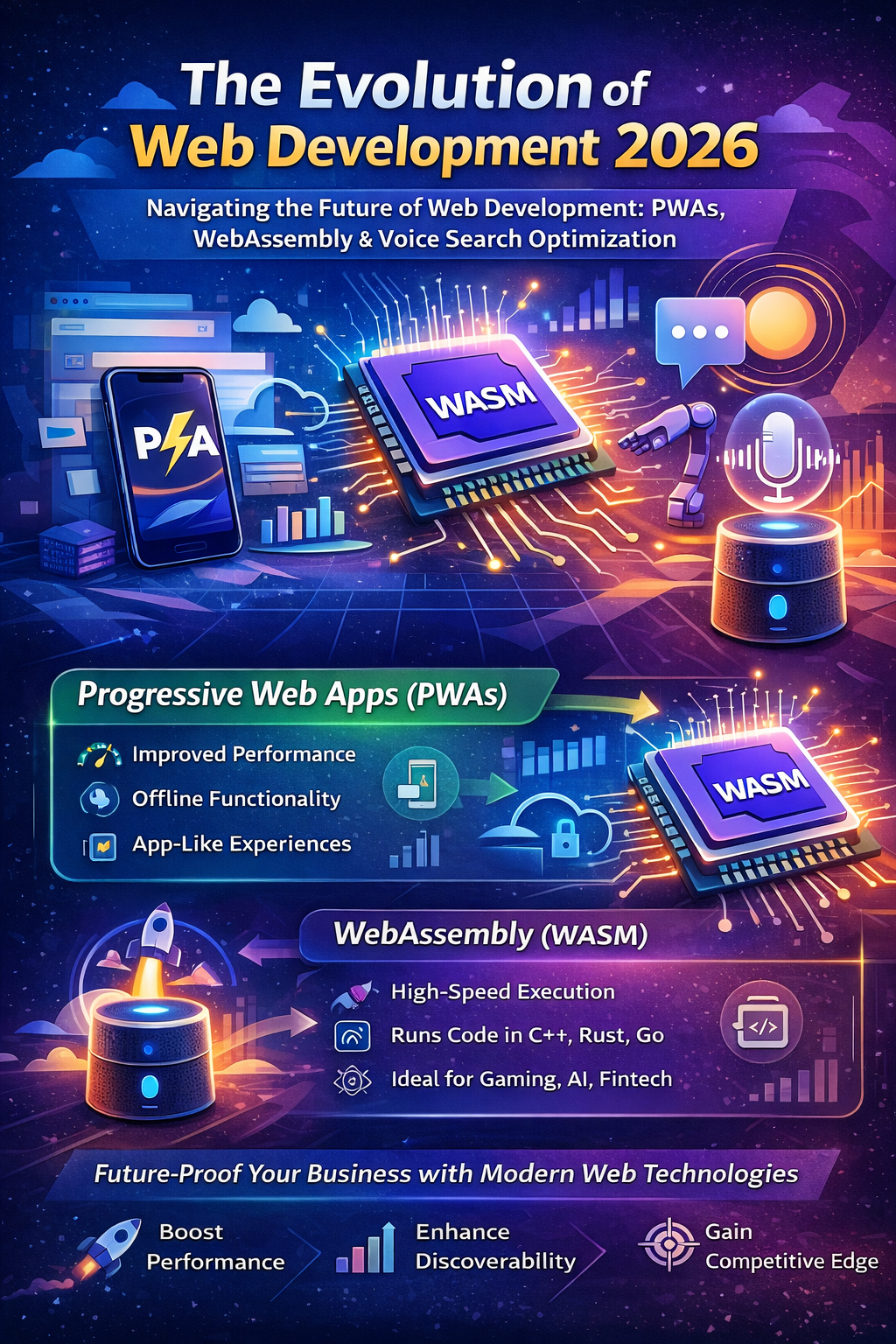
Why PWAs Matter in 2026
As mobile usage continues to dominate global internet traffic, businesses must provide seamless mobile experiences without forcing users to download heavy native apps.
PWAs solve this challenge by offering:
- Faster load times
- Reduced bounce rates
- Lower development costs
- Better user engagement
Major brands like Google, Twitter, Starbucks, and Pinterest have successfully adopted PWAs and seen measurable improvements in conversions and performance.
Key Benefits of Progressive Web Apps
1. Improved Performance
PWAs load almost instantly due to intelligent caching and service workers. This directly improves Core Web Vitals, which impacts SEO rankings.
2. Offline Functionality
Users can access content even without an internet connection. This is especially valuable for e-commerce, media, and enterprise applications.
3. App-Like User Experience
PWAs offer smooth animations, gestures, and navigation similar to native apps—without the complexity of app store submissions.
4. Cross-Platform Compatibility
One PWA works seamlessly across desktops, tablets, and mobile devices.
5. Cost-Effective Development
Businesses can maintain a single codebase instead of separate native apps for Android and iOS.
When Should Businesses Choose PWAs?
PWAs are ideal for:
- E-commerce platforms
- SaaS products
- Media and content websites
- Enterprise dashboards
- Customer portals
For organizations focused on performance, scalability, and engagement, PWAs are no longer optional—they are a strategic necessity.
WebAssembly (Wasm): Unlocking High-Performance Web Applications
What Is WebAssembly?
WebAssembly (Wasm) is a low-level, binary instruction format that enables near-native performance in web applications. It allows developers to run code written in languages like C, C++, Rust, and Go directly in the browser.
Unlike JavaScript, WebAssembly is designed for speed, efficiency, and performance-critical tasks.
Why WebAssembly Is a Game-Changer
JavaScript has been the backbone of web development for years, but it has limitations when it comes to CPU-intensive applications.
WebAssembly addresses these limitations by:
- Running faster than JavaScript in many scenarios
- Enabling complex computations in the browser
- Reducing dependency on server-side processing
This makes WebAssembly ideal for applications that demand high performance.
Key Use Cases of WebAssembly
1. High-Performance Web Applications
Applications like video editing, image processing, and 3D rendering perform significantly better with WebAssembly.
2. Gaming and Interactive Experiences
Many modern browser-based games use WebAssembly to deliver smooth, console-like performance.
3. Financial & Enterprise Applications
WebAssembly enables secure, high-speed data processing for fintech, analytics, and enterprise dashboards.
4. AI and Machine Learning in the Browser
Wasm allows AI models to run locally in browsers, improving speed and privacy.
WebAssembly vs JavaScript
| Feature | JavaScript | WebAssembly |
| Performance | Moderate | Near-native |
| Use Case | UI, logic | CPU-intensive tasks |
| Learning Curve | Easy | Moderate |
| Browser Support | Universal | Widely supported |
Rather than replacing JavaScript, WebAssembly complements it, creating powerful hybrid web applications.
Why Enterprises Are Adopting WebAssembly
For businesses focused on innovation, WebAssembly offers:
- Faster applications
- Better user experience
- Reduced server costs
- Enhanced security
As web apps become more complex, WebAssembly is becoming a core part of modern web architectures.
Voice Search Optimization: Preparing for the Conversational Web
The Rise of Voice-Driven Search
Voice search has rapidly gained popularity due to:
- Smartphones
- Smart speakers
- AI assistants like Google Assistant, Alexa, and Siri
Users are no longer typing keywords—they are asking conversational questions.
Examples:
- “What is the best web development technology in 2026?”
- “How do PWAs improve website performance?”
This shift is transforming how websites must be structured and optimized.
How Voice Search Works
Voice search relies on:
- Natural Language Processing (NLP)
- Semantic search
- AI-driven intent detection
Search engines now prioritize context, intent, and clarity over exact keyword matches.
Key Voice Search Optimization Techniques
1. Conversational Content
Content should answer questions naturally, using simple and clear language.
2. Long-Tail Keywords
Voice queries are longer and more specific than typed searches.
3. Featured Snippets Optimization
Voice assistants often read answers from featured snippets.
4. Structured Data (Schema Markup)
Schema helps search engines understand content context.
5. Fast Page Speed
Voice search heavily favors fast-loading pages.
Voice Search and Web Development
Voice search optimization is not just an SEO tactic—it influences:
- Website structure
- UX design
- Content strategy
- Accessibility
Modern web development must integrate voice-first thinking from the design stage itself.
How PWAs, WebAssembly & Voice Search Work Together
The true power of modern web development lies in combining these technologies.
- PWAs deliver speed, offline access, and mobile-first experiences
- WebAssembly enables performance-intensive features
- Voice Search Optimization ensures discoverability and accessibility
Together, they create:
- Faster websites
- Smarter applications
- Better user engagement
- Higher search visibility
This integrated approach is shaping the future-ready web ecosystem.
Business Benefits of Adopting Modern Web Technologies
Organizations that invest in modern web development gain:
- Higher conversion rates
- Better SEO performance
- Reduced bounce rates
- Improved customer satisfaction
- Long-term scalability
In competitive digital markets, these advantages translate directly into revenue growth.
What Businesses Should Do in 2026: A Strategic Roadmap
To stay ahead, businesses should:
- Audit existing web performance
- Identify opportunities for PWA implementation
- Evaluate WebAssembly for performance-critical features
- Optimize content for voice and conversational search
- Focus on UX, accessibility, and speed
- Partner with experienced web development teams
A proactive strategy ensures long-term digital success.
The Future of Web Development Beyond 2026
Looking ahead, web development will continue to evolve with:
- AI-driven interfaces
- Voice-first and multimodal search
- Edge computing
- Hyper-personalized web experiences
PWAs, WebAssembly, and voice optimization will serve as the foundation for these advancements.
Conclusion: Building Future-Ready Web Experiences
The evolution of web development is driven by performance, intelligence, and user expectations. Progressive Web Apps, WebAssembly, and Voice Search Optimization are no longer experimental technologies—they are essential components of modern digital strategy.
Businesses that embrace these innovations will deliver superior user experiences, achieve higher search visibility, and maintain a strong competitive edge in the digital landscape.
As the web continues to evolve, investing in future-ready web development is not just a technical decision—it is a strategic business imperative.
FAQs The Future of Web Development 2026
What are Progressive Web Apps (PWAs) and why are they important?
Progressive Web Apps are web applications that provide an app-like experience directly in the browser. They are important because they improve loading speed, work offline, enhance user engagement, and eliminate the need for separate native mobile apps.
How do PWAs improve website performance and SEO?
PWAs use service workers and caching to load content instantly, reducing page load time and bounce rate. Faster websites improve Core Web Vitals, which directly impacts search engine rankings and overall SEO performance.
What is WebAssembly and how does it help web developers?
WebAssembly is a high-performance binary format that allows developers to run code written in languages like C++, Rust, and Go inside web browsers. It helps developers build faster, more efficient web applications that handle complex computations better than JavaScript alone.
Is WebAssembly replacing JavaScript?
No, WebAssembly does not replace JavaScript. Instead, it works alongside JavaScript. JavaScript manages UI and interactions, while WebAssembly handles performance-intensive tasks, creating powerful hybrid web applications.
Which industries benefit the most from WebAssembly?
Industries such as fintech, gaming, SaaS, healthcare, AI, and enterprise software benefit significantly from WebAssembly due to its high performance, security, and ability to process complex data directly in the browser.
What is voice search optimization in web development?
Voice search optimization is the process of optimizing websites for spoken queries used with voice assistants like Google Assistant, Alexa, and Siri. It focuses on conversational content, structured data, fast page speed, and clear answers to user questions.
How does voice search impact SEO strategy?
Voice search shifts SEO from short keywords to long, conversational queries. Websites optimized for voice search are more likely to appear in featured snippets and spoken search results, improving visibility and organic traffic.
Why is voice search important for businesses?
Voice search allows users to interact with websites hands-free and in natural language. Businesses that optimize for voice search improve accessibility, user experience, and stay competitive as voice-enabled devices continue to grow.
Can PWAs, WebAssembly, and voice search be used together?
Yes, these technologies work best when combined. PWAs enhance performance and engagement, WebAssembly boosts processing speed, and voice search optimization improves discoverability—together creating future-ready web experiences.
Are PWAs suitable for enterprise applications?
Yes, PWAs are highly suitable for enterprise applications such as dashboards, customer portals, and internal tools due to their scalability, offline support, and cross-platform compatibility.
How can businesses start adopting modern web development technologies?
Businesses should begin with a website performance audit, identify opportunities for PWA implementation, evaluate WebAssembly for performance-heavy features, and optimize content for voice search. Partnering with experienced web development teams ensures successful adoption.
Do modern web technologies increase development costs?
Initially, there may be an investment in upgrading infrastructure, but in the long run, modern web technologies reduce maintenance costs, improve scalability, and deliver higher ROI through better performance and user engagement.
Is voice search optimization relevant for B2B websites?
Yes, voice search optimization is increasingly relevant for B2B websites as decision-makers use voice assistants for research, queries, and quick information retrieval.
How long will PWAs and WebAssembly remain relevant?
PWAs and WebAssembly are foundational technologies and are expected to remain relevant for many years as browsers, AI integration, and performance demands continue to grow.

Pingback: hello world
Pingback: finasteride minoxidil
Pingback: what is meloxicam for