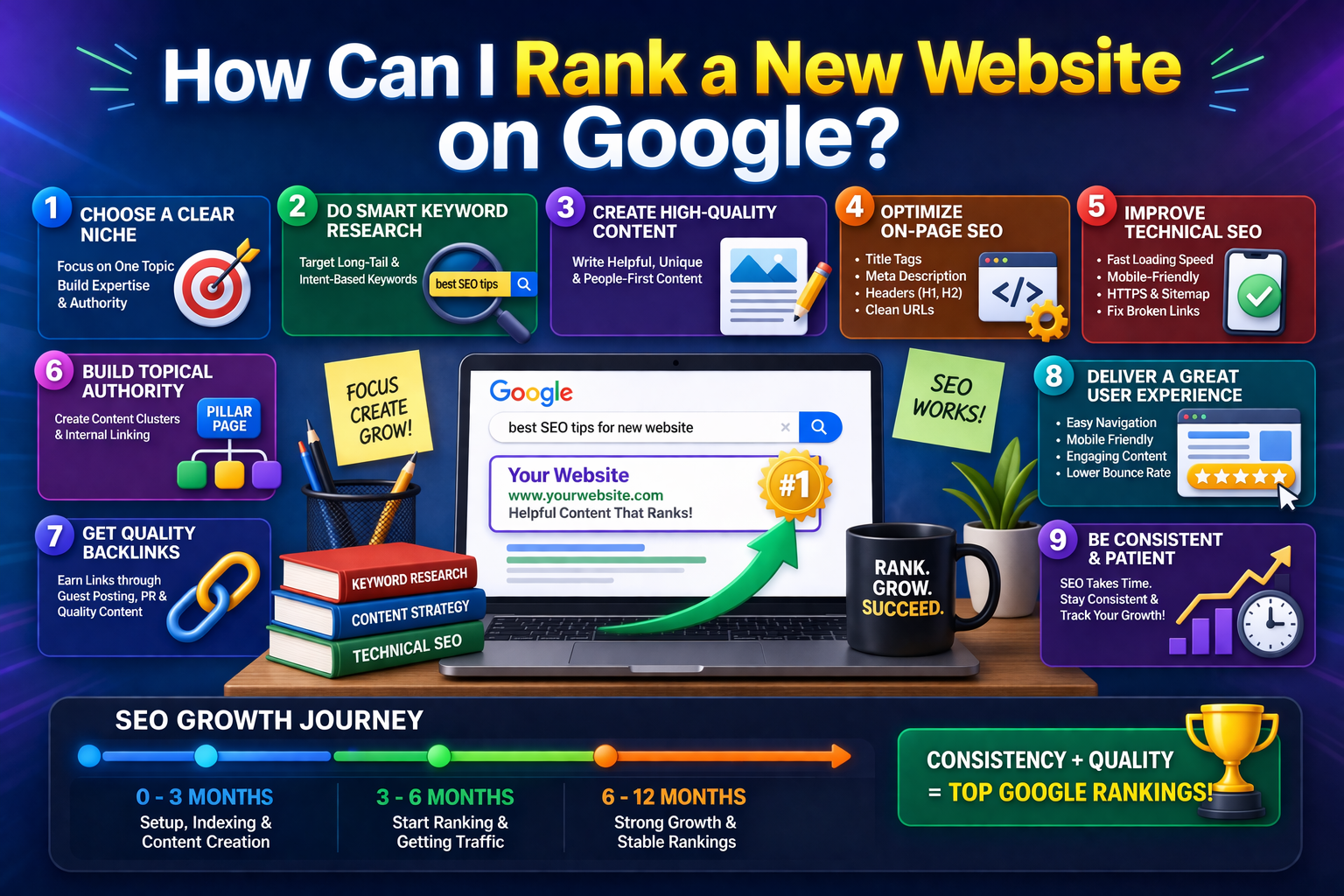
Launching a new website in 2026 is exciting—but ranking it on Google is more challenging than ever. With AI-driven algorithms, intense competition, and evolving ranking factors, simply publishing content is no longer enough. Today, success depends on strategy, consistency, and delivering real value to users.
If you want faster and more reliable results, working with professionals offering local seo services india or Organic SEO Services India can significantly accelerate your growth. But even if you’re starting on your own, this 2026 guide will show you exactly how to rank a new website step by step.
Understanding Google’s Ranking System in 2026
Google has evolved into an AI-powered, intent-driven search engine. It no longer ranks pages based on keywords alone.
Today, Google evaluates:
- User intent and satisfaction
- Content quality and originality
- Website performance and speed
- Trust signals (E-E-A-T)
Websites that genuinely help users and provide real value are rewarded with higher rankings.
👉 In simple terms: If your content solves problems better than competitors, you will rank.
Why New Websites Struggle to Rank
Ranking a new website is difficult because:
- No domain authority
- No backlinks
- No trust signals
- No historical data
Google doesn’t yet trust your site, so it takes time to build credibility.
Additionally, the internet is more crowded than ever, with AI-generated content increasing competition significantly.
Step-by-Step Strategy to Rank a New Website
-
Start with a Clear Niche
One of the biggest SEO mistakes is targeting too many topics.
Instead:
- Focus on a specific niche
- Build expertise in one area
- Create related content
Google prefers websites that show topical authority rather than broad, unfocused content.
-
Perform Smart Keyword Research
Keyword research in 2026 is about intent, not just volume.
Focus on:
- Long-tail keywords
- Question-based queries
- Low-competition keywords
Example:
- ❌ “SEO services”
- ✅ “SEO services for startups in India”
Targeting specific queries helps new websites rank faster.
-
Create High-Quality, Helpful Content
Content is still the most important ranking factor—but only if it’s useful.
Your content should:
- Solve real problems
- Be easy to read
- Offer unique insights
- Be well-structured
Google prioritizes helpful, people-first content over generic articles.
👉 Publishing fewer but high-quality articles is better than mass content.
-
Match Search Intent Perfectly
Search intent is critical.
Every keyword falls into one of these categories:
- Informational
- Navigational
- Commercial
- Transactional
If your content doesn’t match the user’s intent, it won’t rank—no matter how optimized it is.
-
Build a Strong Website Structure
A well-structured website improves both user experience and SEO.
Best practices:
- Clean URL structure
- Logical navigation
- Internal linking
- Mobile-friendly design
This helps Google crawl and understand your site easily.
-
Focus on Technical SEO
Technical SEO is the foundation of rankings.
Must-have elements:
- Fast loading speed
- Mobile optimization
- HTTPS security
- XML sitemap
- No broken links
Google prioritizes fast and responsive websites as ranking factors.
-
Build Topical Authority (Content Clusters)
Instead of random blogs, use a pillar + cluster strategy:
- One main guide (pillar page)
- Multiple supporting articles
- Internal links connecting them
This approach signals expertise and improves rankings.
-
Build High-Quality Backlinks
Backlinks are still one of the strongest ranking signals.
Effective methods:
- Guest posting
- PR outreach
- Directory submissions
- Content marketing
Backlinks act as “votes of trust” for your website.
-
Optimize On-Page SEO
On-page SEO helps Google understand your content.
Key elements:
- Title tags
- Meta descriptions
- Headers (H1, H2, H3)
- Keyword placement
- Image optimization
But avoid keyword stuffing—Google penalizes it.
-
Improve User Experience (UX)
User experience is now a ranking factor.
Google tracks:
- Bounce rate
- Time on page
- Engagement
A better UX leads to higher rankings and conversions.
-
Use Internal Linking Effectively
Internal links help:
- Distribute authority
- Improve navigation
- Increase engagement
👉 Always connect related pages.
-
Leverage Local SEO (If Applicable)
If your business targets a specific area, local SEO is essential.
With local seo services india, you can:
- Optimize Google Business Profile
- Target location-based keywords
- Get local backlinks
- Increase local visibility
This helps attract nearby customers and improve rankings.
-
Use Organic SEO Services for Long-Term Growth
SEO is a long-term investment.
By using Organic SEO Services, you can:
- Build sustainable traffic
- Improve rankings naturally
- Reduce dependency on ads
- Increase ROI
This ensures consistent growth over time.
-
Optimize for AI & Voice Search
AI-driven search is transforming SEO.
To stay ahead:
- Use conversational keywords
- Answer questions clearly
- Add FAQs
- Use structured data
This helps you appear in:
- Featured snippets
- AI-generated answers
- Voice search results
-
Be Consistent and Patient
SEO takes time.
Typical timeline:
- 0–3 months: Setup and indexing
- 3–6 months: Initial rankings
- 6–12 months: Growth
Consistency is the key to long-term success.
Common Mistakes to Avoid
Avoid these errors:
- Publishing low-quality content
- Ignoring technical SEO
- Targeting high-competition keywords
- Not updating content
- Expecting instant results
These mistakes can delay your rankings significantly.
Advanced Tips to Rank Faster
-
Use Schema Markup
Helps Google understand your content better.
-
Update Old Content
Refreshing content improves rankings quickly.
-
Track Performance
Use tools like Google Analytics and Search Console.
-
Focus on Brand Signals
Build trust through reviews and mentions.
Future of SEO Beyond 2026
SEO will continue evolving with:
- AI-powered search engines
- Voice and visual search
- Personalized results
- Zero-click searches
Websites that focus on quality, trust, and user experience will dominate rankings.
Conclusion
Ranking a new website on Google in 2026 is not about shortcuts—it’s about strategy, consistency, and delivering value.
To succeed, focus on:
- High-quality content
- Search intent
- Technical optimization
- Authority building
SEO is a long-term game, but the rewards are massive.
If you want faster results and expert guidance, investing in local seo services India or Organic SEO Services India can help you build a strong foundation and achieve sustainable growth.
FAQs
What is the fastest way to rank a new website?
The fastest way includes:
- Targeting low-competition keywords
- Publishing high-quality content
- Optimizing technical SEO
- Building backlinks
Using professional Organic SEO Services India can also accelerate results.
Can I rank a new website without backlinks?
Yes, but it is difficult. You can rank for low-competition keywords without backlinks, but to compete for high-ranking positions, backlinks are essential.
How important is keyword research in 2026?
Keyword research is still crucial, but now it focuses more on:
- User intent
- Long-tail keywords
- Conversational queries
It helps you target the right audience and improve rankings.
What type of content ranks best on Google?
Content that:
- Solves user problems
- Is original and in-depth
- Matches search intent
- Is easy to read and well-structured
Google prioritizes helpful, people-first content.
Do I need technical SEO for a new website?
Yes, technical SEO is essential. Without it, your site may not rank at all.
Key factors include:
- Website speed
- Mobile-friendliness
- Secure HTTPS
- Proper indexing
How does local SEO help new websites?
If your business targets a specific location, local seo services India can help you:
- Rank in local searches
- Attract nearby customers
- Improve visibility on Google Maps
How many blog posts should I publish initially?
Start with 5–10 high-quality articles focused on your niche. Quality matters more than quantity when building a new website.
What are the biggest SEO mistakes to avoid?
Common mistakes include:
- Keyword stuffing
- Low-quality content
- Ignoring technical SEO
- Not building backlinks
- Expecting quick results
Avoiding these helps you rank faster.
Is SEO better than paid ads for new websites?
SEO provides long-term and sustainable traffic, while paid ads deliver quick but temporary results. Ideally, use both—but SEO offers better ROI over time.