

Have you ever seen a website ranking number one on Google and thought—how did they get there? What if you could look at what they did, copy the smart parts, and use them to grow your own website?
That’s exactly what reverse engineering in SEO is.
At ACSIUS, we use this smart method to help websites rank higher. Want to know how it works? Let’s break it down, step by step—just like a teacher explains a new topic in class.
What Does Reverse Engineering in SEO Mean?
Reverse engineering in SEO means looking at the top websites on Google and learning how they got there.
You find out:
- What keywords they use
- What kind of content they write
- Who links to their pages
- How fast their site loads
- And what you can do better!
Then, you use this information to build your own strong SEO strategy.
Ask Yourself:
- Why start from zero when others have already done the hard work?
- Why not study them and then improve on what they did?
- Isn’t that the smart way to win?
Simple Steps to Reverse Engineering in SEO
Here’s how we do it at ACSIUS:
1. Find your competitors
Look at the websites that show up on Google when people search for your main keywords.
2. Study their keywords
What words do they use to bring people to their site?
3. Read their content
Is it a blog? A video? A guide? How long is it? What topics do they cover?
4. Check who links to them
Are other websites linking to them? Can you get links from the same places?
5. Look at their website speed and structure
Is their site fast? Easy to use on phones? Google loves that.
6. Spot what’s missing
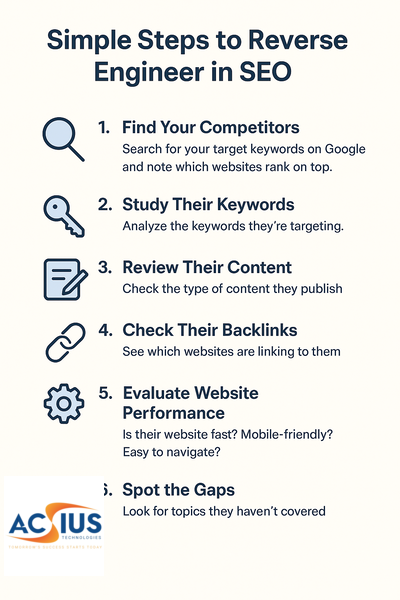
What are they not talking about that you can? Can you write something better?
How ACSIUS Helped a Tech Client in Reverse Engineering
Let’s say ACSIUS is helping a company that sells business software.
We first looked at their top competitors. These competitors were ranking well for words like “business analytics tools” and “best software for small companies.”
Then we saw that the competitors had:
- Long blog posts with real-life examples
- Backlinks from popular tech websites
- Pages that load fast on mobile phones
We helped our client:
- Write better, more useful content
- Target new keywords like “affordable analytics for small teams”
- Get links from trusted blogs
Within a few months, their pages started ranking higher. Why? Because we used reverse engineering to learn what works—and then did it better.
Want to Grow Your Google Rankings?
Let ACSIUS help you use reverse engineering in SEO to boost your website traffic.
👉 Contact us today and let’s make your site rank higher.
Key Benefits of Reverse Engineering in SEO
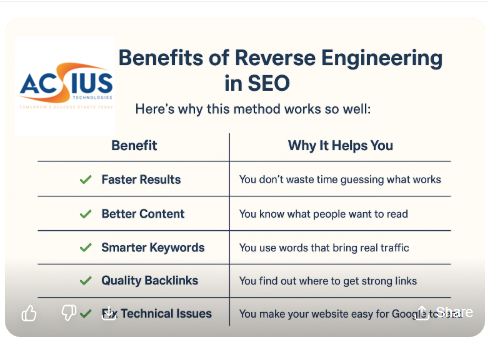
Here’s why this method works so well:
| Benefit | Why It Helps You |
| ✅ Faster Results | You don’t waste time guessing what works |
| ✅ Better Content | You know what people want to read |
| ✅ Smarter Keywords | You use words that bring real traffic |
| ✅ Quality Backlinks | You find out where to get strong links |
| ✅ Fix Technical Issues | You make your website easy for Google to read |
Why do all the hard work from scratch when you can follow what already works?
Understand Reverse Engineering in SEO with example
Imagine you have a math test. Instead of starting fresh, you look at your class topper’s notebook. You see what methods they used, how they solved problems, and what mistakes to avoid.
Wouldn’t that help you score better?
That’s exactly how reverse engineering works in SEO. Learn from the best—then do better.
Can Reverse Engineering in SEO Help You Beat Your Competitors?
Yes, reverse engineering in SEO can help you beat your competitors by showing you exactly what they’re doing right. You can study their keywords, backlinks, and content strategy—then create something even better. This gives you a real chance to outrank them in search results.
Is Reverse Engineering Only for Big Brands with Large SEO Budgets?
No, reverse engineering is not just for big brands. Even small businesses and startups can use free or low-cost SEO tools to analyze competitors and find growth opportunities. It’s a smart and affordable way to improve your rankings, no matter your budget.
Does Reverse Engineering Guarantee First-Page Rankings on Google?
No, reverse engineering doesn’t guarantee page-one results overnight. But yes, it gives you a much better chance of ranking higher by using proven strategies. Combine it with great content and good SEO practices, and your chances of reaching the first page go way up.
Conclusion
So, what is reverse engineering in SEO?
It’s a smart way to grow your traffic without starting from zero. You look at the best-ranking websites, see what they are doing right, and use that knowledge to improve your own website.
At ACSIUS, we help businesses like yours do exactly that. We don’t guess. We study. We plan. We build better strategies.
FAQs related to Reverse Engineering in SEO
What are the key performance indicators (KPIs) to monitor in a PPC campaign?
A breakdown of essential metrics, including click-through rate, conversion rate, and return on investment.
Are there any upcoming trends in PPC services that businesses should be aware of?
A glimpse into emerging technologies and anticipated trends in the PPC industry.
Can PPC campaigns be successful in regional languages in India?
Guidance on adapting PPC strategies to regional languages and cultural preferences in India.
What is PPC?
PPC, or Pay-Per-Click, is a digital advertising model where advertisers pay a fee each time their ad is clicked. It is a way of buying visits to a website rather than earning them organically.
How does PPC work?
Advertisers bid on specific keywords relevant to their target audience. When users search for those keywords, the ads appear in the search engine results. Advertisers only pay when someone clicks on their ad.
Which platforms offer PPC services?
Popular PPC platforms include Google Ads, Bing Ads, and various social media platforms such as Facebook Ads and Twitter Ads.
Why should businesses in India consider PPC services?
PPC offers businesses in India a targeted approach to reach their audience, instant visibility, measurable ROI, and cost-effective advertising with control over budgets.
How important is keyword research in PPC campaigns?
Keyword research is crucial in PPC campaigns as it helps businesses identify and bid on the right keywords relevant to their audience. It forms the foundation for effective ad targeting.
What role does localization play in PPC advertising in India?
Localization is significant in PPC for the Indian market. Ad copies, keywords, and targeting should align with local cultures, languages, and preferences to resonate with the diverse audience.
How does mobile optimization impact PPC campaigns in India?
Mobile optimization is essential as India is a mobile-first market. Responsive ad designs and mobile-friendly landing pages ensure a seamless experience for users on various devices.
What are ad extensions, and how do they benefit PPC campaigns?
Ad extensions are additional information displayed with PPC ads, such as site links, callouts, and structured snippets. They enhance ad visibility, provide more information to users, and make ads more compelling.
How can businesses stay compliant with regulations in India?
Advertisers must stay informed about local regulations related to online advertising and data privacy. Adherence to these regulations is crucial to running PPC campaigns without legal complications.
What metrics are important for measuring the success of PPC campaigns?
Key metrics include click-through rate (CTR), conversion rate, and return on investment (ROI). These metrics help businesses analyze the performance of their campaigns and make data-driven decisions.
Is PPC competitive in the Indian market?
Yes, the Indian digital space is highly competitive. Constant monitoring of competitors, staying updated on industry trends, and adapting strategies are essential to succeed in the dynamic market.
How can businesses ensure cultural sensitivity in their PPC campaigns?
Businesses should understand and respect cultural nuances across different regions in India. Ad copies, images, and overall campaign content should be crafted with cultural sensitivity to avoid any unintentional missteps.
Can PPC campaigns be integrated with social media platforms?
Yes, PPC campaigns can be integrated with popular social media platforms like Facebook, Instagram, and Twitter. Social media integration enhances reach and engagement by connecting with the audience across different online touchpoints.
What is conversion tracking, and why is it important in PPC?
Conversion tracking involves measuring the success of PPC campaigns by tracking desired actions, such as completed purchases or lead generation. It helps businesses understand the effectiveness of their campaigns and optimize for better results.
How can businesses adapt their PPC strategies to the evolving digital landscape in India?
Staying updated on industry trends, technological advancements, and consumer behavior is crucial. Adapting strategies based on these insights ensures that businesses remain relevant and effective in the evolving digital landscape.
