
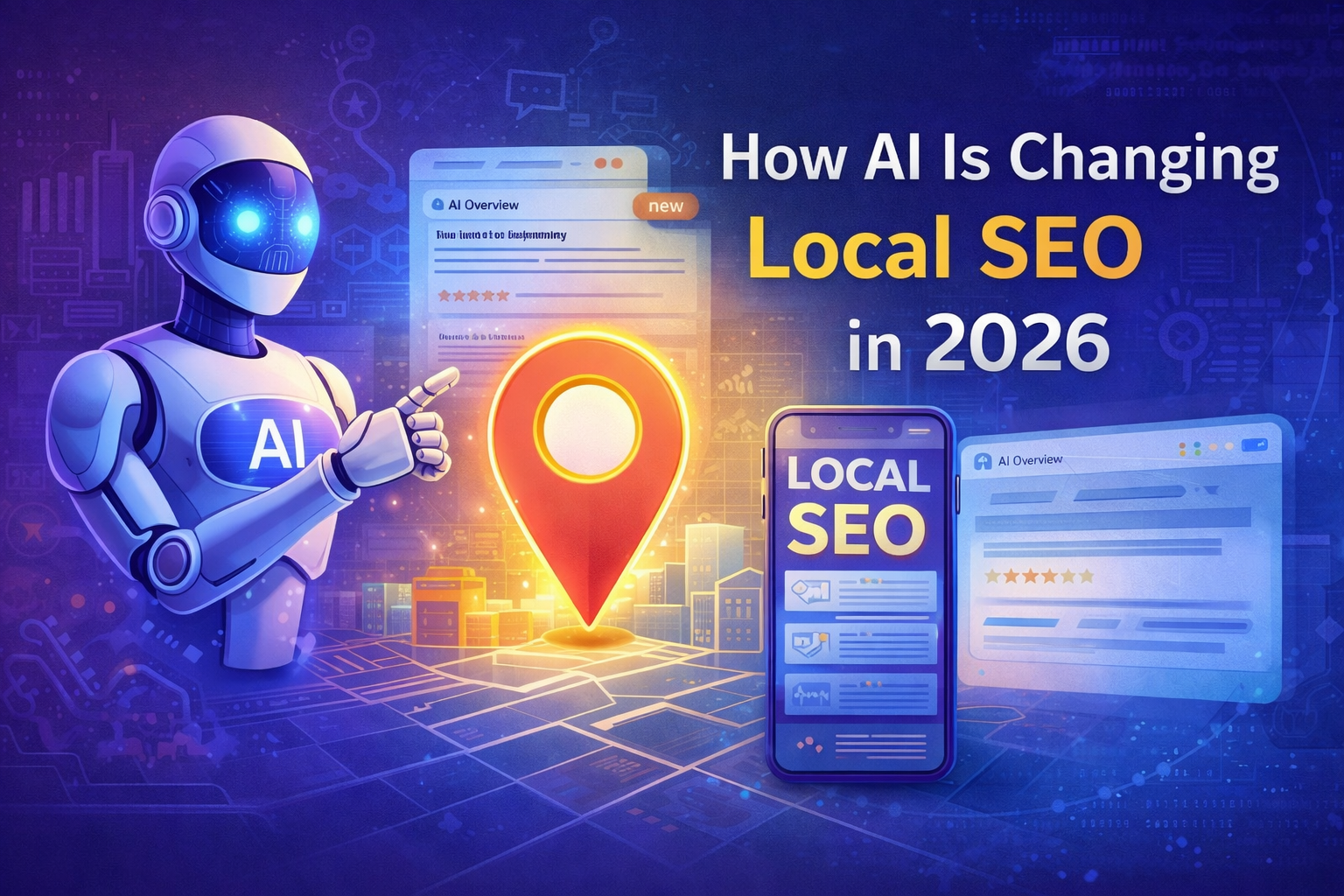
Local search has evolved dramatically over the past few years. What once relied heavily on keywords, citations, and backlinks is now influenced by artificial intelligence, user behavior, intent prediction, and contextual understanding. In 2026, local SEO is no longer just about optimizing for search engines — it is about optimizing for AI-driven search experiences.
Businesses that fail to adapt to this shift risk losing visibility in increasingly personalized and competitive local search results.
Artificial intelligence is not just assisting search engines; it is fundamentally reshaping how local results are generated, ranked, and displayed. From AI-powered search summaries to predictive intent mapping, local SEO strategies must now align with machine learning systems that evaluate context, relevance, trust, and real-world engagement signals.
In this in-depth guide, we will explore how AI is transforming local SEO in 2026 and what businesses must do to remain competitive.
The Evolution of Local SEO: From Keywords to Context
Traditional local SEO focused on:
- Keyword placement
- NAP (Name, Address, Phone) consistency
- Directory citations
- Backlink acquisition
- Basic Google Business Profile optimization
While these elements still matter, AI has added new layers of complexity.
Search engines now evaluate:
- User intent
- Behavioral signals
- Search history
- Location context
- Device type
- Real-time relevance
AI models analyze patterns at scale, meaning local rankings are no longer static. Two users in the same city may see different results based on their behavior and preferences.
This shift from keyword-matching to contextual understanding is one of the most significant changes in modern SEO.
AI-Powered Search Results and Local Visibility
In 2026, AI-generated search summaries and intelligent result panels are becoming increasingly common. Instead of simply listing websites, search engines provide summarized answers, local recommendations, and interactive elements.
For local businesses, this means:
- Visibility is no longer limited to traditional blue links
- Structured data matters more than ever
- Content must answer real user questions
- Authority and trust signals are prioritized
AI-driven results often pull information directly from websites, reviews, and business profiles. If your local business content lacks clarity, structured formatting, or topical authority, it may be excluded from these AI-generated summaries.
The Role of AI in Google Business Profile Optimization
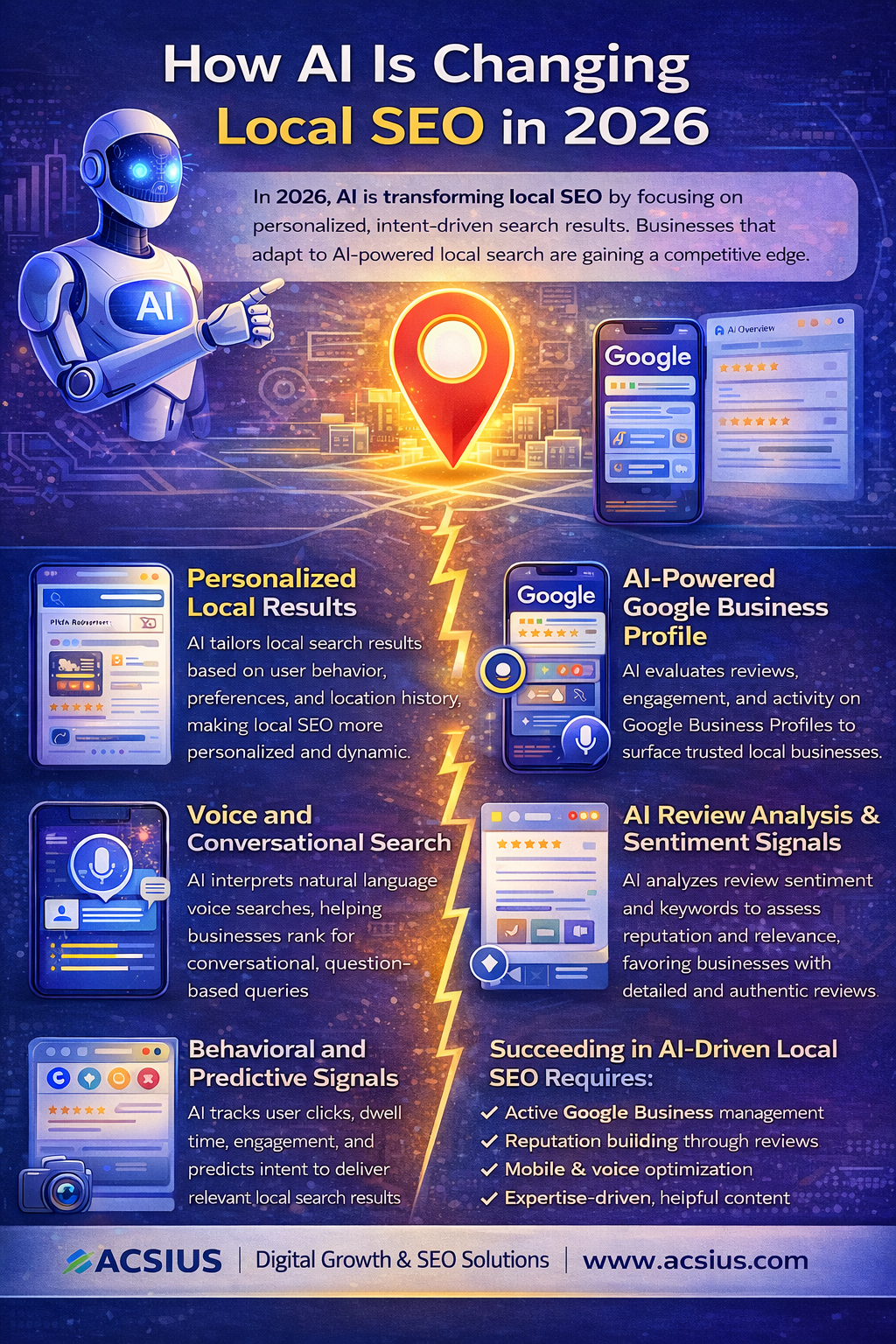
Google Business Profile (GBP) remains a central component of local SEO. However, AI now evaluates GBP profiles more intelligently.
Search engines analyze:
- Review sentiment
- Response behavior
- Posting frequency
- Image engagement
- Category relevance
- Real-world interaction data
AI systems can interpret patterns in customer feedback. For example, if multiple reviews mention “fast service” or “friendly staff,” those phrases can influence ranking for related queries.
This means businesses must actively manage their profiles — not just set them up.
In 2026, local SEO success requires:
- Regular review responses
- Strategic keyword integration in business descriptions
- Consistent updates
- High-quality image uploads
- Accurate category selection
AI rewards businesses that demonstrate ongoing engagement.
AI and Personalized Local Search
One of the biggest changes in local SEO is personalization.
AI uses machine learning models to tailor results based on:
- Previous searches
- Click behavior
- Device usage
- Location history
- Engagement patterns
For example, if a user frequently searches for vegan restaurants, AI may prioritize vegan-friendly options in local search results — even if they don’t include “vegan” in their query.
This makes ranking more dynamic and user-specific.
Businesses must therefore focus on:
- Clear niche positioning
- Targeted content
- Audience-specific messaging
- Structured data that reflects specialties
Broad, generic optimization is no longer sufficient.
AI-Driven Review Analysis and Reputation Signals
Reviews have always been important for local SEO. In 2026, they are even more powerful because AI interprets them contextually.
Search engines analyze:
- Sentiment polarity
- Keyword frequency
- Complaint patterns
- Resolution behavior
- Consistency of praise
AI can distinguish between:
- Authentic engagement
- Spam patterns
- Review manipulation
Businesses must prioritize genuine reputation management. Encouraging satisfied customers to leave detailed reviews improves not only credibility but also contextual relevance.
Review responses also matter. AI systems evaluate how businesses address negative feedback. Professional, solution-oriented responses build trust signals.
Voice Search and Conversational AI
Voice search continues to expand in 2026, powered by AI assistants.
Voice queries tend to be:
- Longer
- Conversational
- Question-based
For example:
Instead of typing “plumber near me,” users may ask:
“Who is the best emergency plumber open right now near my location?”
AI processes natural language queries and matches them to context-rich answers.
To optimize for voice search:
- Use conversational content
- Include FAQ sections
- Structure answers clearly
- Optimize for long-tail keywords
Local businesses that adapt to conversational intent gain a competitive edge.
AI and Behavioral Ranking Signals
User behavior plays a stronger role in ranking decisions.
AI evaluates:
- Click-through rate (CTR)
- Dwell time
- Bounce rate
- Direction requests
- Call clicks
- Website engagement
If users consistently interact positively with your listing, AI interprets that as a relevance signal.
This means:
Ranking is not just about optimization — it is about experience.
Fast-loading websites, mobile optimization, and intuitive design are critical.
Predictive Search and Intent Mapping
AI systems increasingly predict user intent before queries are fully formed.
Search engines analyze patterns to anticipate needs.
For example:
If someone searches for “best cafes” and later searches for “meeting space,” AI may connect those intents and suggest cafes suitable for business meetings.
Businesses must create content that aligns with micro-intents, such as:
- Best for families
- Open late
- Budget-friendly
- Premium experience
- Emergency service
Specificity improves relevance in AI-driven environments.
The Growing Importance of Structured Data
Structured data helps AI systems interpret content accurately.
Schema markup enables search engines to understand:
- Business type
- Operating hours
- Reviews
- Events
- FAQs
- Services
In 2026, structured data is no longer optional. It is foundational.
Well-implemented schema increases eligibility for rich results and AI summaries.
AI-Generated Content and Local SEO
AI content tools are widely used in 2026. However, search engines prioritize helpful, experience-based content.
Generic AI-written content without local relevance may struggle to rank.
Successful local content should:
- Include location-specific references
- Showcase real expertise
- Provide practical insights
- Demonstrate authority
AI can assist in drafting, but human refinement remains essential.
What Businesses Must Do in 2026
To remain competitive in AI-driven local SEO, businesses should:
- Optimize Google Business Profile actively
- Build detailed service pages
- Encourage authentic reviews
- Implement structured data
- Improve website speed
- Create conversational content
- Focus on user experience
- Track behavioral metrics
Local SEO is no longer static optimization. It is continuous refinement.
The Strategic Shift: From Optimization to Authority
AI prioritizes trust, authority, and engagement.
Businesses that position themselves as:
- Industry experts
- Community contributors
- Consistently active brands
Gain stronger local visibility.
Publishing in-depth blogs, updating profiles regularly, and maintaining customer engagement builds algorithmic trust.
FAQs about How AI Is Changing Local SEO in 2026
Does AI replace traditional local SEO strategies?
No, AI does not replace traditional local SEO — it enhances and evolves it. Core elements like Google Business Profile optimization, citations, and on-page SEO still matter. However, AI now evaluates deeper signals such as behavioral data, review context, and content helpfulness, making strategy more advanced and user-focused.
How does AI analyze Google Business Profile listings?
AI evaluates Google Business Profiles by analyzing review sentiment, business activity, response consistency, category accuracy, image engagement, and user interactions such as calls or direction requests. Profiles that show active management and positive engagement are more likely to perform better in local search results.
Are reviews more important in AI-driven local search?
Yes, reviews are more important than ever. AI systems analyze not only the number of reviews but also their sentiment, keyword patterns, and response behavior. Detailed, authentic reviews that mention services, products, and customer experience can significantly improve contextual relevance in local search.
How does AI affect voice search for local businesses?
AI-powered voice search interprets natural language queries and conversational intent. Instead of short keywords, users now ask complete questions like “Where is the best family restaurant near me open now?” To optimize for voice search, businesses should create conversational content and include structured FAQ sections.
Can AI-generated content rank in local SEO?
AI-generated content can rank if it is helpful, locally relevant, and refined with human expertise. Generic, low-value AI content is less likely to perform well. Search engines prioritize experience-driven content that demonstrates expertise and local authority.
What role does structured data play in AI-based local SEO?
Structured data helps AI systems understand business details such as services, operating hours, reviews, and location. Proper schema markup increases eligibility for rich results and AI-generated summaries, improving visibility in modern search environments.
Is local SEO becoming more personalized because of AI?
Yes, personalization is one of the biggest impacts of AI. Search engines now tailor local results based on individual behavior, search patterns, and preferences. Two users in the same location may see different results depending on their browsing history and engagement signals.
What should businesses prioritize in AI-driven local SEO?
Businesses should prioritize:
- Active Google Business Profile management
- Authentic review generation
- Mobile optimization
- Fast website performance
- Structured data implementation
- Intent-focused content
- Strong local authority signals
AI rewards businesses that consistently provide value and maintain engagement.
Will AI make local SEO more competitive in the future?
Yes, AI increases competition by raising the quality threshold. Businesses must focus on expertise, credibility, and user experience. Generic optimization strategies are becoming less effective, while data-driven and authority-based approaches are gaining importance.
Final Thoughts
AI is not replacing local SEO — it is redefining it.
The businesses that succeed in 2026 will be those that:
- Understand search intent deeply
- Prioritize user experience
- Maintain active digital profiles
- Build authority-driven content
- Adapt continuously to algorithm changes
Local SEO is becoming more intelligent, more personalized, and more experience-driven.
Those who evolve with AI will not only rank higher — they will build stronger digital ecosystems for sustainable growth.









Pingback: vibramycin price
Pingback: furosemide 20 mg
Pingback: augmentin antibiotico
Pingback: medication doryx
Pingback: lasix diuretic medicine
Pingback: sildenafil citrate 200mg
Pingback: what is cenforce 200
Pingback: sildenafil onset delay with food