The digital landscape is undergoing a massive transformation with the rise of Large Language Models (LLMs) like ChatGPT, Google Gemini, and other AI-driven search systems. Traditional SEO is no longer the only way to rank online. Today, businesses—especially eCommerce brands—must optimize their content not just for search engines, but also for AI-powered platforms that deliver direct answers to users.
This shift has given rise to a new concept: LLM SEO (Large Language Model Optimization). For eCommerce brands, this is a game-changing opportunity to drive more traffic, increase visibility, and boost conversions.
In this comprehensive guide, we’ll explore how LLM SEO works, why it matters for eCommerce, and how you can implement effective strategies to rank higher in AI-driven search results.
What is LLM SEO?
LLM SEO refers to optimizing your website content so that it is easily understood, referenced, and recommended by AI models like ChatGPT, Google SGE (Search Generative Experience), and voice assistants.
Unlike traditional SEO, which focuses on ranking in search engine results pages (SERPs), LLM SEO focuses on:
- Providing clear, structured, and authoritative information
- Answering user queries directly
- Building trust and credibility
- Enhancing content readability and context
For eCommerce brands, this means your product pages, category pages, and blogs should be optimized to become a reliable source for AI-generated answers.
Why LLM SEO is Important for E-commerce Brands
E-commerce is one of the most competitive industries online. With thousands of brands competing for attention, standing out requires more than just keyword optimization.
LLM SEO helps eCommerce brands:
- Gain visibility in AI-generated answers
- Increase organic traffic without relying solely on SERPs
- Build brand authority and trust
- Improve conversion rates through better content
Modern businesses often combine advanced SEO strategies with strong technical foundations offered by an eCommerce Web Development Company India to ensure their platforms are optimized for both users and AI systems.
How LLMs Interpret E-commerce Content
Understanding how LLMs process content is key to optimizing for them. These models analyze:
- Context and semantics
- Content structure
- Relevance to user queries
- Authority and credibility
LLMs prefer content that is:
- Well-structured with headings and subheadings
- Informative and concise
- Free from ambiguity
- Supported by data and examples
This means eCommerce brands must move beyond keyword stuffing and focus on meaningful, high-quality content.
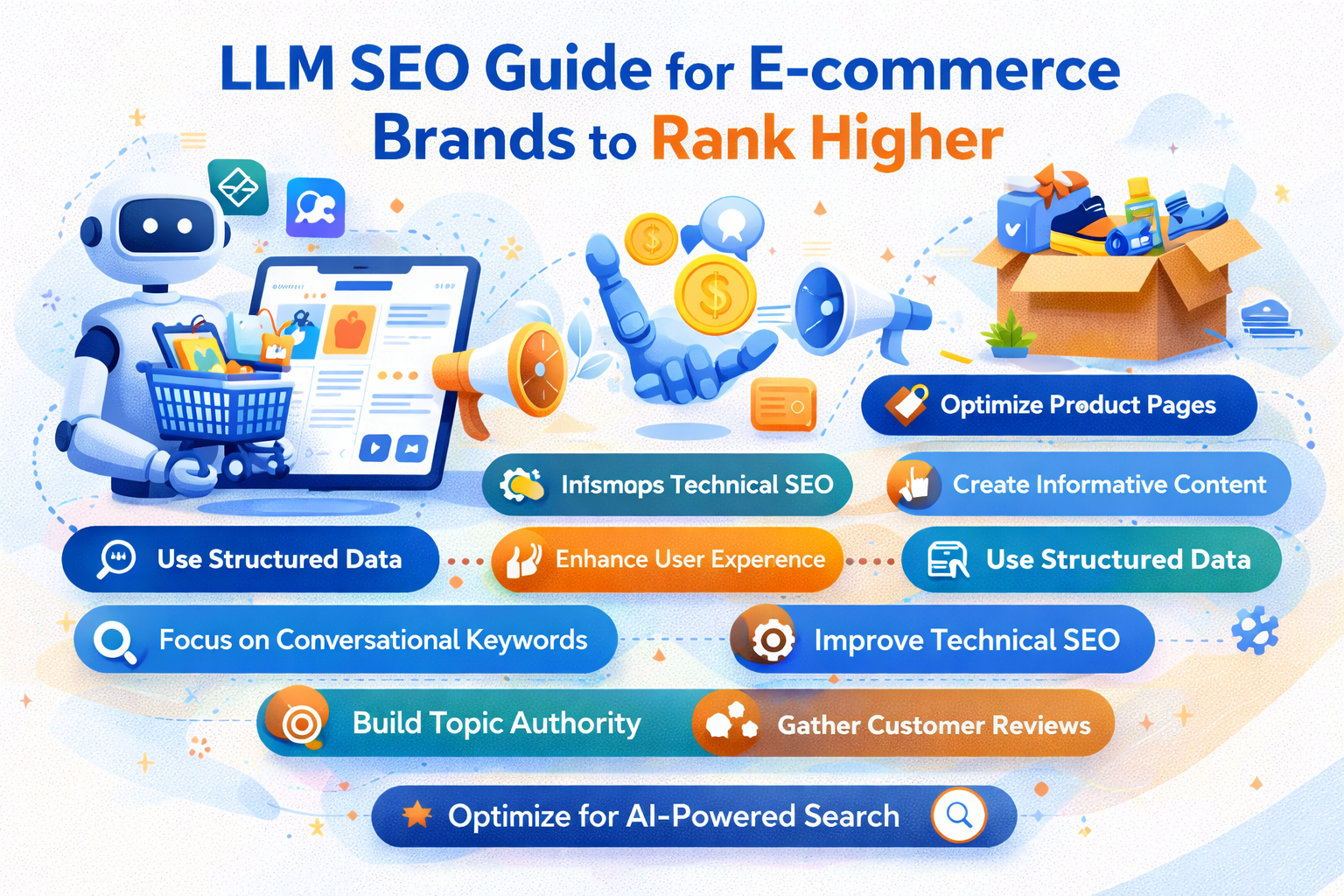
Optimize Product Pages for LLM SEO
Product pages are the backbone of any eCommerce website. To rank higher in AI-driven search results, they must be optimized for both users and machines.
Key strategies:
- Write detailed product descriptions
- Include FAQs on product pages
- Use structured data (schema markup)
- Add customer reviews and ratings
- Use natural language instead of keyword stuffing
For example, instead of writing generic descriptions, explain:
- How the product solves a problem
- Who it is best suited for
- Key benefits and use cases
This helps LLMs understand and recommend your products more effectively.
Create High-Quality Informational Content
LLMs prioritize informational content that answers user queries directly. For eCommerce brands, this means investing in blog content and guides.
Examples include:
- Buying guides
- Product comparisons
- How-to articles
- Industry trends
These types of content help position your brand as an authority and increase the chances of being referenced by AI tools.
Focus on Conversational Keywords
Unlike traditional SEO, LLM SEO emphasizes conversational queries. Users are increasingly asking questions in natural language.
Instead of targeting:
- “best running shoes”
Focus on:
- “What are the best running shoes for beginners?”
This aligns your content with how users interact with AI systems.
Build Topic Authority
LLMs prefer brands that demonstrate expertise in a specific niche. To build authority:
- Create content clusters around key topics
- Interlink related pages
- Cover topics in-depth
For example, if you sell fashion products, create content around:
- Styling tips
- Seasonal trends
- Fabric guides
This signals to AI models that your brand is a trusted source in that domain.
Improve Technical SEO for AI Crawling
Technical SEO remains important for LLM optimization. Ensure your website is:
- Fast-loading
- Mobile-friendly
- Secure (HTTPS)
- Easy to crawl and index
A strong technical foundation is essential, and many businesses choose to hire magento developers India to build scalable and optimized eCommerce platforms.
Use Structured Data and Schema Markup
Structured data helps search engines and AI models understand your content better.
Implement schema for:
- Products
- Reviews
- FAQs
- Articles
This improves your chances of appearing in rich results and AI-generated answers.
Optimize for Voice Search
Voice search is closely related to LLM SEO. Users often use voice assistants to find products and information.
To optimize for voice search:
- Use natural language
- Answer questions directly
- Keep sentences concise
Voice-friendly content increases your visibility across multiple platforms.
Enhance User Experience (UX)
User experience plays a crucial role in both traditional and LLM SEO.
Focus on:
- Easy navigation
- Fast page speed
- Mobile responsiveness
- Clear call-to-actions
A positive user experience leads to higher engagement, which signals quality to AI systems.
Leverage Customer Reviews and UGC
User-generated content (UGC) such as reviews and testimonials adds authenticity to your website.
Benefits include:
- Increased trust
- More content for AI to analyze
- Better conversion rates
Encourage customers to leave detailed reviews, as these can influence AI recommendations.
Create FAQ Sections
FAQs are highly valuable for LLM SEO because they directly answer user queries.
Include FAQs on:
- Product pages
- Category pages
- Blog posts
This increases your chances of being featured in AI-generated answers.
Optimize Content for Featured Snippets
Although LLM SEO is different, featured snippets still play a role in visibility.
To optimize:
- Use bullet points and lists
- Provide clear answers
- Use structured headings
This helps both search engines and AI systems extract information easily.
Build High-Quality Backlinks
Backlinks remain an important ranking factor. They signal authority and credibility.
Focus on:
- Guest posting
- Influencer collaborations
- Industry partnerships
High-quality backlinks increase your chances of being recognized by AI systems.
Monitor and Adapt Your Strategy
LLM SEO is constantly evolving. Regularly analyze your performance and adapt your strategy.
Track:
- Traffic sources
- Engagement metrics
- Conversion rates
Continuous improvement is key to staying ahead.
Common Mistakes to Avoid
When implementing LLM SEO, avoid:
- Keyword stuffing
- Thin or duplicate content
- Ignoring user intent
- Poor website structure
- Lack of mobile optimization
These mistakes can negatively impact your rankings.
Future of LLM SEO in E-commerce
The future of SEO is AI-driven. As LLMs become more advanced, eCommerce brands must adapt to new trends.
Emerging trends include:
- AI-generated product recommendations
- Personalized shopping experiences
- Voice commerce
- Visual search integration
Brands that embrace these changes early will gain a significant competitive advantage.
Conclusion
LLM SEO is transforming the way eCommerce brands approach digital marketing. By focusing on high-quality content, user intent, and AI-friendly optimization, businesses can achieve higher visibility and drive more traffic.
From optimizing product pages and creating valuable content to improving technical SEO and leveraging structured data, every aspect of your strategy plays a role in success.
As the digital landscape continues to evolve, partnering with experts who understand both traditional and AI-driven SEO can make a significant difference. ACSIUS helps eCommerce brands implement advanced strategies, build scalable platforms, and achieve long-term growth in an AI-powered world.
FAQs
How is LLM SEO different from traditional SEO?
Traditional SEO focuses on ranking in search engine results pages (SERPs) using keywords and backlinks. LLM SEO focuses more on content quality, context, user intent, and structured information to appear in AI-generated answers.
Why is LLM SEO important for eCommerce websites?
LLM SEO helps eCommerce brands:
- Gain visibility in AI-powered search results
- Increase organic traffic
- Build trust and authority
- Improve conversion rates
How can I optimize my product pages for LLM SEO?
To optimize product pages:
- Write detailed and helpful descriptions
- Add FAQs
- Use structured data
- Include customer reviews
- Focus on user intent instead of just keywords
Does website development impact LLM SEO?
Yes, a well-structured and technically sound website is crucial. Many businesses work with an eCommerce Web Development Company India to ensure their site is optimized for performance, user experience, and AI crawling.
What type of content works best for LLM SEO?
Content that performs well includes:
- Buying guides
- Product comparisons
- How-to articles
- FAQs
- Informational blogs
These formats directly answer user queries, making them ideal for AI systems.
Are keywords still important in LLM SEO?
Yes, but they are used differently. Instead of focusing on exact keywords, LLM SEO emphasizes conversational and long-tail queries that match how users naturally ask questions.
How does structured data help in LLM SEO?
Structured data (schema markup) helps AI models and search engines better understand your content, increasing the chances of being featured in rich results and AI-generated responses.
Can Magento websites be optimized for LLM SEO?
Yes, Magento websites can be highly optimized for LLM SEO with the right technical setup. Many businesses hire magento developers India to build scalable and SEO-friendly eCommerce platforms.
How important are customer reviews for LLM SEO?
Customer reviews are very important as they:
- Add authenticity
- Provide additional content
- Improve trust signals
- Influence AI recommendations
What role does user experience play in LLM SEO?
User experience is critical. Fast loading speed, mobile responsiveness, and easy navigation improve engagement, which signals quality to AI systems.
Can small eCommerce businesses benefit from LLM SEO?
Yes, LLM SEO levels the playing field. Even small businesses can rank higher by creating high-quality, informative, and user-focused content.
How long does it take to see results from LLM SEO?
Results vary depending on competition and strategy. Some improvements may be visible within weeks, while significant growth typically takes a few months.
What are common mistakes to avoid in LLM SEO?
Avoid:
- Keyword stuffing
- Low-quality content
- Ignoring user intent
- Poor site structure
- Lack of mobile optimization
Is LLM SEO the future of digital marketing?
Yes, LLM SEO is rapidly becoming a key part of digital marketing. As AI-driven search grows, optimizing for LLMs will be essential for long-term online success.