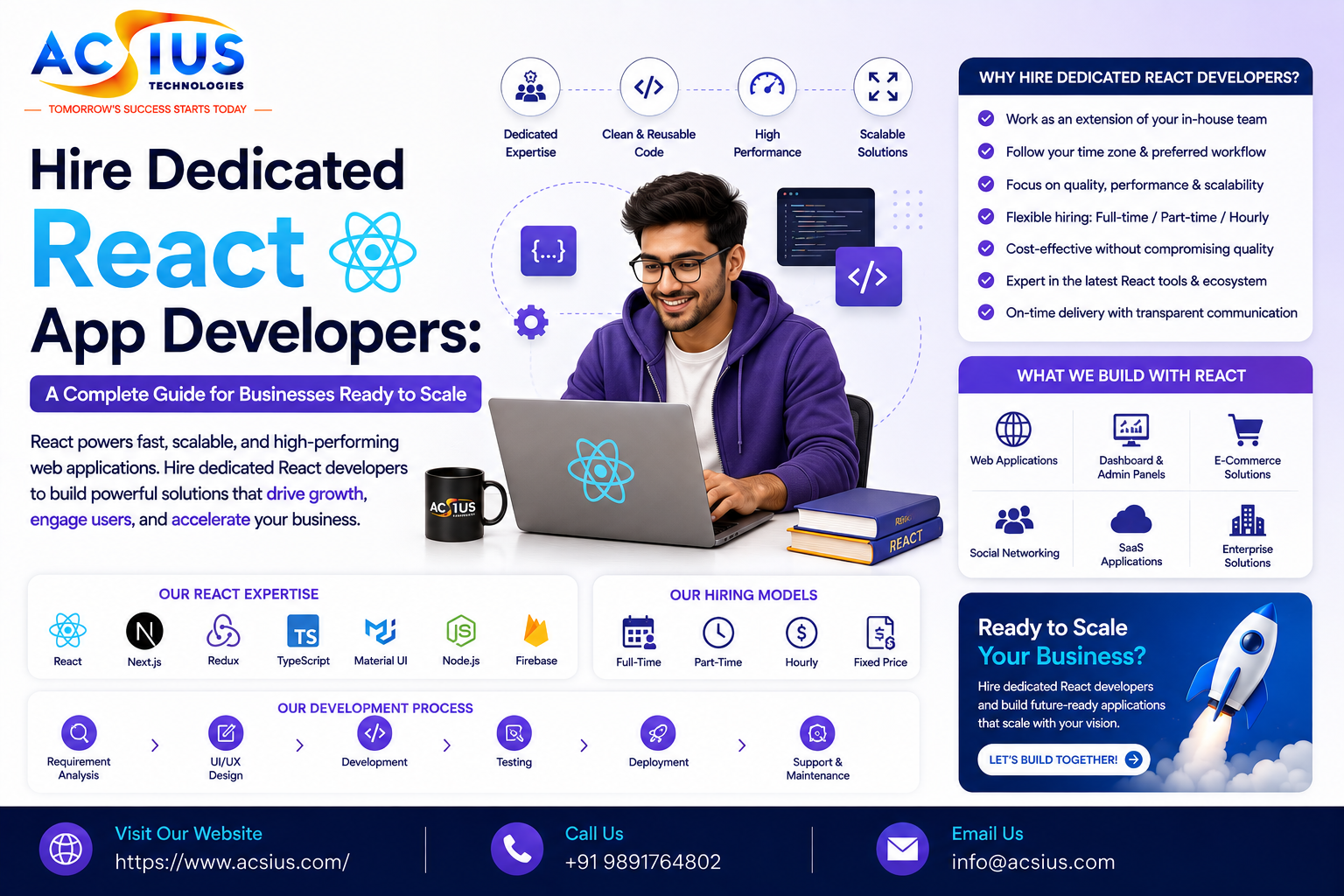
There’s a moment almost every growing product hits where the frontend starts fighting back. Pages that used to load instantly now stutter. A feature that should take two days to build takes two weeks because the codebase has turned into a tangle of quick fixes stacked on top of each other. Developers spend more time working around old decisions than making new ones. If any of that sounds familiar, it’s usually not a sign the product failed — it’s a sign the team has outgrown its current setup and needs people who can rebuild the foundation properly.
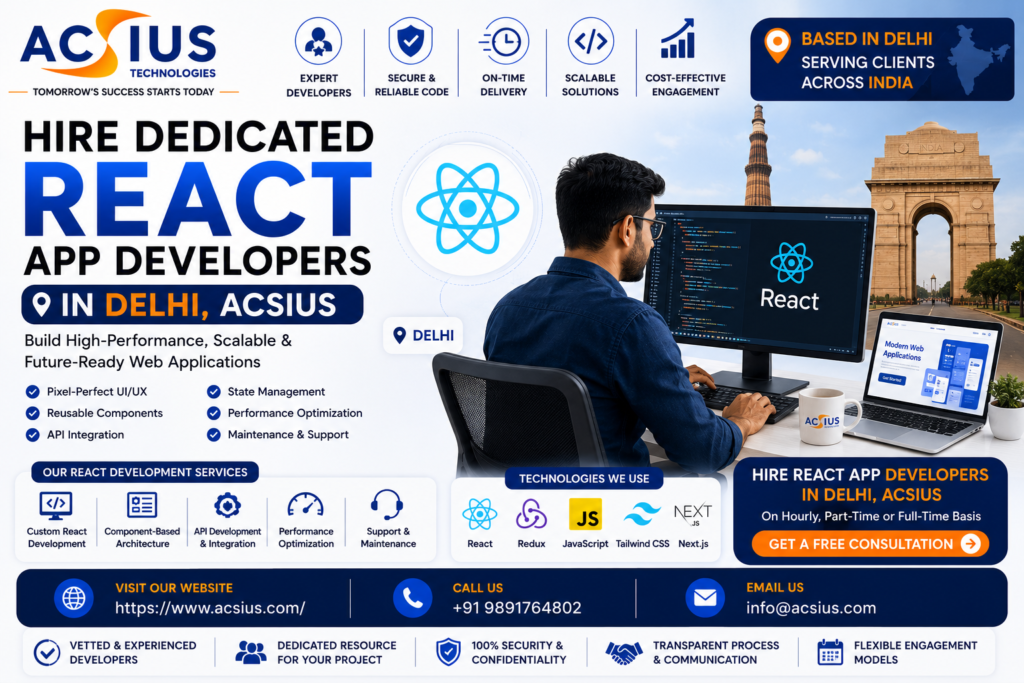
That’s the point where most founders and product leads start to seriously consider whether to hire dedicated React app developers instead of continuing to patch things together internally. React has become the default choice for building fast, interactive, maintainable web applications, but the framework itself doesn’t guarantee good architecture — that depends entirely on the people writing the code. A dedicated developer brings the judgment to structure components sensibly, manage state without creating a mess, and build something that can actually be extended six months from now instead of rewritten. At ACSIUS, we’ve built and rescued React applications across industries ranging from ecommerce to healthcare to internal business tools, and this guide walks through everything worth knowing before you bring someone on.
Why React Is Still the Go-To Choice for Modern Web Applications
React has been around for over a decade now, and unlike a lot of frontend trends, it hasn’t faded — it’s become more embedded in how modern web development actually happens. A few reasons it’s stuck around:
- Component-based architecture makes UI easier to reason about, test, and reuse across a growing application
- A massive ecosystem of libraries, tooling, and community knowledge means fewer problems require solving from scratch
- Strong hiring pool compared to less common frameworks, which matters when a team eventually needs to scale beyond one developer
- Flexibility to pair with different backends, state management approaches, and rendering strategies (client-side, server-side, or static)
- Long-term backing from Meta and a broad open-source community, which reduces the risk of the framework being abandoned
None of that means React is automatically the right choice for every project, but for teams building interactive, data-heavy, or frequently updated interfaces, it remains one of the most dependable options available.
Signs Your Business Actually Needs to Hire Dedicated React App Developers
Not every project needs a dedicated hire. Sometimes a generalist or a short-term contractor is enough. But certain signals tend to point toward needing someone more committed to the codebase long-term:
- The application has grown past what one generalist developer can maintain alone
- Performance issues are showing up as the user base or data volume increases
- The existing codebase has become difficult to extend without breaking something else
- The product roadmap includes frequent new features that need consistent architecture
- The team is migrating from an older framework, jQuery-based site, or legacy system to React
- Investors, customers, or internal stakeholders are starting to notice bugs or slowness
If even a couple of these sound familiar, it’s usually a sign the frontend needs dedicated attention rather than being treated as something anyone on the team can pick up when they have spare time.
What Does a Dedicated React Developer Actually Do?
The title covers a wide range of responsibilities depending on the project’s maturity. Broadly, the work includes:
- Building reusable, well-structured components instead of one-off code for every screen
- Managing application state cleanly, using tools like Redux, Zustand, or React’s built-in Context API depending on what the project actually needs
- Integrating with backend APIs and handling data fetching, caching, and error states properly
- Writing code that’s testable, documented, and understandable to other developers who join later
- Optimizing rendering performance so the app stays fast as it grows in complexity
- Working with design teams to translate UI/UX specifications into functioning, responsive interfaces
- Debugging and maintaining existing applications, including ones originally built by someone else
Good React development isn’t just about knowing the syntax. It’s about making decisions that hold up as the application scales — decisions around folder structure, component boundaries, and how much complexity gets pushed onto the frontend versus handled elsewhere.
How to Define “Hire Dedicated React App Developers” Services — What’s Actually Included
When businesses search for this service, the expectations vary widely — some assume it just means “someone who codes in React,” while others expect a full team handling design, backend, and deployment. At ACSIUS, we define the service around the actual stages a React project moves through, so there’s no ambiguity about what’s covered.
New Application Development
For businesses starting from scratch, this covers the full build — architecture planning, component structure, state management setup, API integration, and deployment. We design the application to be maintainable from day one rather than something that needs a rewrite once it grows.
Legacy Application Modernization
Many businesses come to us with an aging frontend — built on jQuery, an outdated Angular version, or an early React setup that’s become difficult to work with. We plan and execute migrations that modernize the codebase without disrupting the live product, often moving feature by feature rather than attempting a risky full rewrite all at once.
Performance Optimization
When an existing React app has become slow — long load times, laggy interactions, unnecessary re-renders — we audit the codebase, identify bottlenecks, and apply targeted fixes like code splitting, memoization, and lazy loading rather than a blanket rewrite.
Custom Component & Design System Development
For products expecting to scale, we build reusable component libraries and design systems so future development stays visually and functionally consistent instead of every new feature reinventing the wheel.
API Integration & Backend Connectivity
React applications rarely exist in isolation. We handle integration with REST or GraphQL APIs, third-party services, authentication systems, and real-time data sources like WebSockets when the product requires live updates.
Testing & Quality Assurance
We write unit and integration tests as part of development, not as an afterthought, which reduces the number of regressions introduced as the codebase grows and new developers join the project.
Ongoing Development & Maintenance
Most applications don’t stop needing development after launch. We offer ongoing engagements where a dedicated developer continues building features, fixing bugs, and keeping dependencies updated as the product evolves.
The Technology Around React We Also Work With
A React application rarely stands alone. Our developers regularly work with the broader ecosystem surrounding it, including:
- Next.js for server-side rendering, static site generation, and improved SEO performance on content-heavy applications
- TypeScript for type safety on larger codebases where catching errors early matters
- Redux, Zustand, and React Query for state and data management, chosen based on what the project actually needs rather than defaulting to the most popular option
- Tailwind CSS and styled-components for maintainable, scalable styling approaches
- Node.js and Express when the backend also needs attention alongside the frontend
- REST and GraphQL APIs for connecting the application to whatever data sources the business relies on
We don’t force every project into the same stack. Part of the value of hiring dedicated developers is that the tooling gets chosen based on the specific product, not a one-size-fits-all template.
Why ACSIUS When You Decide to Hire Dedicated React App Developers
Architecture-first thinking. We don’t just write code that works today — we structure applications so they can be extended without becoming unmanageable as features get added over time.
Developers who communicate directly. Clients work with the actual developers building their application, with regular updates and reviewable progress, rather than a project manager relaying vague status reports.
Experience across industries and app types. Our team has built React applications for ecommerce platforms, SaaS dashboards, internal business tools, and content-heavy sites, which means we’ve already run into most of the technical challenges a new project is likely to face.
Flexible engagement models. Some clients need a single feature built. Others want a dedicated developer embedded with their team for months. We structure the engagement around the business’s actual stage rather than pushing a fixed package.
Full-stack support when needed. React applications need to talk to something on the backend. Businesses that also need backend or general JavaScript development can hire JavaScript developers from our team, working alongside the React specialist or as a standalone engagement.
Dedicated Hire vs. Freelancer vs. In-House: What Actually Makes Sense
This is a question we get often enough that it’s worth addressing directly, because the right answer depends on the business’s stage, not a universal rule.
Freelancers can work well for small, well-defined, short-term projects — a landing page, a small feature addition, a quick bug fix. The risk shows up when the project grows in scope or the freelancer becomes unavailable mid-project, leaving the business with a half-finished codebase and no continuity.
In-house hiring makes sense once a business has consistent, long-term development needs and the budget to support recruiting, onboarding, benefits, and management overhead. It’s a serious commitment that takes time to get right.
Dedicated hiring through an agency sits in between — you get a developer (or team) focused specifically on your project, with the continuity and accountability of a long-term engagement, but without the overhead of building an internal hiring pipeline from scratch. It also gives businesses access to a broader bench of expertise if the project’s needs shift over time — for example, needing backend support alongside frontend work.
For most growing products, the dedicated hire model offers the best balance of commitment and flexibility, which is why it’s become the default approach for businesses serious about their application’s long-term health.
Our Process
- Discovery call — We start by understanding the current state of the application (or the concept, if starting fresh), the business goals, and the specific pain points driving the search for a developer.
- Technical audit (for existing apps) — We review the current codebase, identify architectural issues, and flag quick wins versus longer-term fixes.
- Scope and proposal — You receive a clear breakdown of the recommended approach, timeline, and cost before any code is written.
- Development in sprints — Work happens in reviewable milestones so progress is visible throughout, not just revealed at the end.
- Code review and testing — Every feature is tested and reviewed before being considered complete, reducing the chance of regressions down the line.
- Deployment and handoff — We support deployment and provide documentation so your team (or ours, in an ongoing engagement) can maintain the application going forward.
- Ongoing support (optional) — Many clients continue with a dedicated developer to keep building features and maintaining the application as it grows.
What It Costs to Hire Dedicated React App Developers
Pricing depends heavily on project scope and engagement length. A small feature addition looks very different from a full application rebuild or an ongoing dedicated hire. Generally, businesses can expect one of these structures:
- Hourly rates for smaller fixes, audits, or short-term work
- Fixed-price quotes for well-defined projects with a clear scope, like a new application build
- Monthly dedicated hire rates for businesses that want a developer consistently working on their product over an extended period
We provide a clear quote after understanding the actual scope and goals, rather than a flat rate that ignores the complexity of the application or the business’s long-term plans.
Common Mistakes Businesses Make When Hiring React Developers
A few patterns come up often enough that they’re worth flagging before you start the hiring process:
- Hiring based on framework buzzwords alone. Knowing React syntax isn’t the same as knowing how to architect a scalable application. Look for evidence of real project experience, not just familiarity with the tools.
- Skipping a technical audit on existing codebases. Bringing on a developer without first understanding the current state of the code often leads to underestimating the actual scope of work.
- Underestimating ongoing maintenance needs. Applications need continued attention after launch — dependency updates, bug fixes, performance tuning. Budgeting only for the initial build often leads to a stagnant, increasingly fragile product.
- Choosing the cheapest option without checking process. Low rates sometimes mean less experience with testing, documentation, or code review — costs that show up later as technical debt.
Final Thoughts
A slow, fragile, or hard-to-extend frontend isn’t usually a sign that React was the wrong choice — it’s typically a sign the application was built without the architectural discipline needed to scale. The right dedicated developer brings that discipline from the start, or repairs it in an existing codebase before small issues become expensive rewrites.
If you’re ready to hire dedicated React app developers who understand both the technical depth of the framework and how to build applications that hold up over time, ACSIUS is here to help — from the first discovery call through long-term, ongoing product support.
FAQs
How long does a typical React project take?
A single feature addition might take one to two weeks. A full application build typically takes eight to sixteen weeks depending on complexity, and legacy migrations vary widely based on the size of the existing codebase.
Can ACSIUS take over an existing React application built by someone else?
Yes. A large portion of our work involves auditing and continuing development on applications that were started by another team or developer, even when the original code has little to no documentation.
Do you also handle backend development for React applications?
Yes — our team includes developers available to hire for general JavaScript and Node.js backend work, so the frontend and backend can be built and maintained together when needed.
What if my project isn't purely React-based — does it still make sense to hire your team?
Often, yes. Many applications combine React with other JavaScript tooling, and our developers work across that broader ecosystem rather than being limited to a single framework.
How is a dedicated React developer different from hiring a development agency for a fixed project?
A fixed-scope project ends once the defined deliverables are complete. A dedicated developer works as an ongoing extension of your team, continuing to build features, fix issues, and adapt to changing priorities over time — closer to an in-house hire than a one-off engagement.
Will I be able to communicate directly with the developer working on my project?
Yes. Clients work directly with the developers assigned to their project rather than through a layer of account managers, which keeps technical discussions accurate and reduces delays.
Can you work with our existing in-house team instead of taking over the whole project?
Yes. Many engagements involve our developers working alongside an existing in-house or offshore team, either to cover a skills gap, add capacity during a busy period, or support a specific part of the application.
What happens if we need to scale the team up or down during the project?
Because engagements are structured around dedicated hiring rather than a single fixed contract, we can adjust the number of developers involved as project needs change, without renegotiating an entirely new agreement each time.
Do you sign NDAs and handle code ownership agreements before starting a project?
Yes. We're glad to sign an NDA before any project details are shared, and all code, assets, and intellectual property produced during the engagement belong to the client once the project is underway.