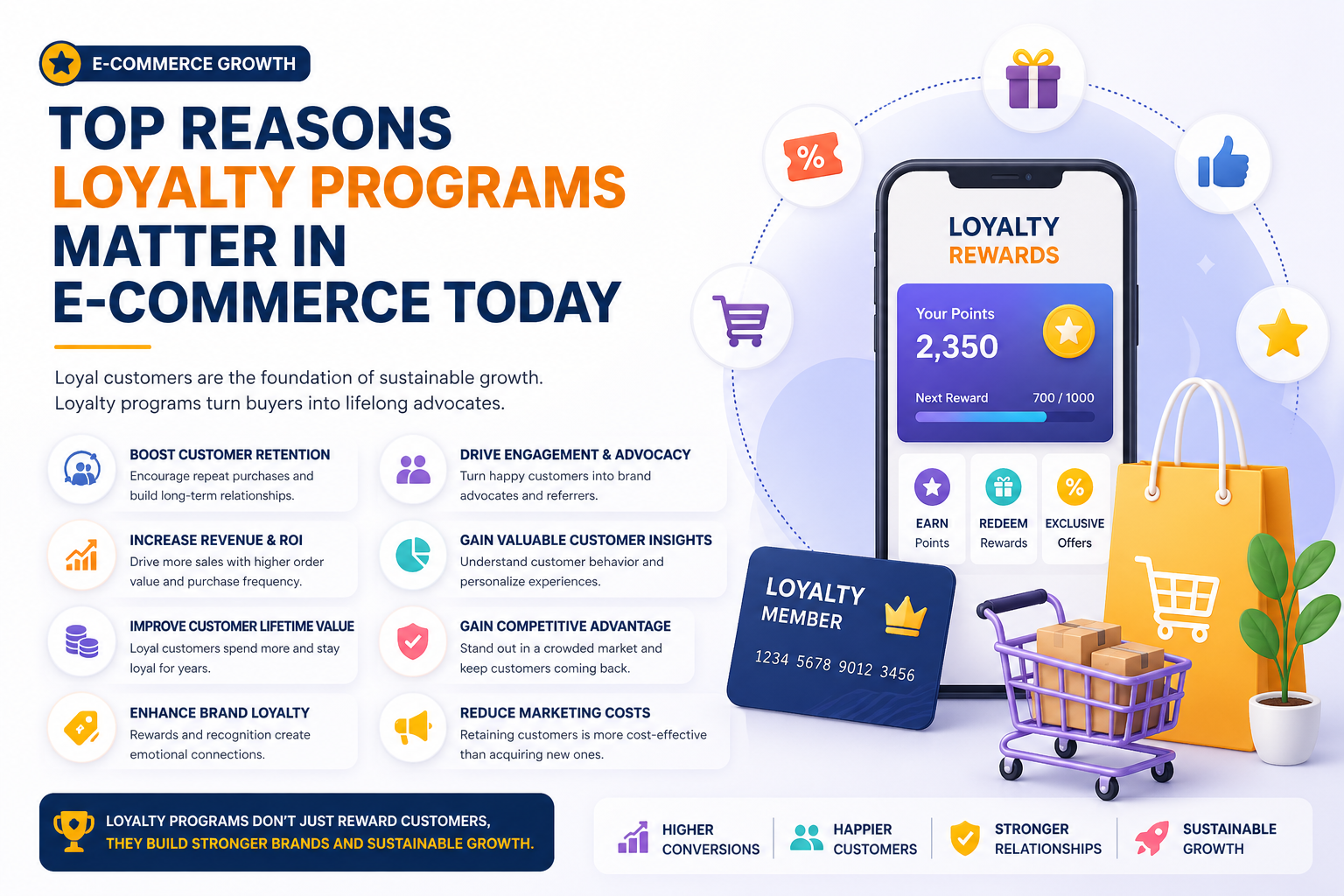
In today’s highly competitive digital marketplace, customer expectations have evolved dramatically. With countless online stores offering similar products, brands can no longer rely solely on pricing or product quality to win customers. Instead, building long-term relationships has become the real differentiator—and that’s where loyalty programs come in.
E-commerce loyalty programs are no longer optional marketing add-ons; they are now a core growth strategy. From increasing repeat purchases to boosting customer lifetime value, loyalty initiatives play a critical role in driving sustainable success. In fact, modern data shows that 90% of loyalty programs deliver positive ROI, with average returns of 4.8x , proving their undeniable impact on business performance.
In this comprehensive guide, we’ll explore the top reasons why loyalty programs matter in e-commerce today and how businesses can leverage them effectively.
Boost Customer Retention
Customer retention is the backbone of profitable e-commerce. Acquiring new customers is significantly more expensive than retaining existing ones, making repeat buyers incredibly valuable.
Loyalty programs encourage customers to return by rewarding them for repeat purchases. Whether through points, discounts, or exclusive perks, these incentives create a compelling reason to choose your brand over competitors.
Research shows that:
- Loyalty program members purchase 33% more frequently
- 83% of consumers say loyalty programs influence repeat purchases
By creating consistent engagement, loyalty programs reduce churn and build lasting relationships.
Increase Customer Lifetime Value (CLV)
Customer Lifetime Value (CLV) measures how much revenue a customer generates over time. Loyalty programs directly enhance CLV by encouraging ongoing purchases and deeper engagement.
When customers feel rewarded, they are more likely to:
- Spend more per transaction
- Shop more frequently
- Stay loyal for longer periods
Studies indicate that loyal customers make 2–5x more purchases annually . This makes loyalty programs a powerful engine for long-term revenue growth.
Drive Higher Revenue and ROI
One of the strongest arguments for loyalty programs is their measurable financial impact.
Key statistics include:
- 90% of programs report positive ROI
- Top-performing programs generate 15–25% annual revenue growth
- Loyalty members spend 12–18% more per transaction
These figures clearly show that loyalty programs are not just customer engagement tools—they are revenue-generating systems.
Encourage Repeat Purchases
Repeat purchases are the lifeblood of e-commerce businesses. Loyalty programs create a psychological incentive for customers to come back.
When customers accumulate points or rewards, they are naturally inclined to:
- Return to redeem rewards
- Complete purchases to reach reward thresholds
- Stick with brands they are already invested in
Additionally, returning customers tend to spend 67% more than new customers , making repeat purchase strategies extremely valuable.
Improve Average Order Value (AOV)
Loyalty programs often use tiered rewards systems to encourage higher spending. For example:
- Spend ₹1,000 → Earn 100 points
- Spend ₹2,000 → Earn bonus rewards
This structure motivates customers to increase their cart size to maximize benefits.
As a result:
- Customers spend more per order
- Brands increase revenue without increasing acquisition costs
Strengthen Brand Loyalty and Emotional Connection
Beyond financial incentives, loyalty programs foster emotional connections with customers.
When customers feel appreciated, they are more likely to:
- Trust your brand
- Recommend your business
- Stay loyal even when competitors offer lower prices
Loyalty programs help build this connection by:
- Offering personalized rewards
- Celebrating milestones (birthdays, anniversaries)
- Providing exclusive experiences
This emotional loyalty is far more powerful than transactional relationships.
Enhance Customer Engagement
Loyalty programs create multiple touchpoints for interaction, such as:
- Earning points
- Redeeming rewards
- Participating in promotions
- Engaging with gamified experiences
These interactions keep customers engaged with your brand even when they are not actively shopping.
In fact, 78% of customers spend more due to loyalty programs , highlighting their ability to drive engagement and spending.
Provide Valuable Customer Data
Modern loyalty programs are powerful data collection tools. They allow businesses to gather insights such as:
- Purchase behavior
- Preferences
- Spending patterns
- Engagement levels
This data enables:
- Personalized marketing campaigns
- Better product recommendations
- Improved customer experiences
Additionally, 65% of customers are willing to share personal data for better rewards , making loyalty programs a key source of zero-party data.
Gain Competitive Advantage
In a crowded e-commerce market, differentiation is essential. Loyalty programs give brands a competitive edge by:
- Offering unique value beyond price
- Encouraging brand switching
- Building long-term customer relationships
Since many customers compare multiple brands before purchasing, a strong loyalty program can be the deciding factor.
Encourage Customer Advocacy and Referrals
Happy and loyal customers often become brand advocates. Loyalty programs can amplify this by rewarding:
- Referrals
- Reviews
- Social media engagement
This not only increases customer acquisition but also builds trust, as recommendations from real customers carry more weight than traditional advertising.
Support Personalization Strategies
Personalization is a key driver of modern e-commerce success. Loyalty programs provide the data and structure needed to deliver personalized experiences.
Examples include:
- Tailored rewards based on purchase history
- Personalized offers and discounts
- Exclusive recommendations
This level of customization enhances customer satisfaction and increases conversion rates.
Reduce Marketing Costs
Loyalty programs help reduce reliance on expensive acquisition channels such as paid ads.
By focusing on existing customers, businesses can:
- Lower customer acquisition costs
- Increase ROI on marketing spend
- Improve overall profitability
Retention strategies are often far more cost-effective than acquisition strategies.
Encourage Behavioral Changes
Loyalty programs influence customer behavior in several ways:
- Encouraging larger purchases
- Increasing purchase frequency
- Promoting specific products
In fact, 73% of consumers modify their spending behavior to maximize rewards , showing how effective these programs can be.
Build a Community Around Your Brand
Loyalty programs can go beyond transactions and create a sense of community.
Examples include:
- VIP tiers
- Exclusive member events
- Early access to products
This sense of belonging strengthens customer relationships and fosters brand loyalty.
Adapt to Changing Consumer Expectations
Modern consumers, especially younger generations, expect:
- Instant rewards
- Seamless digital experiences
- Personalized interactions
Loyalty programs help meet these expectations by:
- Offering real-time rewards
- Integrating with mobile apps
- Providing engaging experiences
Brands that fail to implement loyalty strategies risk falling behind.
Enable Omnichannel Experiences
Today’s customers interact with brands across multiple channels, including:
- Websites
- Mobile apps
- Social media
Loyalty programs unify these experiences by:
- Tracking customer activity across channels
- Providing consistent rewards
- Enhancing the overall customer journey
Increase Redemption and Engagement Rates
Customers who actively redeem rewards are more engaged and valuable.
Research shows that customers who redeem rewards spend 3.1x more annually , highlighting the importance of encouraging redemption.
Build Long-Term Business Sustainability
Loyalty programs contribute to sustainable growth by:
- Creating predictable revenue streams
- Reducing dependence on new customers
- Building a loyal customer base
This stability is crucial for long-term success in e-commerce.
Improve Customer Satisfaction
Rewarding customers makes them feel valued, which directly impacts satisfaction levels.
Satisfied customers are more likely to:
- Return for future purchases
- Recommend your brand
- Leave positive reviews
Leverage Technology and Automation
Modern loyalty programs leverage advanced technologies such as:
- AI-driven personalization
- Automation tools
- Integration with e-commerce platforms
Businesses using platforms like Shopify can enhance loyalty strategies by choosing to hire shopify developers for seamless implementation.
Similarly, for customized solutions, companies often hire wordpress developers or hire dedicated woocommerce developer to build scalable loyalty systems tailored to their needs.
Challenges of Loyalty Programs (And How to Overcome Them)
While loyalty programs offer numerous benefits, they also come with challenges:
- Low engagement if rewards are not attractive
- Complex structures that confuse customers
- Data privacy concerns
To overcome these challenges:
- Keep programs simple and transparent
- Offer meaningful rewards
- Focus on personalization
Best Practices for E-commerce Loyalty Programs
To maximize effectiveness:
- Keep it simple – Easy-to-understand programs perform better
- Offer real value – Ensure rewards are meaningful
- Encourage quick wins – Provide instant gratification
- Use personalization – Tailor rewards to customer behavior
- Promote engagement – Use gamification and interactive elements
The Future of Loyalty Programs in E-commerce
The future of loyalty programs lies in:
- AI-driven personalization
- Gamification
- Subscription-based loyalty models
- Blockchain-based rewards systems
As technology evolves, loyalty programs will become even more sophisticated and impactful.
Conclusion
Loyalty programs have become a cornerstone of modern e-commerce success. They go far beyond simple rewards systems, acting as powerful tools for customer retention, revenue growth, and brand building.
With proven benefits such as increased customer lifetime value, higher engagement, and strong ROI, loyalty programs are no longer optional—they are essential.
Businesses that invest in well-designed loyalty strategies will not only survive but thrive in today’s competitive e-commerce landscape. By combining technology, personalization, and meaningful rewards, brands can create lasting relationships that drive long-term success.
If you’re looking to implement or enhance your e-commerce loyalty strategy, investing in expert development—whether through Shopify, WordPress, or WooCommerce—can make all the difference in delivering a seamless and rewarding customer experience.
FAQs
Why are loyalty programs important for online businesses?
Loyalty programs help increase customer retention, boost repeat purchases, and improve customer lifetime value. They also reduce marketing costs and create long-term relationships, making them essential for sustainable growth in e-commerce.
How do loyalty programs increase customer retention?
Loyalty programs provide incentives such as rewards, points, and exclusive offers that motivate customers to return. When customers feel valued and rewarded, they are more likely to stick with a brand instead of switching to competitors.
What are the most common types of loyalty programs?
The most popular types include:
- Points-based programs
- Cashback or rewards programs
- Tiered (VIP) programs
- Subscription-based loyalty programs
- Referral programs
Each type serves different business goals and customer preferences.
Do loyalty programs really increase sales?
Yes, loyalty programs significantly boost sales. They encourage repeat purchases, increase average order value, and motivate customers to spend more to earn rewards, ultimately driving higher revenue.
How can small e-commerce businesses benefit from loyalty programs?
Small businesses can use loyalty programs to:
- Compete with larger brands
- Build strong customer relationships
- Encourage repeat purchases
- Increase brand awareness through referrals
Even simple reward systems can deliver strong results.
What features should a successful loyalty program have?
A successful loyalty program should include:
- Easy-to-understand structure
- Valuable rewards
- Personalization
- Mobile-friendly access
- Seamless integration with the website
How can I implement a loyalty program on my website?
You can implement a loyalty program by integrating tools or plugins into your e-commerce platform. Businesses often choose to hire shopify developers to build advanced loyalty features on Shopify stores.
Can loyalty programs be added to WordPress or WooCommerce sites?
Yes, loyalty programs can be easily integrated into WordPress and WooCommerce websites. Many businesses prefer to hire wordpress developers or hire dedicated woocommerce developer to create customized and scalable loyalty systems.
How do loyalty programs help in collecting customer data?
Loyalty programs track customer behavior such as purchase history, preferences, and engagement patterns. This data helps businesses create personalized marketing campaigns and improve customer experiences.
What is the difference between loyalty programs and referral programs?
Loyalty programs reward customers for repeat purchases and engagement, while referral programs reward customers for bringing in new customers. Both strategies can work together to maximize growth.
Are loyalty programs suitable for all types of e-commerce businesses?
Yes, loyalty programs can be adapted for almost any type of e-commerce business, including fashion, electronics, beauty, and subscription services. The key is to tailor the rewards and structure to your target audience.
How can I measure the success of a loyalty program?
Key metrics to track include:
- Customer retention rate
- Repeat purchase rate
- Customer lifetime value (CLV)
- Average order value (AOV)
- Redemption rate
These metrics help evaluate the effectiveness of your program.
What are the challenges of running a loyalty program?
Common challenges include:
- Low customer participation
- Poor reward structure
- Complex program design
- Data privacy concerns
These can be overcome by simplifying the program and offering meaningful incentives.
What is the future of loyalty programs in e-commerce?
The future of loyalty programs includes AI-driven personalization, gamification, mobile-first experiences, and subscription-based rewards. These innovations will make loyalty programs more engaging and effective.
How often should rewards be offered in a loyalty program?
Rewards should be frequent enough to keep customers engaged but balanced to maintain profitability. Offering small, achievable rewards along with bigger milestone incentives works best.
Can loyalty programs improve brand reputation?
Yes, loyalty programs enhance brand perception by showing customers that their loyalty is appreciated. This builds trust and encourages positive word-of-mouth marketing.
Are loyalty programs expensive to maintain?
Loyalty programs can be cost-effective when designed properly. The increase in repeat purchases and customer retention usually outweighs the cost of rewards and program management.
How do tiered loyalty programs work?
Tiered programs offer different levels of rewards based on customer spending or engagement. Higher tiers unlock better benefits, encouraging customers to spend more to reach the next level.
Should I combine loyalty programs with other marketing strategies?
Yes, combining loyalty programs with email marketing, social media campaigns, and personalized offers can significantly enhance overall performance and maximize results.