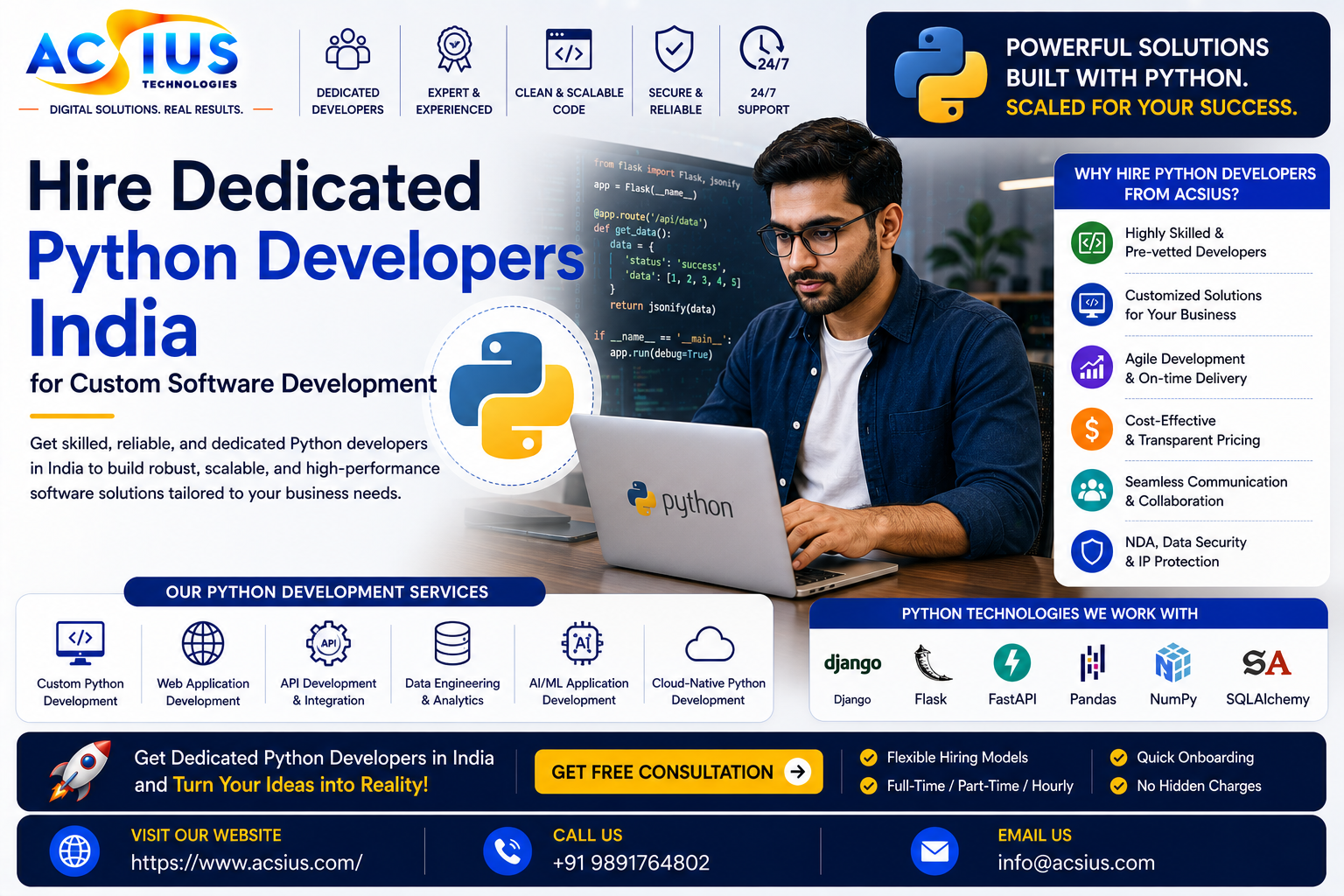
If you have spent any time researching software talent this year, you already know the conversation around Python has changed. It is no longer a “nice to have” skill buried in a job description — it is the backbone of AI products, data platforms, automation tools, fintech engines, and half the SaaS products you use daily. And increasingly, the companies building these products are not hiring locally. They are choosing to hire Python developers in India.
This isn’t a trend built on hype. It’s built on math, talent depth, and a maturing outsourcing ecosystem that has moved far beyond the “cheap labor” reputation it had a decade ago. Today, when a startup founder in Austin or a CTO in London decides to hire a Python developer in India, they’re making a calculated business decision — not a budget compromise.
This guide breaks down why that decision makes sense, what to actually look for in a hire python developer India or team, the different ways you can structure the engagement, and how a company like ACSIUS approaches Python hiring and development for global clients.
Why Python Is the Language Businesses Are Building Around
Before talking about where to hire, it’s worth understanding why Python keeps winning.
Python’s readability and simplicity mean development cycles are shorter. Its ecosystem — Django and Flask for web applications, Pandas and NumPy for data work, TensorFlow and PyTorch for machine learning, FastAPI for high-performance APIs — covers nearly every modern use case a business might need. That versatility is exactly why it shows up everywhere: internal automation scripts, customer-facing web apps, data pipelines, AI-powered features, and backend systems for mobile apps.
For a growing business, this matters because you’re rarely hiring “just” a Python developer. You’re hiring someone who can plug into web development, data engineering, automation, or machine learning projects without your team needing five different specialists for five different languages. That flexibility alone is a strong argument for building a Python-first stack — and for finding developers who genuinely understand its depth, not just its syntax.
Why Companies Are Choosing to Hire Python Developers in India
A Genuinely Deep Talent Pool
India produces one of the largest pools of engineering graduates in the world every year, and Python has become a default teaching language in computer science programs, coding bootcamps, and self-taught developer communities alike. This means the talent pool isn’t just large — it’s also relatively young, current with modern frameworks, and comfortable with the tools businesses are using right now, from cloud-native development to AI integration.
Real Cost Efficiency, Not Just Cheap Labor
Let’s be direct about this, because it’s usually the first question on a founder’s mind: yes, hiring a Python developer in India typically costs significantly less than hiring the equivalent experience level in the US, UK, or Western Europe. But the more useful way to think about this isn’t “cheaper,” it’s “better allocation of budget.” The savings on development cost often free up runway for product testing, marketing, or hiring additional specialized roles — without compromising code quality when you work with an experienced team.
Time Zone Advantage, Not Time Zone Problem
A lot of businesses hesitate here, assuming time zone differences will slow everything down. In practice, the opposite often happens. With the right process in place, work handed off at the end of a US or UK business day is developed overnight and ready for review the next morning. Many companies that hire Python developers in India describe it as gaining an extra shift, not losing overlap hours.
English Proficiency and Communication Standards
India has one of the largest English-speaking professional workforces globally, and Indian IT companies have spent two decades refining client communication standards specifically because so much of their business is international. Daily standups, sprint reviews, and async documentation are standard practice, not an afterthought.
Maturity of the IT Services Ecosystem
This is the part that’s changed the most in the last ten years. India isn’t just a source of individual freelancers anymore — its home to established software companies with structured hiring pipelines, dedicated QA processes, and project management frameworks that mirror what you’d expect from an in-house team. That maturity reduces a lot of the risk that used to be associated with offshore development.
What “Hiring a Python Developer” Actually Means in 2025
One mistake businesses make is treating “Python developer” as a single, interchangeable role. In reality, Python spans several specializations, and knowing which one you need will shape your entire hiring process.
Backend / Web Development — Developers working with Django, Flask, or FastAPI to build APIs, server-side logic, and web applications.
Data Engineering — Developers who build pipelines, work with large datasets, and use tools like Pandas, Airflow, and SQL-heavy Python workflows.
Machine Learning / AI Development — Developers or ML engineers working with TensorFlow, PyTorch, scikit-learn, and increasingly, LLM integration frameworks.
Automation & Scripting — Developers who build internal tools, testing frameworks, and process automation using Python’s scripting strengths.
DevOps & Infrastructure — Python is heavily used in infrastructure-as-code, CI/CD pipelines, and cloud automation scripts.
Before you hire a Python developer in India, get specific about which of these categories your project actually needs. A brilliant machine learning engineer may not be the right fit for a Django e-commerce backend, and vice versa. This is one of the most common reasons offshore hiring goes wrong — not because the talent wasn’t skilled, but because the skill didn’t match the project.
What to Actually Look For When You Hire a Python Developer in India
Technical Depth beyond the Resume
Certifications and years of experience are a starting point, not proof of ability. Look for developers or teams that can walk you through actual problem-solving decisions — why they’d choose Flask over Django for a specific use case, how they’d structure a database for scale, or how they approach testing and code review. This conversation tells you far more than a resume bullet point ever will.
Portfolio Relevance, Not Portfolio Size
A long portfolio isn’t automatically a good sign. A short portfolio with two or three projects closely related to your industry or use case is often more valuable than a long list of unrelated work.
Communication and Process Discipline
Ask how they manage sprints, how often you’ll get updates, and what happens when a blocker comes up. Teams that can answer this clearly, without vague reassurances, are usually the ones that will actually deliver on schedule.
Security and Code Quality Standards
Especially for fintech, healthcare, or SaaS products handling user data, ask directly about coding standards, code review practices, and security protocols. A team that takes this seriously will have a clear, specific answer — not a generic “we follow best practices” response.
Post-Launch Support
Development doesn’t end at deployment. Ask what support looks like after launch — bug fixes, scaling assistance, feature iteration — before you sign anything.
Engagement Models: How Businesses Actually Structure This
When you decide to hire Python developers in India, you’re not locked into one type of arrangement. The right model depends on your project timeline, budget, and how much ongoing management you want to handle.
Dedicated Developer Hiring — You hire one or more Python developers who work exclusively on your project, functioning like an extension of your in-house team. Best for long-term products and ongoing development.
Project-Based Hiring — You define a scope, timeline, and deliverables, and the development company manages the execution. Best for well-defined projects with a clear end point, like an MVP build or a specific feature rollout.
Staff Augmentation — You bring in Python developers to fill a specific skills gap within an existing team you already manage. Best for companies with in-house engineering leadership who need additional hands.
Hourly/Part-Time Hiring — For smaller tasks, maintenance work, or projects with unpredictable scope. Best for startups testing an idea before committing to a larger build.
None of these models is inherently “better” — the right choice depends entirely on where your project actually is right now.
The Real Cost of Hiring Python Developers in India
Pricing varies significantly based on experience level, specialization, and engagement model, but here’s a general framework businesses use to budget:
- Junior Python Developers typically fit smaller, well-defined tasks or projects with close oversight from a senior lead.
- Mid-Level Python Developers handle the bulk of standard web application, API, and automation work.
- Senior Python Developers / Architects lead complex builds, make architectural decisions, and manage scalability and security concerns.
Compared to hiring the same experience levels in the US or Western Europe, businesses that hire Python developers in India commonly report cost savings in the range of 40-60%, without a corresponding drop in code quality when the hiring process is done carefully. The key phrase there is “done carefully” — cost savings evaporate quickly if a mismatched hire leads to rework, missed deadlines, or a product that needs to be rebuilt.
Common Mistakes Businesses Make When Hiring Offshore Python Talent
Hiring purely on price. The lowest quote is rarely the lowest total cost once you factor in delays, bugs, and rework.
Skipping a technical interview or code review. Even when working with an agency, ask to see sample code or have a technical call with the actual developers who’ll work on your project — not just the sales team.
Underestimating documentation needs. Clear requirements matter more in offshore relationships than local ones, simply because there’s less room for casual, in-person clarification.
Ignoring time zone planning. The time zone advantage only works if you actually build a communication rhythm around it — daily async updates, clear escalation paths, and defined overlap hours for live discussions when needed.
Not clarifying IP and ownership terms upfront. Make sure contracts are explicit about code ownership, confidentiality, and data handling before development begins.
How ACSIUS Approaches Python Development for Global Clients
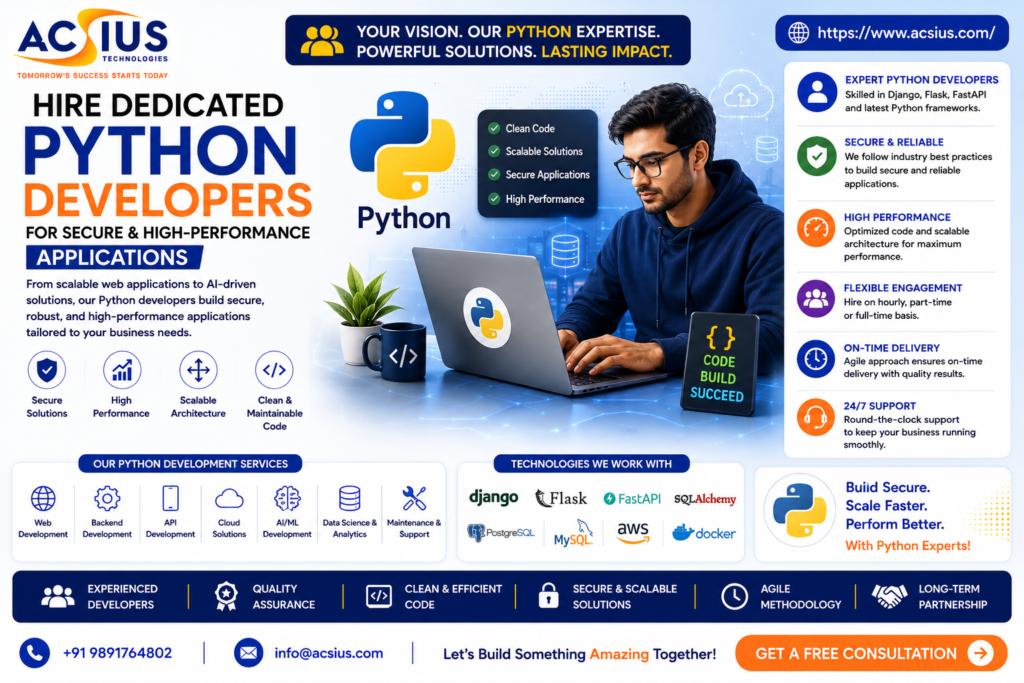
At ACSIUS, Python hiring isn’t treated as a staffing transaction — it’s treated as the start of a technical partnership. The team works across the full range of Python specializations, from Django and Flask-based web applications to data engineering pipelines and AI/ML integration, which means clients aren’t forced to fit their project into a narrow skill set.
What tends to set the process apart is the emphasis on matching developers to the actual technical requirements of a project rather than assigning generalist resources. Before development begins, the focus is on understanding the business goal behind the build — not just the feature list — because a Python developer who understands why they’re building something makes better decisions when edge cases and trade-offs inevitably show up mid-project.
Clients working with ACSIUS typically get:
- Developers vetted specifically for the technical domain of the project (web, data, ML, automation)
- Transparent communication cadence, with regular updates rather than black-box development
- Flexible engagement models — dedicated hiring, project-based delivery, or staff augmentation — depending on what actually fits the business stage
- Code quality and security practices built into the development process, not bolted on at the end
- Support that extends past launch, since most real product work happens after the first release
For businesses that want the cost and talent advantages of hiring in India without taking on the operational risk of managing offshore hiring alone, this kind of structured, partnership-first approach is usually what makes the difference between a good hire and a good outcome.
A Practical Checklist Before You Hire
Before reaching out to any Python development company or freelancer, it helps to have clarity on a few things internally:
- What specific type of Python development does this project need (web, data, ML, automation)?
- What’s the realistic timeline, and is it flexible or fixed?
- What’s the budget range, and does it account for post-launch support?
- Do you need a dedicated long-term hire or project-based delivery?
- What does success look like — a working MVP, a scalable product, a specific feature?
Having clear answers to these questions before you start interviewing developers or agencies will save significant time and reduce the chance of a mismatched hire.
Final Thoughts
The decision to hire a Python developer in India isn’t just about cutting costs — though that’s certainly part of the appeal. It’s about accessing a genuinely deep, technically capable talent pool that has matured alongside the global demand for Python expertise. Companies that treat this as a strategic hiring decision, not just a budget line item, consistently get better outcomes than those chasing the lowest possible quote.
The businesses that get the most value from offshore Python hiring are the ones that go in with clarity — about their project scope, their engagement model, and what they actually need from a developer or team. Whether you’re building an MVP, scaling a data platform, or integrating AI into an existing product, the right Python talent in India can move that project forward without stretching your budget past what’s sustainable.
If you’re exploring what that looks like for your own project, working with a team that treats the hiring process as a genuine technical partnership — like ACSIUS does — tends to be the difference between a developer who simply writes code and one who actually helps you build the right product.
FAQs
Is it safe to hire Python developers in India for long-term projects?
Yes, as long as you work with an established company that has clear contracts covering IP ownership, confidentiality, and data handling. India's IT services industry has decades of experience serving international clients, and reputable companies follow structured processes for security, code review, and project management. The risk isn't the country — it's skipping due diligence on any vendor, anywhere.
What is the time zone difference, and does it slow down development?
The time difference is typically 9.5 to 12.5 hours depending on your location, but most companies find this speeds things up rather than slowing them down. Work handed off at the end of your day is often developed overnight and ready for review the next morning, effectively giving you a second shift of progress.
Should I hire a dedicated Python developer or work with an agency?
It depends on your project. A dedicated developer works well for ongoing, long-term products where you want consistent involvement. An agency or development company is often better for defined projects, since they bring project management, QA, and backup resources if a developer is unavailable — reducing the risk of a single point of failure.
What Python frameworks should I expect a developer to know?
This depends on your use case. For web applications, look for Django, Flask, or FastAPI experience. For data-heavy projects, look for Pandas, NumPy, and SQL proficiency. For AI/ML work, look for TensorFlow, PyTorch, or scikit-learn. Not every Python developer needs to know all of these — matching the framework to your specific project is more important than breadth alone.
How do I evaluate a Python developer's skills before hiring?
Ask for relevant portfolio examples, request a short technical interview or code walkthrough, and pay attention to how clearly they explain their decisions — not just what they built, but why they built it that way. A live discussion about a real problem usually reveals more than a resume or certification list.
Can Indian Python developers integrate with my existing in-house team?
Yes. Staff augmentation is a common engagement model specifically for this purpose, where Python developers in India work directly alongside your existing team using your project management tools, communication channels, and workflows, rather than operating as a separate silo.
How long does it take to hire a Python developer in India?
With an established development company, the process is often much faster than traditional local hiring — sometimes a matter of days rather than weeks, since companies like ACSIUS maintain vetted talent pools rather than starting recruitment from scratch for every request.
What happens if I'm not satisfied with the developer's work?
Reputable companies build in review checkpoints, trial periods, or the ability to request a different developer if there's a mismatch. Before signing any agreement, clarify what recourse you have — this should be addressed in the contract, not left as an assumption.
Is Python still a good choice for new projects in 2025, or should I consider another language?
Python remains one of the strongest choices for most business use cases, particularly anything involving data, automation, AI/ML, or rapid backend development. Its large talent pool, mature libraries, and readability make it a practical default for startups and enterprises alike, though the right language always depends on your specific technical requirements.