There’s a moment almost every growing business reaches where their website platform stops being helpful and starts being a limitation. Maybe it’s a content team that can’t publish without waiting on a developer for every small change. Maybe it’s an ecommerce catalog that’s outgrown what a template-based system can handle. Whatever the trigger, this is usually the point where businesses start searching for a custom CMS development company in India, realizing that generic, one-size-fits-all platforms simply weren’t built for how their business actually operates.
Here’s something worth sitting with for a moment: search behavior around this topic has shifted in a way that most businesses don’t consciously notice, even as they experience it firsthand. A few years ago, someone might have searched best CMS platform and compared a handful of generic tools. Today, business owners search far more specifically — things like CMS that can handle my multi-location inventory or content system my non-technical team can actually update themselves. Google has adapted to reward this kind of precise, intent-rich searching, surfacing providers who speak directly to specific operational pain points rather than generic platform comparisons. This shift matters just as much for businesses exploring ecommerce website design services in India, where the search isn’t just ecommerce website design anymore, but increasingly specific queries about handling regional payment gateways, GST-compliant invoicing, or multi-warehouse shipping logic that off-the-shelf templates rarely handle well.
What Does Custom CMS Development Actually Mean?
Before going further, it’s worth clearly defining what a custom CMS Development Company India actually does, because the term gets used loosely across the industry.
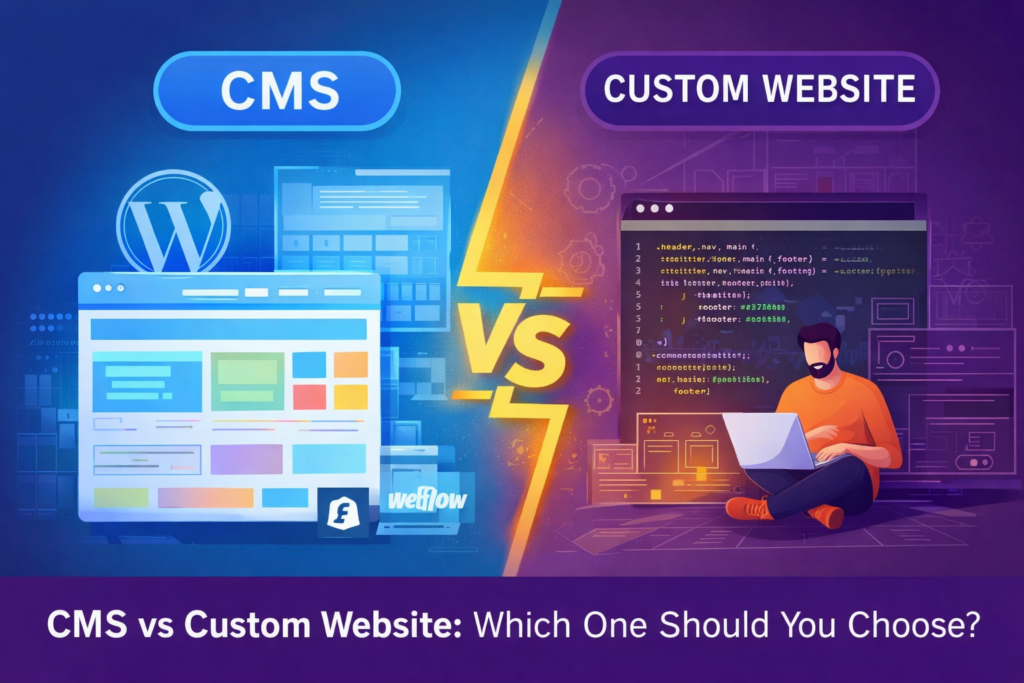
A content management system, or CMS, is the backend software that allows a business to create, edit, and manage website content without needing to touch code for every change. Popular off-the-shelf options like WordPress, Shopify, or Wix work well for many businesses, especially smaller ones with straightforward needs.
A custom CMS, on the other hand, is built specifically around a business’s unique workflows, data structures, and operational requirements. Instead of forcing a business to adapt to a platform’s limitations, a custom CMS is shaped around how the business actually works.
Services Typically Provided by a Custom CMS Development Company
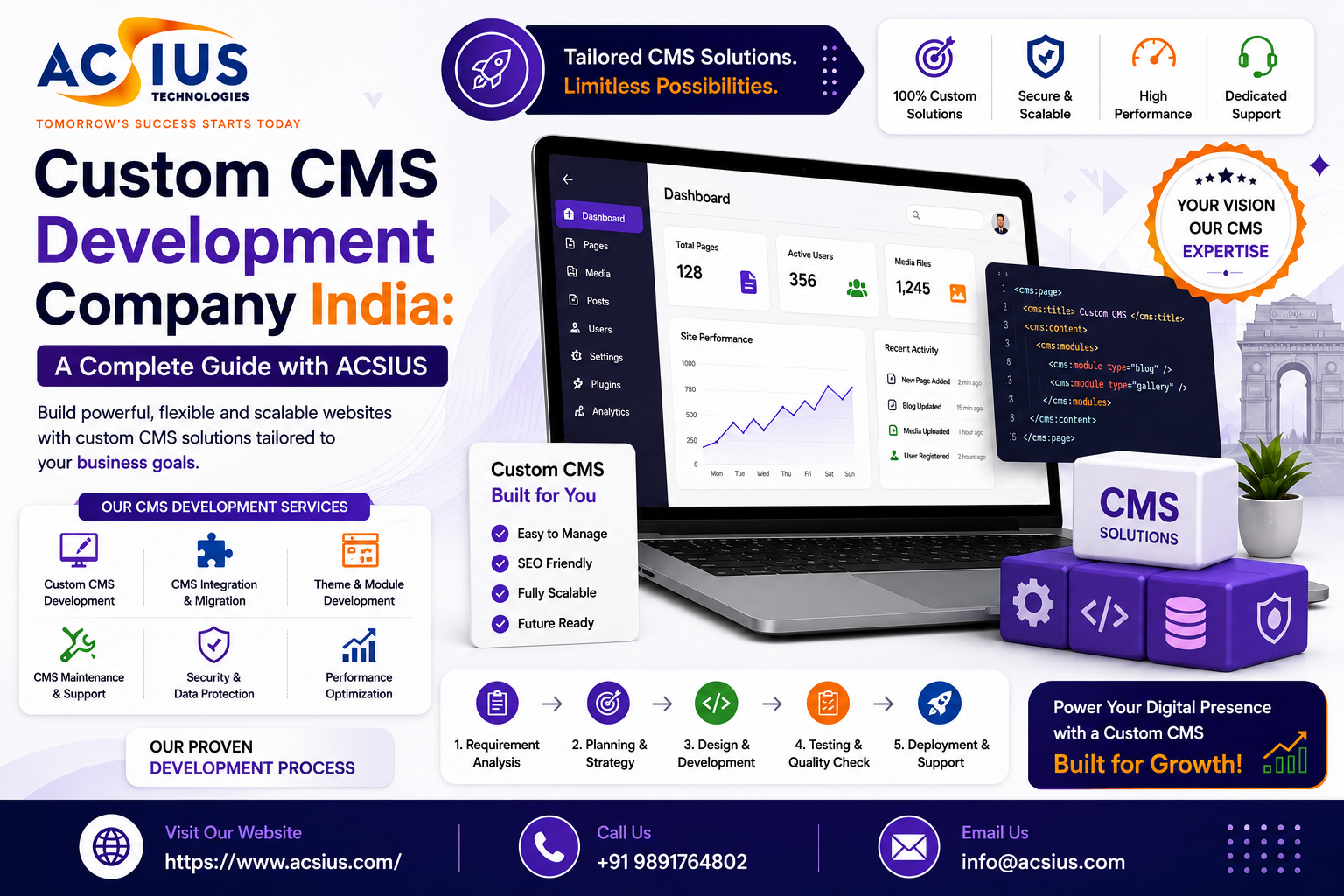
A genuine custom CMS development company in India, like ACSIUS, typically offers the following core services:
- Requirements Analysis and Architecture Planning Before any development starts, the team maps out exactly what the business needs: content types, user roles, workflows, integrations, and scalability requirements.
- Custom Backend Development Building the actual system that powers content creation, editing, and publishing, tailored to the business’s specific data structures rather than generic templates.
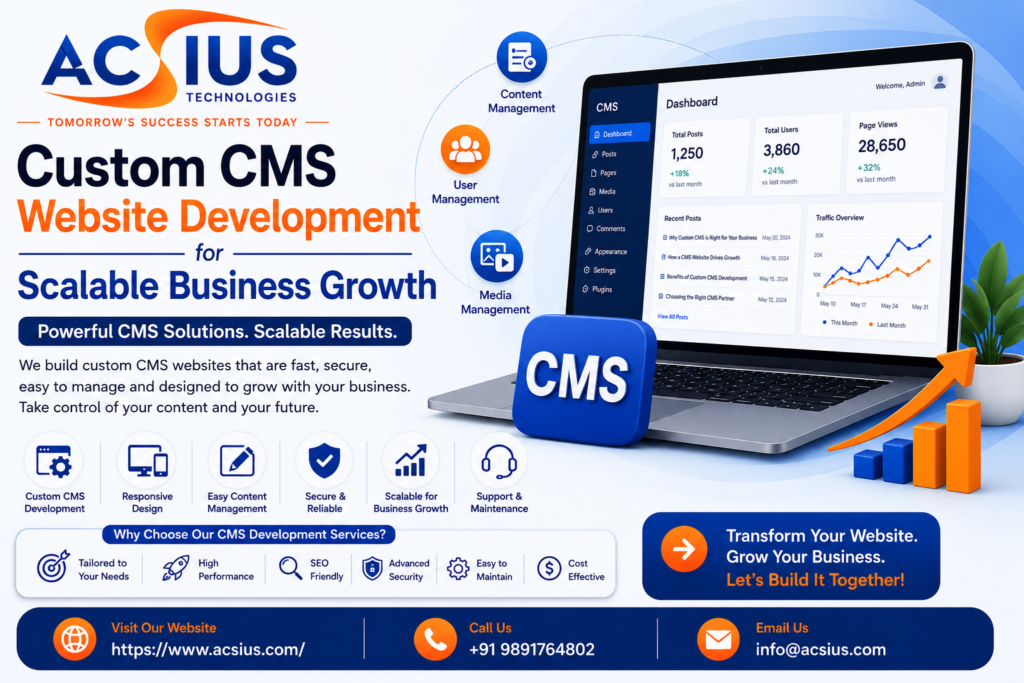
- Custom Admin Dashboards Designing intuitive, role-based dashboards so different teams (marketing, sales, operations) can manage exactly the content relevant to them, without confusion or unnecessary complexity.
- Third-Party Integrations Connecting the CMS with existing tools like CRM systems, inventory management software, payment gateways, or marketing automation platforms.
- Multi-Language and Multi-Region Support For businesses operating across different states or countries, building content structures that support regional language variations and localized content management.
- Scalability and Performance Engineering Ensuring the system can handle growth, whether that’s increased content volume, higher traffic, or expanding user teams, without requiring a rebuild down the line.
- Security and Access Control Implementing proper authentication, role-based permissions, and data protection measures suited to the sensitivity of the business’s content and customer data.
- Ongoing Support and Maintenance Custom systems need custom support. A responsible CMS development partner provides continued maintenance, updates, and troubleshooting well after launch.
Why Businesses Outgrow Off-the-Shelf Platforms
Off-the-shelf platforms are popular for good reason. They’re affordable, quick to set up, and supported by huge communities of plugins and themes. But they come with real limitations that become more apparent as a business scales.
Rigid Content Structures: Generic platforms often force content into predefined formats that don’t match how a business actually organizes its information.
Plugin Dependency: Achieving custom functionality on platforms like WordPress often means stacking plugin upon plugin, which can slow down performance and create security vulnerabilities.
Scalability Ceilings: What works fine for a small catalog or a handful of content pages can become unwieldy once a business scales to thousands of products or complex content relationships.
Limited Workflow Support: Many businesses need specific approval workflows, multi-team collaboration, or role-based access that generic platforms simply weren’t designed to handle elegantly.
Integration Headaches: Connecting off-the-shelf platforms with specialized business systems often requires workarounds that are fragile and difficult to maintain long-term.
How ACSIUS Approaches Custom CMS Development
ACSIUS treats custom CMS development as a long-term infrastructure investment rather than a quick technical fix. The process typically unfolds like this:
Discovery and Business Mapping
Understanding not just what the business wants technically, but how teams actually work day to day, what bottlenecks currently exist, and where growth is expected in the coming years.
Architecture and Technology Selection
Choosing the right technical foundation based on the business’s specific needs, whether that’s a headless CMS approach for maximum flexibility or a more traditional structure suited to simpler content needs.
Iterative Development
Building the system in stages, with regular check-ins and testing, rather than disappearing for months and delivering a finished product with no opportunity for course correction.
User Training and Documentation
Ensuring the teams who will actually use the system day to day understand how to use it confidently, backed by clear documentation.
Post-Launch Partnership
Continuing to support, refine, and expand the system as the business evolves, rather than treating launch as the end of the relationship.
Custom CMS and Ecommerce: Where the Two Often Meet
For many businesses, the need for a custom CMS becomes especially clear once ecommerce enters the picture. Off-the-shelf ecommerce platforms work well for straightforward product catalogs, but businesses with complex pricing structures, B2B and B2C hybrid models, or region-specific inventory often find themselves boxed in.
This is where ecommerce website design services in India increasingly overlap with custom CMS development. A well-designed ecommerce storefront needs to be paired with a backend system flexible enough to handle:
- Dynamic pricing based on customer type or region
- Complex product variants and bundling
- Integration with logistics and inventory systems across multiple warehouses
- Custom checkout flows suited to Indian payment preferences, including UPI and regional gateways
- GST-compliant invoicing and tax handling built directly into the platform
ACSIUS offers both custom CMS development and ecommerce website design services together, recognizing that for many growing businesses, these two needs are deeply intertwined rather than separate projects.
The E-E-A-T Standard in Custom Development
Just as E-E-A-T (Experience, Expertise, Authoritativeness, Trustworthiness) matters for content and search rankings, it applies directly to how businesses should evaluate a development partner, especially for something as foundational as a custom CMS.
- Experience: A track record of successfully delivered custom systems, not just theoretical capability.
- Expertise: Deep technical knowledge across backend architecture, security, and scalable system design.
- Authoritativeness: Recognition within the industry and verifiable client outcomes.
- Trustworthiness: Transparent processes, honest timelines, and a genuine commitment to building systems that hold up long-term rather than cutting corners for a fast delivery.
ACSIUS builds every custom CMS project around these principles, understanding that a poorly built system doesn’t just create technical headaches, it can quietly limit a business’s growth for years if built without proper foresight.
Common Mistakes Businesses Make When Choosing a CMS Partner
Underestimating future needs: Building only for current requirements without considering how the business might scale in two or three years.
Choosing based on cost alone: The cheapest development option often results in a system that requires expensive rework later.
Skipping proper discovery: Jumping straight into development without fully understanding existing workflows leads to systems that don’t actually solve the real problem.
Neglecting user training: Even the best-built system fails if the team using it day to day isn’t properly trained and supported.
Ignoring long-term maintenance needs: Custom systems require ongoing support. Businesses that don’t plan for this often find themselves stuck when issues arise post-launch.
What to Look for in a Custom CMS Development Company in India
- A genuine portfolio: Real examples of custom systems built for businesses with similar complexity.
- Clear discovery process: Evidence that the company takes time to understand business needs before jumping into development.
- Technical transparency: Willingness to explain architecture decisions in plain language, not just technical jargon.
- Security-first approach: Demonstrated commitment to data protection and proper access control.
- Post-launch support plan: A clear structure for ongoing maintenance and future scalability.
The same criteria apply closely when evaluating ecommerce website design services in India, with the added consideration of platform experience specific to online retail and payment processing.
The ACSIUS Process, Start to Finish
- Consultation: Understanding business goals, current pain points, and growth plans.
- Discovery and Mapping: Detailed analysis of workflows, content types, and integration needs.
- Architecture Design: Planning the technical foundation suited to the business’s specific requirements.
- Development: Iterative building with regular testing and feedback loops.
- Training and Handoff: Equipping internal teams to use the system confidently.
- Ongoing Support: Continued maintenance, updates, and scalability planning as the business grows.
Final Thoughts
A custom CMS isn’t about building something complicated for the sake of it. It’s about building a system that actually fits how a business operates, rather than forcing the business to bend around a generic platform’s limitations. For businesses reaching the point where off-the-shelf solutions no longer serve their real operational needs, partnering with an experienced custom CMS Development Company in India can be the difference between a website that constantly fights against the business and one that genuinely supports its growth.
ACSIUS approaches every project, whether it’s custom CMS development, ecommerce website design services in India, or a combination of both, with the same commitment to understanding the real business behind the request. In a digital environment where customers form judgments within seconds and businesses need systems that can scale without breaking, that kind of thoughtful, custom-built foundation isn’t a luxury anymore. It’s simply what sustainable digital growth requires.
FAQs
How do I know if my business actually needs a custom CMS?
If your team regularly hits limitations with your current platform, such as needing developer help for basic content updates, struggling to manage complex product catalogs, or relying on multiple plugins just to achieve simple functionality, these are strong signs it's time to consider a custom CMS. Businesses with unique workflows, multi-location operations, or specialized integrations typically benefit the most.
How long does custom CMS development usually take?
Timelines vary based on complexity, but most custom CMS projects at ACSIUS range from a few weeks for smaller, focused systems to a few months for more complex platforms involving multiple integrations, user roles, and custom workflows. A clear discovery phase upfront helps set realistic expectations early in the process.
Is a custom CMS more expensive than using an off-the-shelf platform?
Generally, yes, the upfront cost is higher compared to using a pre-built platform. However, businesses often save significantly over time by avoiding plugin subscriptions, workaround development, and the eventual cost of rebuilding a system that's outgrown its original platform. It's best viewed as a long-term investment rather than a one-time expense.
Will my team be able to manage the CMS without needing a developer for every change?
Yes, that's actually one of the core goals of custom CMS development. ACSIUS builds intuitive, role-based admin dashboards so non-technical team members can manage their relevant content confidently, without needing to involve a developer for routine updates.
Can a custom CMS integrate with tools we already use, like our CRM or inventory system?
Yes, integration with existing business tools is a standard part of custom CMS development. Whether it's a CRM, inventory management software, payment gateway, or marketing automation platform, the system can be built to connect smoothly with the tools your business already relies on.
Do you also handle ecommerce-specific requirements within a custom CMS?
Yes. Many businesses need their CMS to support ecommerce functionality like dynamic pricing, complex product variants, multi-warehouse inventory, and region-specific payment options like UPI. ACSIUS offers ecommerce website design services in India alongside custom CMS development, since these two needs are often closely connected for growing businesses.
What happens after the CMS is launched? Is support included?
Launch isn't treated as the end of the relationship. ACSIUS provides ongoing support and maintenance after launch, including handling updates, troubleshooting issues, and helping the system scale as business needs evolve over time.
Is a custom CMS secure, especially for businesses handling sensitive customer data?
Security is built in from the start rather than added as an afterthought. This includes proper authentication, role-based access control, and data protection measures suited to the sensitivity of the business's content and customer information.
How do I get started if I'm considering a custom CMS for my business?
The process typically begins with a discovery consultation to understand your current challenges, workflows, and growth plans. From there, ACSIUS maps out a recommended approach, whether that's a fully custom build or a hybrid solution, before moving into architecture planning and development.