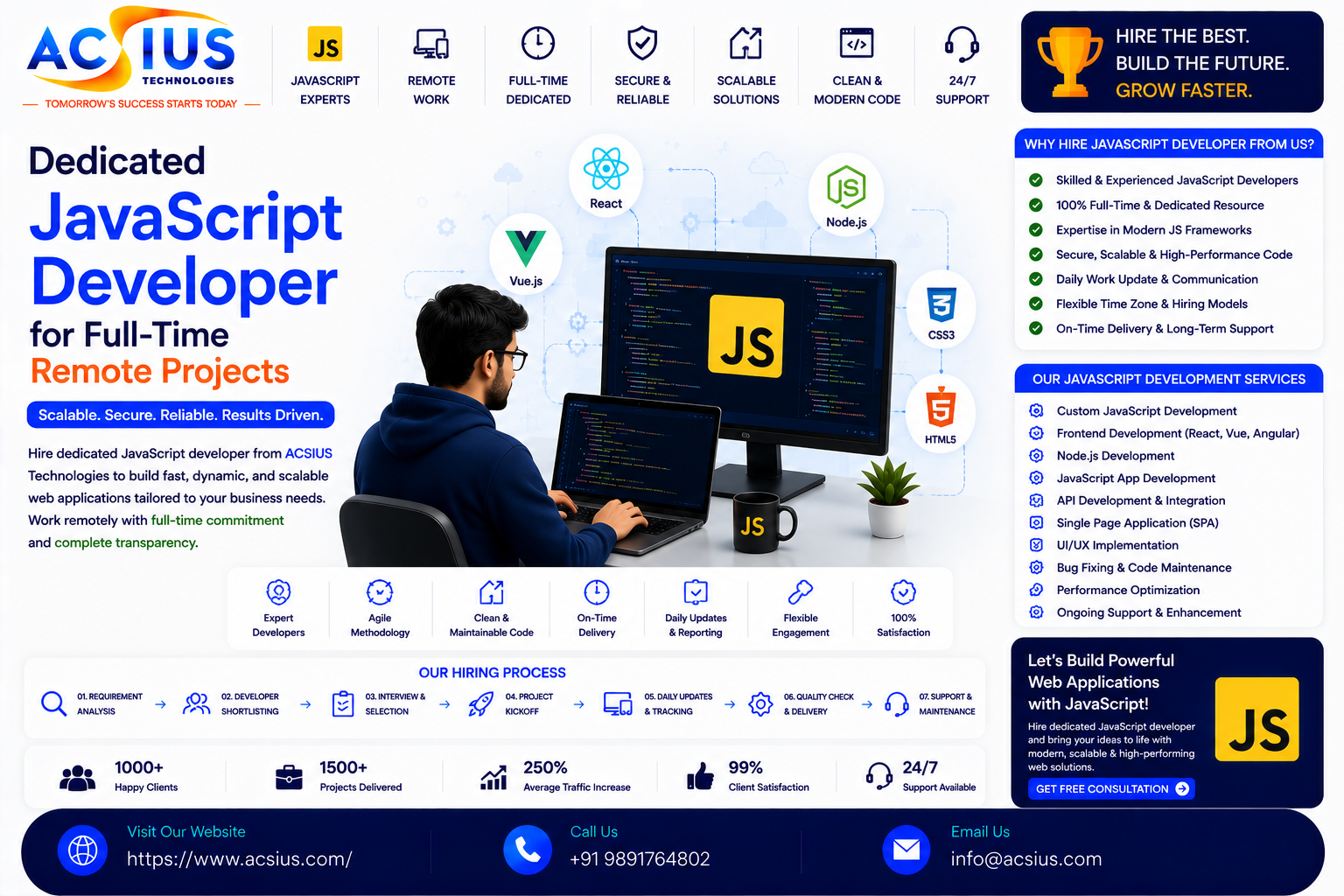
If you have spent any time trying to staff a web development project in the last couple of years, you already know the problem. Good JavaScript developers are busy, in-house hiring takes months, and freelancers disappear right when you need them most. This is exactly why so many founders, CTOs, and product managers now search for one specific solution: hire dedicated JavaScript developer talent instead of building a team from scratch.
This guide walks through what the dedicated hiring model actually means, why it works, what to look for in a JavaScript development partner, and how a company like ACSIUS approaches dedicated JavaScript development alongside related services like AWS app development and Magento development.
What Does It Mean to Hire a Dedicated JavaScript Developer?
A dedicated JavaScript developer is a professional (or a small team of professionals) who works exclusively on your project for an agreed period, usually full-time, while being employed and managed administratively by the outsourcing company. You get the focus of an in-house hire without the overhead of recruitment, payroll, benefits, or office infrastructure.
This is different from two other common models:
- Freelance hiring, where you get a contractor juggling multiple clients at once, with limited accountability and no team backup.
- Project-based outsourcing, where an agency owns the entire delivery and you have little day-to-day control over who is writing your code.
With dedicated hiring, you sit somewhere in the middle—you get direct control over priorities, sprints, and communication, while the vendor handles recruitment, HR, infrastructure, and backup staffing.
For companies building anything from a single-page application to a complex enterprise dashboard, this model has become the default choice because it combines flexibility with accountability.
Why Businesses Are Choosing to Hire Dedicated JavaScript Developers in 2026
JavaScript Is Still the Backbone of the Web
JavaScript continues to power the majority of interactive websites, single-page applications, and progressive web apps. Frameworks like React, Vue, Angular, and Node.js on the backend all sit on top of the same language, which means a strong JavaScript developer can move fluidly between frontend, backend, and full-stack responsibilities. That versatility is hard to replace.
Faster Time-to-Market
When you hire a dedicated JavaScript developer who has already been vetted and onboarded by an experienced agency, you skip weeks of interviewing, technical testing, and negotiation. Most dedicated developers can start contributing to a sprint within days, not months.
Cost Predictability Without Sacrificing Quality
Full-time in-house hiring comes with fixed costs: salary, benefits, equipment, training, and retention risk. A dedicated developer model gives you a transparent, often monthly, cost structure while still delivering senior-level output — particularly valuable for startups and mid-sized companies managing tight budgets.
Access to a Broader Skill Pool
Instead of being limited to local talent, dedicated hiring opens the door to specialists in specific frameworks, cloud integrations, or e-commerce platforms—which matters a lot if your roadmap includes things like AWS-based scaling or a Magento storefront rebuild.
Scalability on Demand
Project scope rarely stays static. A dedicated hiring partner lets you scale your JavaScript team up during a product launch and scale back down during quieter phases, without the emotional or financial cost of layoffs.
Core Skills to Look For Before You Hire a Dedicated JavaScript Developer
Not every developer who lists “JavaScript” on a resume is ready to own a production application. Here’s what genuinely separates a capable dedicated JavaScript developer from an average one.
Strong Fundamentals, Not Just Framework Knowledge
Frameworks change every few years. What doesn’t change is a developer’s grasp of core JavaScript concepts — closures, asynchronous programming, the event loop, prototypal inheritance, and memory management. A developer who understands these fundamentals adapts quickly to new tools; one who only knows a framework’s syntax struggles the moment something breaks outside the documentation.
Framework and Library Depth
Depending on your project, you’ll want proven experience in:
- React.js or Next.js for modern, component-driven frontends
- Vue.js or Nuxt.js for lightweight, flexible interfaces
- Angular for large enterprise applications with strict structure
- Node.js and Express for backend APIs and server-side logic
API and Integration Experience
Most real-world applications aren’t standalone—they talk to payment gateways, CRMs, cloud storage, and third-party APIs. A developer who has handled REST and GraphQL integrations, webhook handling, and authentication flows will save you significant rework later.
Performance and Security Awareness
A developer who understands lazy loading, code splitting, caching strategies, and basic security practices (input validation, XSS prevention, and secure token handling) protects your application long after launch—not just at delivery.
Communication and Process Discipline
This is the one criterion people underestimate. A dedicated developer works closely with your product team, sometimes across time zones. Clear daily updates, comfort with tools like Jira, Slack, or GitHub, and the ability to explain technical trade-offs in plain language matter just as much as coding ability.
How to Define the Best Dedicated JavaScript Developer Services: A Practical Framework
If you’re comparing vendors, it helps to have a structured way to evaluate them rather than relying on a sales pitch. Here’s a framework worth applying before you commit.
Verify Real-World Portfolio and Case Studies
Ask for actual project examples relevant to your industry—not just a logo wall. A trustworthy provider will walk you through the problem, the technical approach, and the measurable outcome, and will be transparent about challenges faced along the way.
Check the Vetting Process
Ask how developers are screened before joining the bench. Serious providers combine technical assessments, live coding rounds, architecture discussions, and soft-skill interviews — not just a resume review. This is one of the interviews—not of long-term reliability.
Understand the Engagement Models Offered
Good dedicated JavaScript development services typically offer flexibility across:
- Full-time dedicated hiring for long-term, ongoing projects
- Part-time or hourly engagement for smaller or maintenance-focused work
- Team augmentation where developers slot into your existing in-house team
- Fully managed teams where the vendor also handles project management
The right provider will help you choose based on your project stage, not push you toward the most expensive option.
Ask About Communication and Reporting Structure
Clarify upfront: Will you get a dedicated project manager? What’s the reporting cadence — daily standups, weekly sprint reviews? Which time zone o—daily stand-ups orect? These operational details often matter more to project success than raw technical skill.
Look at Contract Flexibility
Best-in-class services allow you to scale the team up or down, swap a developer if there’s a mismatch, and exit the contract with reasonable notice—without punitive lock-in clauses. Read the fine print before signing.
Confirm Code Ownership and IP Protection
This is non-negotiable. Make sure the contract explicitly states that all code, documentation, and intellectual property belong to you, not the vendor, along with clear confidentiality and data protection terms.
Evaluate Post-Launch Support
A dedicated developer’s job doesn’t end at deployment. Ask whether the service includes bug fixes, performance monitoring, and ongoing feature development after go-live, or whether that’s billed separately.
Look for Transparent, Value-Based Pricing
Avoid vendors who are vague about billing. The best providers offer clear rate cards, explain what’s included at each tier, and avoid hidden charges for code reviews, documentation, or communication overhead.
Applying this framework consistently—rather than comparing hourly rates alone—is what actually separates a good hiring decision from a costly mistake.
How ACSIUS Approaches Dedicated JavaScript Development
At ACSIUS, dedicated JavaScript development is built around a simple principle: developers should feel like an extension of your team, not an external vendor you have to manage from a distance.
Here’s what that looks like in practice:
- Pre-vetted developers across React, Node.js, Angular, and Vue, screened through technical and communication assessments before ever joining a client project
- Flexible engagement models—full-time, part-time, or project-based—so you’re not locked into a structure that doesn’t fit your roadmap
- Direct communication with your assigned developer or team, supported by a project coordinator who keeps delivery on track
- Transparent reporting, with regular sprint updates and access to your project management tools of choice
- Clear IP ownership, documented in every contract, so your code and product remain entirely yours
Because ACSIUS also works across cloud infrastructure and e-commerce platforms, clients often extend a JavaScript engagement into broader technical territory—which is where AWS app development and Magento development naturally come in.
Why Pair JavaScript Development with AWS App Development Services
Modern JavaScript applications rarely live in isolation—they need infrastructure that can scale. ACSIUS’s AWS app development services complement dedicated JavaScript teams by handling:
- Cloud architecture design using services like EC2, Lambda, S3, and RDS to match your application’s actual traffic and data patterns
- Serverless application development, reducing infrastructure overhead for applications with variable load
- CI/CD pipeline setup, so your JavaScript codebase deploys reliably and quickly across environments
- Auto-scaling and load balancing, ensuring your application performs consistently during traffic spikes
- Security and compliance configuration, including IAM policies, encryption, and monitoring
When your JavaScript developers and AWS specialists work from the same playbook, you avoid the common disconnect where a well-built frontend is let down by infrastructure that wasn’t designed to support it.
Why Pair JavaScript Development with a Magento Development Agency
For businesses running or building an online store, JavaScript expertise and Magento development go hand in hand. ACSIUS operates as a Magento development agency alongside its JavaScript services, which means:
- Custom Magento theme development with JavaScript-driven interactive elements for a faster, more engaging storefront
- Magento 2 migration and optimization, improving page speed and checkout performance
- Third-party integrations—payment gateways, ERPs, shipping APIs—handled by developers who understand both the Magento backend and JavaScript frontend layer
- Headless Magento development, using React or Vue on top of Magento’s API layer for a modern, decoupled storefront experience
- Ongoing store maintenance and performance tuning, keeping conversion rates and load times competitive
This combination is particularly valuable for e-commerce businesses that want a storefront that looks and feels custom-built, rather than a template with a logo swapped in.
Signs Your Business Is Ready to Hire a Dedicated JavaScript Developer
Not every project needs a dedicated hire on day one. Here are a few signals that suggest the model is the right fit for where you are right now.
Your in-house team is stretched thin. If your existing developers are constantly context-switching between maintenance work and new features, a dedicated JavaScript developer can absorb one side of that workload so your core team can focus.
You have a defined roadmap but not the bandwidth to execute it. Dedicated hiring works best when there’s clarity on what needs to be built, even if the finer technical details are still being worked out with the developer.
You’re scaling faster than your hiring pipeline can keep up with. Startups going through a growth phase often find that traditional recruitment simply can’t move fast enough — dedicated hiring closes that gap without compromising on quality.
You need specialized skills for a limited window. If your project needs deep AWS or Magento-JavaScript integration expertise for a few months rather than permanently, dedicated hiring avoids the cost of a full-time hire you won’t need later.
You’ve been burned by inconsistent freelance work before. If unreliable turnaround times, disappearing contractors, or inconsistent code quality have slowed down a previous project, the accountability built into dedicated hiring is often exactly what was missing.
If two or more of these sound familiar, it’s a reasonable time to start evaluating dedicated JavaScript development providers seriously rather than continuing to patch the gap internally.
Common Mistakes Businesses Make When Hiring Dedicated JavaScript Developers
Even experienced teams get this wrong sometimes. A few patterns worth avoiding:
- Choosing the lowest bidder without checking the process—cheap hourly rates often mean less experienced developers or hidden costs later
- Skipping the technical interview because the vendor “already vetted” the candidate—always do your own final check
- Not defining ownership and communication expectations upfront, which leads to friction a few weeks into the project
- Ignoring time zone overlap, which can quietly slow down decision-making and feedback cycles
- Treating dedicated hiring as “hands-off”—the best results still come from active collaboration, not simply handing off a spec and waiting
Avoiding these mistakes is often more important than finding the single “best” developer—a good process consistently outperforms a lucky hire.
Final Thoughts
Hiring a dedicated JavaScript developer isn’t just about filling a technical gap—it’s about finding a working relationship that fits how your business actually operates: your timeline, your budget, and your appetite for day-to-day involvement. The businesses that get the most value from this model are the ones that evaluate vendors carefully, ask direct questions about process and ownership, and treat the relationship as a genuine partnership rather than a transaction.
Whether you need a single JavaScript developer to extend your existing team, a full team to build a new product from scratch, or a combined effort across JavaScript, AWS infrastructure, and Magento e-commerce, the right partner will make the process feel far less risky than it initially seems.
If you’re currently evaluating where to start, ACSIUS works with businesses across these exact needs—dedicated JavaScript development, AWS app development, and Magento development—under one roof, with transparent contracts and developers who are ready to integrate with your team from day one.
FAQs
Can I interview the developer before starting the project?
Yes — any credible dedicated hiring service should allow you to interview candidates and request a replacement if there isn't a strong fit.
Is dedicated hiring more expensive than freelancing?
Not necessarily. While hourly freelance rates can look lower on paper, dedicated hiring often works out more cost-effective once you factor in reliability, backup support, and reduced management overhead.
Do I retain full ownership of the code?
With a properly structured contract, yes. This should always be confirmed in writing before the engagement begins.
Can a dedicated JavaScript developer also help with AWS or Magento work?
Many developers have cross-functional experience, and agencies like ACSIUS often provide combined teams — JavaScript, AWS, and Magento specialists working together — for projects that span frontend, infrastructure, and e-commerce.
What's the difference between hiring a dedicated JavaScript developer and hiring a full development agency team?
A dedicated developer joins your project as an individual contributor (or small unit) that you direct day to day, while a full agency team usually comes with its own project manager, QA, and delivery process already built in. Dedicated hiring gives you more control; a managed team gives you more hands-off delivery. ACSIUS offers both, depending on how involved you want to be.
Which JavaScript frameworks does ACSIUS typically work with?
ACSIUS developers commonly work across React.js, Next.js, Node.js, Vue.js, and Angular, along with TypeScript for larger, more structured codebases. The right framework depends on your existing stack and long-term maintenance plans, which is usually discussed during the initial project scoping call.
Can I start with a small trial project before committing long-term?
Yes, most reputable providers, including ACSIUS, allow a short trial or paid pilot sprint so you can evaluate code quality, communication, and workflow fit before signing a longer-term engagement.
What happens if the assigned developer isn't the right fit?
A well-structured contract should include a replacement clause. If skills, communication style, or working hours don't align well after a fair evaluation period, the provider should offer a substitute developer at no extra cost to you.
Do dedicated JavaScript developers work in my time zone?
This depends on the provider and the developer's location, but most established agencies offer flexible overlap hours, and some — like ACSIUS — structure schedules specifically to match client working hours for smoother daily collaboration.
Is dedicated hiring suitable for a short-term project, or only long-term ones?
It works for both. While dedicated hiring is often associated with long-term product development, many businesses use it for defined, shorter engagements too, such as a three-month MVP build or a focused AWS migration project.
How is code quality maintained across a dedicated development engagement?
Through code reviews, version control practices (typically Git-based workflows), automated testing where applicable, and regular sprint demos. Ask any prospective provider to walk you through their specific quality assurance process before signing on.